• Skip to primary navigation
  • Skip to main content
  • Skip to primary sidebar

TireTerrain

  • Home
  • Comparisons & Reviews
  • All-Terrain Tire Decision Tool
  • Pro Tips
  • About

Off-Road All Terrain Tires

Sumitomo Encounter AT2 Review: What Changed and Why It Matters

Updated: November 11, 2025 by Emrecan Gurkan Leave a Comment

I’ve always seen the Sumitomo Encounter AT as one of the better on-road all-terrain tires out there. It had the kind of stability, wet grip, and steering feel that made it perfect for towing or everyday work trucks that spend most of their life on pavement. It wasn’t flashy, but it got the job done quietly and lasted long enough to earn a loyal following among drivers who wanted something dependable without paying a premium.

Now, with the Encounter AT2, I feel like Sumitomo is trying to tighten its grip on that same audience. The goal seems clear: dominate the on-road all-terrain market with a bargain price, a long treadwear warranty, and small design tweaks that make it more refined where it counts.

At first glance, the tread looks like a typical 4-rib layout, but if you take a closer look, you can see a 6-rib structure hiding in there — something you almost never see on off-road-focused A/T tires. That’s usually a design you’d find on a more highway-oriented model, which tells me Sumitomo is chasing better stability and smoother road manners this time around.

Since there’s no official test data yet, I’ll approach this from an engineering perspective and walk through what you can expect from the new model based on its tread pattern, construction, and compound design.

Quick Look
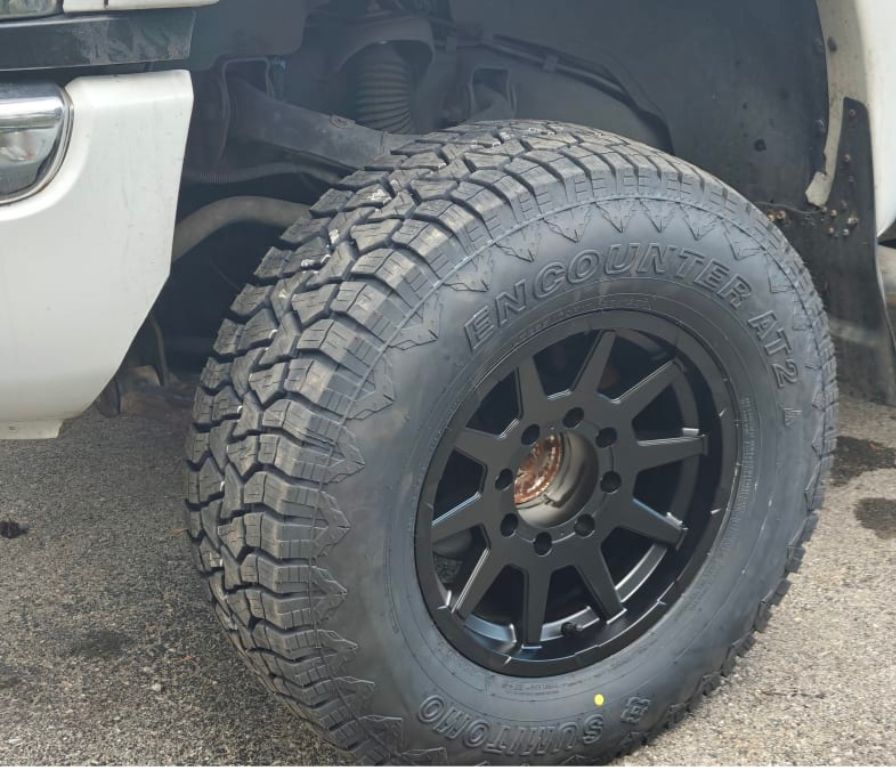
Close-up of Sumitomo Encounter AT2 tire mounted on a truck, showing its deep tread blocks and aggressive shoulder design for off-road traction.
Sumitomo Encounter AT2 — rugged all-terrain tire offering dependable grip, stability, and long tread life for light trucks and 4x4s.

The Sumitomo Encounter AT2 looks like a smarter version of the old one. It’s lighter, sharper on steering, and definitely built more for everyday trucks and SUVs than deep off-road rigs. The six-rib tread should make it more stable on pavement, and those wider shoulder slots will help it move water better. It also seems to clean itself easier in snow and light mud, which is a nice step up from the previous design. The smaller shoulder blocks tell me Sumitomo really wanted this tire to stay quiet and smooth on the highway, and from the pattern alone, I think they nailed it. I’m still a bit unsure about long-term wear, but with how balanced the structure looks, I’d say just keep up with rotations and you’ll be fine. Overall, it feels like the kind of tire that just works — clean design, no drama, comfortable, and practical for daily use.

    Steering, Stability, and Dry Grip

    On dry pavement, I can already tell the AT2 should feel more precise than the old Encounter AT. The previous version used stepped center blocks and open shoulders that worked well for stability, but there was still a bit of tread movement when cornering or towing heavy loads. That’s why, even though it scored well in tests, some drivers described it as a little heavy on steering.

    This new version is around 4–5 lbs lighter depending on size, which is a significant change for an all-terrain tire. Despite the weight drop, the contact patch and section width are slightly wider, which usually means quicker steering response and more feedback through the wheel, especially during cornering or low-speed maneuvers with a trailer attached.

    The UTQG rating and tread depth remain almost identical, so there’s probably no major compound change, and honestly, that’s a smart decision. The compound from the previous model already worked well — it gripped predictably, stayed consistent in heat, and wore evenly. When something performs that reliably, there’s no need to fix it.

    It feels like Sumitomo focused its updates on pattern geometry and casing stiffness rather than the rubber mix, and that’s exactly what gives the AT2 a more balanced, controlled feel on dry roads. For towing, highway driving, or long commutes, this tire should feel lighter on its feet and more stable under load while keeping the easy, predictable steering that made the first version so popular.

    Wet Traction and Braking

    All right, we all know Sumitomo does a great job with compounds. That’s always been one of their strongest areas. However, wet performance isn’t just about the compound — it’s also about how well the tread can move water out from under the tire.

    In this case, the new AT2 design uses wider shoulder slots, and that’s the key improvement here. Those channels help evacuate water faster, which is critical for keeping traction in heavy rain. With a tread pattern this tight and symmetrical, they almost had to make that adjustment. Without those wider shoulders, a design like this would hydroplane easily, especially at highway speeds.

    What’s interesting is that the AT2 seems to put a little less rubber on the road compared to the older Encounter AT. That’s likely intentional. By spreading out the tread into what looks like a six-rib layout, Sumitomo can create more biting edges and extra notches across the tread blocks. This helps shorten wet braking distances and keeps the tire predictable when the surface is slick.

    That said, there’s always a trade-off. I expect the AT2 to offer better hydroplaning resistance overall, but maybe a slightly longer braking distance on damp pavement compared to the original. This trade-off will actually work in your favor if you’re running loaded applications or towing, since the wider voids will keep the tread from glazing over under weight and will help maintain grip stability in standing water. It’s a smart design move — prioritizing control and stability when things get messy, which is exactly where most A/T drivers need it.

    Snow and Winter Traction

    When it comes to winter grip, both versions of this tire look good on paper, but the AT2’s approach is clearly more refined. The first Encounter AT already carried the 3PMSF severe snow rating, and it honestly performed better than most people expected for a value all-terrain. The new model builds on that by using a tread design that seems to clean itself better, especially in deep snow. The wider shoulder slots and slightly more open voids help push snow and slush out faster, which usually means stronger traction in heavier conditions and less chance of the tread packing up.

    Another key change is the switch to 3D Wave Sipes, replacing the older zigzag pattern. These interlocking sipes stay open just enough to bite into snow and slush while keeping the blocks stable on dry pavement. That gives the tire a more predictable feel in light to moderate snow, with better braking stability and fewer of those sudden grip losses that older A/T patterns sometimes have.

    When it comes to ice, things might play out a little differently. I expect it to feel more predictable overall, but probably with slightly longer stopping distances than the previous version. The tread seems tuned for stability rather than extreme softness, so it’ll likely track straighter on frozen roads but take a little longer to come to a full stop.

    For most drivers who deal with occasional winter weather—slush, packed snow, or short freeze periods—this design hits a very good balance. It’s the kind of tire you can run year-round without feeling like you’re giving up control in cold conditions. But if you drive on glare ice or constant deep freeze, a proper winter tire is still the smarter call.

    Noise and Comfort

    One thing that always stood out with the old Encounter AT was how quiet it was for an all-terrain tire. It had that steady hum on the highway, but it was never harsh or annoying. With the AT2, I think Sumitomo tried to take that same character and smooth it out even more. The tread looks tighter and more symmetrical, and when you combine that with the new jointless polyamide reinforcement, it should ride softer without losing control.

    I haven’t driven it yet, but looking at the pattern and construction, I’d expect less vibration through the cabin and a bit more cushioning on broken pavement. The six-rib layout plays a big role here. Because the tread blocks are smaller and more evenly spaced, they should make contact with the road in shorter, more frequent pulses. That’s what gives a tire that refined, steady highway feel instead of the thumping rhythm you get from wide-void off-road designs.

    The shoulder blocks are noticeably less aggressive than the ones on the previous AT, and that’s an interesting design decision. Sumitomo seems to have moved most of the biting edges toward the center section, which makes sense if they’re targeting drivers who use higher air pressures or spend more time towing and commuting. For this type of tire, most of the road noise usually comes from the shoulder area, so keeping those blocks smaller and more uniform is a win. In this case, it feels like Sumitomo hit the jackpot — less shoulder void means less resonance and cleaner airflow, which should translate into a quieter ride without killing its light off-road grip.

    Overall, the Encounter AT2 looks built to stay quiet and composed on the highway. It’s not the kind of tire that’ll make your truck sound aggressive when you pull into a parking lot, and that’s the whole point. If you value long-distance comfort and subtle road manners more than a rugged look, this design direction is going to suit you well.

    Off-Road and Dirt Performance

    The first thing that caught my eye is the higher void area compared to the old Encounter AT. That change alone should help the AT2 clean itself better on muddy or wet dirt, especially when the tread starts packing up. More void means more space for mud and stones to escape, and that usually translates to better traction when the surface gets sloppy. It’s a subtle tweak but an important one for drivers who find themselves on job sites or unpaved trails after a storm.

    That said, the shoulder blocks aren’t as aggressive as before. Sumitomo clearly moved the grip focus toward the center ribs, which makes sense if this tire is meant for higher-pressure, on-road-heavy setups. Those narrower shoulders help keep the road noise low, but they’re not designed for deep ruts or rocky crawling. So while the AT2 will dig better in mud and soft soil, it’s still not a tire you’d air down and take through brutal terrain.

    Overall, I expect a small but noticeable improvement in off-road traction, especially on loose gravel, clay, and shallow mud. It’ll probably hook up faster when you roll into soft ground and clean itself more easily once it spins. Honestly, I think I love this tread design. It feels like Sumitomo finally found the right balance between practical off-road traction and clean highway behavior — and for most daily drivers, that’s exactly what you want.

    Treadwear and Durability

    To be honest, this is the only part where I still have questions. The design looks great, but I’m not entirely sure how evenly it’s going to wear. Sumitomo is a Japanese company, and if there’s one thing I know from my time around engineers there, it’s that they don’t release anything before it’s fully tested. (Hello to my colleagues from Bridgestone — you made those testing phases feel like forever.) So I’m sure this tire has gone through the right internal validation. Still, from an outside perspective, I’ll wait to see how it performs in the field.

    Because of the higher traction capability and slightly more complex tread structure, I’d keep a close eye on rotation timing with this one. The wear pattern might need a bit more attention than usual, especially during the first 10,000 miles. If you’re good about rotations and alignments, it should reward you with long life. If you’re not, you might see uneven wear a little faster than with the older Encounter AT.

    Sumitomo extended the warranty to 65,000 miles, which suggests they actually expect better treadwear performance despite keeping the same tread depth. That’s an optimistic sign. The only thing I can’t predict yet is how the new tread geometry and added traction edges will behave long-term. Sometimes more grip means quicker wear if the compound isn’t perfectly balanced.

    So for now, I’ll say this: it looks promising, but let’s hold judgment until more real-world mileage data comes in. This feels like a special tire, not a rehash of the old one — but that also means it’s worth watching how it ages.

    Conclusion

    After looking through the details, I think the Sumitomo Encounter AT2 is exactly what it looks like — a smarter, cleaner, and more balanced version of the original. It doesn’t try to be a full-on off-road tire, and it doesn’t need to. Sumitomo clearly focused on improving what already worked: on-road comfort, steering precision, and wet confidence.

    The tread design is one of the best I’ve seen from Sumitomo in this category. It’s lighter, more stable, and better suited for trucks that spend most of their life on pavement but still need to handle dirt or mild trails without drama. The higher voids give it better self-cleaning in soft terrain, while the compact shoulder setup keeps it quiet and smooth on the highway.

    If I had to pick one word for this tire, it would be refined. It’s built for people who want all-terrain traction without the bulk or noise that usually comes with it. I still have a few questions about long-term treadwear, but that’s not something I can call until we see more real-world data. What’s clear is that Sumitomo didn’t cut corners here. The design feels intentional, the construction looks strong, and the balance between comfort and grip is spot on.

    If you’re someone who drives mostly on-road, tows occasionally, and doesn’t want to sacrifice ride quality for off-road looks, the Encounter AT2 fits that profile perfectly. It feels like a tire designed by engineers who actually drive trucks — and for me, that’s a very good sign.

    FAQ – Sumitomo Encounter AT2

    What makes the Sumitomo Encounter AT2 different from the previous Encounter AT?

    The Encounter AT2 refines the original AT by improving handling precision and wet-road confidence. It uses a lighter, 4-rib high-void pattern and stiffer belt package for smoother highway manners and better steering response. While the older Encounter AT relied on stepped center blocks, the AT2’s optimized tread geometry reduces noise and improves wear balance.

    Is the Encounter AT2 suitable for heavy towing or hauling?

    Yes. LT-rated versions feature reinforced polyester plies, dual steel belts, and a jointless polyamide cap that enhances stability under load. The E-load models can support up to 3,750 lbs at 80 psi, making them ideal for light-truck owners who tow frequently.

    How does it perform on wet and snowy roads?

    Independent evaluations show strong wet braking and hydroplaning resistance, thanks to its deeper circumferential grooves and variable-width shoulders. The 3D wave sipes and aggressive biting edges help it earn the Three-Peak Mountain Snowflake (3PMSF) certification, giving it reliable light-snow capability—though it’s not a replacement for a true winter tire.

    Is the AT2 a quiet all-terrain tire?

    Yes. The tread pattern is tuned to limit harmonic noise that typically comes from large voids. Many drivers describe it as “quiet on pavement”, even in LT constructions, making it a solid fit for daily-driven trucks and SUVs.

    What about treadwear and longevity?

    Sumitomo backs the AT2 with a 65,000-mile limited warranty across both passenger and LT versions. Early reports indicate stable wear and even tread contact, although long-term field data is still limited. The uniform warranty coverage shows Sumitomo’s confidence in its new compound and casing balance.

    Filed Under: All Terrain Tires, Off-Road All Terrain Tires Tagged With: Review, Sumitomo, Sumitomo Encounter AT2

    Falken Wildpeak AT Trail vs AT3W vs AT4W — 2025 Buyer’s Guide

    Updated: November 11, 2025 by Emrecan Gurkan Leave a Comment

    As a former Bridgestone field test engineer, I see the same dilemma over and over: Wildpeak AT Trail vs AT3W vs AT4W. They share a name, but they’re built for different drivers. The simplest way to pick the right one is to start from your size and vehicle type, then match performance priorities (winter, comfort, towing, off-road). This guide does exactly that—then gives you quick recommendations you can act on.

    Important Note on the AT3W Legacy:

    You may have searched for the discontinued Falken Wildpeak AT3W. While production has ceased, some closeout stock is still available. This comparison is based on some popular-sized sized can still be found on retailers like Tire Rack:

    Click here for the Full Technical Breakdown: AT4W vs Discontinued AT3W Test Results

    Quick Take

    Falken Wildpeak A/T4W

    Falken Wildpeak AT4W tire
    Tested Rating: 8.4/10

    Trusted Retailers with Best Deals:

    Tire Rack
    Free road-hazard coverage Backed by Discount Tire
    SimpleTire
    Financing options Local installers
    Amazon
    Prime shipping Direct from brands

    Falken Wildpeak AT Trail

    Falken Wildpeak AT Trail tire
    Tested Rating: 8.6/10

    Trusted Retailers with Best Deals:

    Tire Rack
    Free road-hazard coverage Backed by Discount Tire
    SimpleTire
    Financing options Local installers
    Amazon
    Prime shipping Direct from brands

    The Falken Wildpeak lineup splits into three very different personalities. The AT Trail is designed for crossovers and SUVs first — it’s quiet, composed, and light off-road capable, making it the best choice if you want the A/T look without sacrificing daily comfort. The AT3W, while traditionally seen as a light-truck A/T, is also a smart pick for SUV and CUV owners in snow belt regions who want real winter performance, thanks to its 3PMSF certification and dense siping. It balances road manners with credible traction on dirt and snow, offering a more “planted” feel than the Trail. The new AT4W pushes deeper into truck territory — tuned for towing stability, heavier loads, and rocky terrain, it feels more locked-in at speed but rides firmer than the other two.

      225/65R17 — Compact & Mid SUVs (RAV4, CR-V, Forester, CX-5)

      Availability & Fitment
      In this size, Falken splits the lineup in an interesting way. The AT Trail comes in an SL load rating at 31 lbs, making it light and efficient — a natural fit for smaller crossovers that don’t need reinforced sidewalls. The AT4W is also offered in 225/65R17, but only in XL load rating at 35 lbs, which adds toughness for off-road but also a bit more rolling resistance. The AT3W isn’t officially sold in this exact size anymore, though Falken does offer a special edition 235/65R17 in SL load (31 lbs), which some SUV owners in snow-heavy regions still seek out for its winter traction.

      Daily Ride & Handling
      For everyday driving, the AT Trail feels closest to stock — quiet, smooth, and quick to settle in lane changes. The AT4W rides firmer thanks to its XL build, but that stiffness translates into better stability when loaded or aired down. Drivers who spend most of their time on pavement will notice the Trail’s refinement, while the AT4W carries a bit more weight in the steering wheel.

      Winter & Snow
      This is where the AT3W’s special edition size still matters. If you’re in the snow belt and prioritize winter grip, the AT3W remains the reference point, with its 3PMSF badge and dense siping. The AT Trail is fine for light snow, while the AT4W provides good bite but leans more “truck-like” in feel, prioritizing carcass stability over soft-road grip.

      Light Off-Road / Gravel Roads
      The AT Trail is comfortable on forest roads and gravel — think fire roads, mild camping access, or light exploration. The AT4W’s XL build gives it more bite and stability on rougher tracks, but you’ll pay for it at the pump with a slight mpg hit compared to the Trail.

      👉 Verdict: For compact and mid-SUVs, the AT Trail is the best everyday choice if you value comfort and efficiency. If you live in a snow-heavy region, hunting down the AT3W in 235/65R17 SL is still worthwhile for real winter confidence. If you want extra toughness and don’t mind a firmer ride with slightly worse mpg, the AT4W in XL is the right upgrade for mild off-road use.

      255/65R18 — Bigger SUVs (Explorer, 4Runner, Highlander)

      Availability & Fitment
      In this size, buyers have three paths. The AT Trail is offered in SL load at 42 lbs, tuned for comfort and daily efficiency. The AT4W comes only in XL load at 42.4 lbs, with deeper tread (13/32”) and higher pressure capacity (50 PSI), making it tougher and more stable. The AT3W isn’t available directly in 255/65R18, but some SUV owners upsize to 285/65R18 if they want its proven winter traction and burlier construction.

      Daily Ride & Stability
      The AT Trail rides closest to stock — smoother, quieter, and easier on mpg. The AT4W feels firmer and more “locked in” at speed, giving extra confidence in highway crosswinds and when carrying gear. That stability, however, comes with a small fuel economy trade-off compared to the lighter Trail.

      Winter & Snow
      The AT3W isn’t available in this size anymore, so it’s only an option if you upsize to 285/65R18 — a move some snow-belt SUV owners still make for its outstanding winter grip. For drivers sticking with 255/65R18, the AT4W is the stronger choice for harsher winter use, offering dependable traction and stability even in challenging conditions, though it carries a more truck-like feel. The AT Trail can handle light winter duty just fine, but it doesn’t inspire the same confidence once snow piles up or roads turn icy.

      Off-Road / Gravel & Rock
      Here the AT4W is the clear winner. Its XL build and shoulder geometry give it more bite and composure when aired down on rocky or rutted surfaces. The AT Trail handles forest roads and light gravel without issue, but it isn’t designed for sustained off-road punishment.

      👉 Verdict: For bigger SUVs, the AT Trail is the comfort-focused choice if your driving is mostly highway and city. The AT4W is the tougher option for towing, hauling, and rougher terrain, though it costs a bit of mpg. And if you’re in a snow belt and willing to upsize, the AT3W in 285/65R18 remains Falken’s best winter performer.

      LT265/70R17 — Trucks (Tacoma, 4Runner, F-150, Wrangler)

      Availability & Fitment
      In this core truck size, only the AT4W is offered. The AT3W isn’t built in 265/70R17 anymore, and the AT Trail never scaled to LT construction. If buyers want the AT3W, they’ll need to step out of stock sizing:

      • Downsize: 265/65R17 (−3%) → works fine, slightly less clearance.

      • Upsize: 275/70R17 (+3%) → popular choice, minimal trimming needed.

      • Aggressive: 285/70R17 (+3.5%) → requires leveling/lift, but unlocks AT3W availability.

      Daily Ride & Stability
      The AT4W’s firmer carcass and XL/LT build make it more planted under load — especially when towing, hauling, or dealing with highway crosswinds. Downsizing or upsizing into the AT3W gives a slightly softer ride, but that means stepping outside factory spec.

      Winter & Snow
      For stock 265/70R17, the AT4W handles winter well enough, though its tuning leans more toward stability than soft-road grip. Buyers in the snow belt who want the AT3W’s legendary 3PMSF bite will need to resize into 265/65R17, 275/70R17, or 285/70R17.

      Off-Road / Gravel & Rock
      The AT4W is the go-to here, with its reinforced shoulders and stability when aired down. The AT3W is still excellent off-road — but only if you make the size jump.

      👉 Verdict: If you’re sticking to LT265/70R17, AT4W is your only choice — and it’s built for stability, towing, and rocky trails. Winter-focused buyers can resize into an AT3W, with minor adjustments depending on whether they go downsize (265/65R17) or upsize (275/70R17, 285/70R17).

      285/65R18 — Trucks & SUVs on 18s (Silverado, F-150, Ram 1500, etc.)

      Availability & Fitment
      This is the size where the AT3W and AT4W directly compete. Both are offered, giving buyers a true choice. The AT Trail is not produced in this LT truck fitment.

      Daily Ride & Stability
      The AT3W rides softer and more compliant, making it the better choice for trucks that split commuting and light off-road. The AT4W is firmer and more stable under towing or heavy payloads, especially noticeable in highway sweepers and crosswinds.

      Winter & Snow
      The AT3W is still the benchmark for winter traction among Falken’s A/Ts, thanks to its siping density and 3PMSF certification. The AT4W narrows the gap, performing well but with a more truck-like feel.

      Off-Road / Gravel & Rock
      The AT4W is the tougher choice for rocky and technical trails, with stronger casing support and better stability when aired down. The AT3W handles dirt and gravel easily, but doesn’t feel as bulletproof in harsher conditions.

      👉 Verdict: In 285/65R18, buyers finally get a real choice. For winter traction and smoother daily driving, pick the AT3W. For towing, payload, and rocky off-road confidence, go with the AT4W.

      265/60R18 — Light Trucks & Larger SUVs

      In this size, the Wildpeak AT4W is your only option, and it’s a good one. With its XL/LT construction, it covers everything from towing and payload stability to rocky trail use, while still handling daily highway duty confidently. If you run 265/60R18 stock, the AT4W matches all needs without compromise — there’s no AT3W in this exact size, and the AT Trail doesn’t apply.

      👉 Verdict: Stick with the AT4W here. It’s built to handle the full mix of truck and SUV demands.

      Head-to-Head by Condition

      ConditionWildpeak AT Trail
      CUV/SUV
      Wildpeak AT3W
      Winter/Balance
      Wildpeak AT4W
      Truck/Load
      Dry & Wet RoadsMost comfortable and quiet; tuned for CUV/SUV daily pavement use.Balanced manners; a bit more A/T presence but good grip in both dry and wet.Firmer and more “locked-in,” especially under load; best for towing stability.
      Winter & SnowFine for light winter use; not as secure in heavy snow/ice.Wildpeak benchmark for snow/slush (3PMSF + siping density).Close behind AT3W; dependable snow traction with a truck-tuned feel.
      Off-Road (Gravel/Rock/Mud)Forest roads, fire trails, mild gravel.Capable on dirt and light trails; good for casual off-roaders.Leader on rocky/rutted terrain; tougher carcass & shoulders; better aired down.
      Comfort & NoiseQuietest and smoothest; closest to a stock highway tire.Middle ground — comfortable daily, some A/T hum.Firmest and noisier; trades softness for loaded stability and control.

      What Drivers Say

      AT Trail (CUV/SUV)

      • “They’re very quiet, and the ride… is in no way harsh.” subaruoutback.org

      • “Lost 1–2 mpg in a larger size… quiet. Note these are the TRAILS.” rav4world.com

      • “Overall… very pleased… my only complaint is tread wear appears faster than stock.” subaruforester.org

      AT3W (Balanced + Winter)

      • “I changed to Wildpeak AT3W… better wet traction… better dirt and mud… no regrets.” cumminsforum.com

      • “I’ve never had problems in the snow with them… from 5°F to deep snow.” Tacoma World

      • (Counterpoint) “Off-grid in the Cascades… disappointed by winter performance.” Reddit

      AT4W (Truck/Load)

      • “For being A/T tires, they’re very quiet… excellent so far on dry highway.” Reddit

      • “Better durability, towing stability, on-road handling, and treadlife than AT3W.” (owner discussion) forum.ih8mud.com

      • “When towing I like the extra weight… don’t feel the wind or trucks as much.” Facebook

      Final Verdict

      When choosing between the AT Trail, AT3W, and AT4W, it comes down to your vehicle type, climate, and how much weight or off-road abuse you throw at your tires.

      AT Trail is the comfort-first choice for CUVs and SUVs that want the all-terrain look without the trade-offs. It runs smooth and quiet, but tread life won’t match the heavier-duty AT4W if you load it down or live on gravel.

      AT3W remains the winter benchmark in the Wildpeak family, with proven snow and slush performance. While it’s being phased out of some stock SUV and truck sizes, it’s still worth considering if you’re in the snow belt and willing to upsize.

      AT4W is Falken’s modern truck/all-terrain workhorse. It feels more stable under towing, carries heavy payloads without squirm, and brings extra off-road bite. The trade-off is a firmer ride and a small hit to mpg compared to the lighter AT Trail.

      👉 Size & Load Note:

      • AT Trail = P-metric/SL & XL SUV sizes (lighter, efficiency-focused).

      • AT3W = still available in broader P/XL/LT sizes, but shrinking in some key SUV/truck fitments — often an upsize option now.

      • AT4W = built around modern LT truck sizes with XL or LT load ranges, making it the go-to if stability and load are priorities.

      Bottom line:

      • Daily driver SUV with mild winters → AT Trail.

      • SUV/Truck in snow belt, or drivers who want year-round balance → AT3W.

      • Truck owners who tow, haul, or hit tougher trails → AT4W.

      Filed Under: All Terrain Tires, Off-Road All Terrain Tires, On-Road All Terrain Tires Tagged With: Comparisons, falken, Falken Wildpeak AT Trail, falken wildpeak at3w, Falken Wildpeak AT4W

      Cooper Discoverer Stronghold AT Review (2025): Cooper’s First Balanced AT Tire

      Updated: November 11, 2025 by Emrecan Gurkan Leave a Comment

      Close-up of Cooper Discoverer Stronghold AT tire tread on a black alloy wheel, featuring large staggered blocks, deep grooves, and siping for all-terrain grip.
      Cooper Discoverer Stronghold AT — rugged tread design built for traction, stability, and durability on both highways and off-road trails.

      Unlike brands like BFGoodrich or Toyo, which tend to release one “do-it-all” all-terrain model and update it every few years, Cooper has built its lineup around user intent. The Discoverer AT3 series made this clear: the AT3 XLT was tuned for towing stability, while the AT3 4S leaned toward on-road comfort for daily drivers. From there, they expanded — the Rugged Trek for trail lovers, the Road+Trail AT for highway-focused drivers, and now the Cooper Discoverer Stronghold AT, a tire released exclusively in LT sizes.

      And here’s the big shift: Stronghold AT feels like Cooper’s first attempt at a true on-/off-road balance, positioned directly against heavy hitters like the BFGoodrich KO3. With tougher construction, a more aggressive tread, and LT-only availability, Cooper is signaling this tire isn’t just about comfort anymore — it’s aiming for credibility in the off-road arena.

      In this article, I’ll break down independent test results, driver feedback, and design details to see where the Stronghold AT actually lands — and whether it can hold its own against proven competitors. Let’s get into it.

      Quick Look

      Cooper Discoverer Stronghold AT

      Cooper Discoverer Stronghold AT tire
      Tested Rating: 8.2/10

      Trusted Retailers with Best Deals:

      Tire Rack
      Free road-hazard coverage Backed by Discount Tire
      SimpleTire
      Financing options Local installers
      Amazon
      Prime shipping Direct from brands

      The Cooper Discoverer Stronghold AT shines with its excellent off-road traction, giving drivers confidence in mud, rocks, and loose dirt, and it feels especially stable under load thanks to a strong casing that resists sway when towing or hauling. It’s also 3PMSF-rated for snow, carries a 60,000-mile treadwear warranty, and comes in at a better value than KO2 or KO3 while offering similar trail strength. But it’s not without compromises — wet braking lags behind silica-rich rivals, ice traction is its weakest point, and on the road it can feel noisier and firmer than comfort-focused A/Ts, with a slight hit to fuel economy compared to lighter-duty options. That makes it best for drivers who want durability, trail confidence, and towing stability without paying top premium, while less ideal for daily commuters in rainy or icy climates who value comfort and wet-road grip above all else.

        Raw Test Data

        Tire Test Data

        Pick categories to show metrics, then open ☰ to pick tires. Optional chart is hidden by default.

        Parentheses show the rank among the currently displayed tires (1 = best for that metric).
        Left axis lists metrics. Top axis is used for g-force metrics so they scale clearly.
        Note: Lower is better for Stopping & Acceleration; higher is better for g-force, comfort, traction & off-road ratings. Parentheses show the rank among the currently displayed tires (1 = best for that metric).
        Sources worth checking
        Tire Rack AT Tire Test Tire Rack On-Road A/T Ratings Tire Rack Off-Road A/T Ratings SimpleTire Reviews Amazon SUV/LT Tires

        Dry Performance — Stronghold Carries Its Weight

        On paper, the Stronghold AT stops in 139 feet with 0.70 g cornering grip — respectable numbers that put it right in line with premium A/Ts. But as with most tires, the feel matters more than the sheet.

        Owners who’ve tried the Stronghold describe it as “fairly quiet considering the tread spacing” and note that it feels more composed than expected on pavement. One Wrangler driver mentioned how it rolled into roundabouts with the same confidence as stock 20s, while a Tundra owner praised its “planted, solid feel on logging roads and highways.” That sense of stability comes from its LT-only casing, which locks the tire down at speed and really shines once you start adding weight to the rig.

        Unloaded, however, that same stiffness can make the Stronghold feel heavier in the steering wheel compared to more commuter-friendly A/Ts. It’s not twitchy or unsettled — just a bit slower to react in sudden lane changes or quick maneuvers. Where the Stronghold really comes alive is under load: towing, hauling, or carrying gear. The tire tracks straight, resists sway, and feels like it digs into the asphalt with more authority the harder you lean on it.

        👉 Verdict: Stronghold is built for stability, not snap. It might not give you razor-sharp agility in daily commuting, but if your truck regularly works under weight, its dry performance feels reassuringly solid and composed.

        Wet Performance — Where Stronghold Shows Its Limits

        The Stronghold AT needs about 180 feet to stop in the wet and manages 0.47 in traction. That puts it behind leaders like the Falken AT4W (171 ft, 0.58) and even Cooper’s own AT3 when the rain really comes down. Drivers echo this: “Fine in drizzle, but you know you’re carrying more weight when the highway’s soaked,” noted one Trail Boss owner.

        Why the gap? Cooper carved in deep grooves and wide notches to fight hydroplaning, but the compound is tuned for durability and off-road bite rather than high-silica wet grip. The interlocking tread blocks that make it stable on dirt also limit the siping needed for slick asphalt traction.

        At moderate speeds it feels stable, but in heavy rain the Stronghold doesn’t lock down like Falken or Toyo. One Silverado driver explained: “It rides solid on wet pavement until you really slam the brakes — then you feel it push.”

        👉 Verdict: The Stronghold is serviceable in the wet, but it’s a trade-off tire. If you live in a rainy climate or spend most of your time on highways in storms, you’ll want a silica-rich all-terrain. If your weekends are mud and rock, the compromise is worth it.

        Winter & Ice — Strong in Snow, Soft on Ice

        The Stronghold AT posts a 72.5-foot stop on packed snow with a 47.4-foot snow acceleration run — right in line with proven names like the KO2 and KO3. That’s backed up by the 3PMSF snowflake rating, which means it’s certified for severe snow service. Drivers who’ve used it in light to moderate snow generally agree: “Plenty of bite when you pull away, doesn’t spin like some A/Ts,” said one Wrangler owner.

        Where things slide is on ice. The Stronghold needs 52.3 feet to stop on ice, the weakest showing in our dataset and a reminder that the 3PMSF symbol doesn’t turn it into a true winter tire. A Colorado driver put it bluntly: “Solid in powder and packed snow, but on glare ice it skates more than I’d like.”

        The reason ties back to Cooper’s tread design. The alternating scoop lugs and hook sidewall features claw well in loose snow, while the stone ejectors and block spacing help it clear slush. But without the soft compounds and dense siping of a dedicated winter tire, ice traction stays limited.

        👉 Verdict: The Stronghold is confident in snow, delivering traction that rivals the big names, but ice is its weak spot. If you’re driving in a region with frequent icy mornings or frozen roads, you’ll still want a set of dedicated winters.

        Off-Road Performance — Where Stronghold Feels at Home

        Cooper Discoverer Stronghold AT tire mounted on a truck, highlighting aggressive tread blocks and wide stance designed for dirt, mud, sand, and rocky trails.
        Cooper Discoverer Stronghold AT — engineered for off-road traction with alternating scoop lugs, hook-shaped sidewalls, and stone ejectors.

        This is where the Stronghold AT earns its name. With scores of 8.6 in dirt, 8.2 in sand, 8.9 in mud, and 8.7 on rock, it’s one of the strongest off-road showings in the all-terrain class — landing just shy of the KO3, but ahead of options like the Recon Grappler.

        Drivers notice it too. A Tundra owner described the tire as “planted and steady on logging roads, no squirm, just bite,” while a Jeep driver reported it “walked up slick rock steps with less spin than my old KO2s.” That confidence comes from Cooper’s design choices: alternating scoop lugs, hook-shaped sidewalls, and stone ejectors that dig into loose terrain and shed debris before it can pack in.

        The two-ply polyester casing with steel belts and a polyamide cap adds toughness, keeping the Stronghold stable under load and resistant to sidewall damage. That makes it feel more like a “serious trail tire” than some of Cooper’s more comfort-leaning Discoverer models.

        There is a trade-off, though. On sand, the tire’s stiff LT construction can make it feel a bit heavy compared to softer, more flexible A/Ts. But on dirt, mud, and rock — where it matters most — the Stronghold feels like it was purpose-built to compete with BFG.

        👉 Verdict: Off-road is where the Stronghold shines brightest. If your weekends mean trails, mud, or rocky climbs, it delivers the kind of grip and durability that finally makes Cooper a real rival to KO2 and KO3.

        Durability & Load Handling — Stronger Under Stress

        Cooper Discoverer Stronghold AT tire on a heavy-duty pickup, showing reinforced sidewall and wide tread stance built for towing and hauling.
        Cooper Discoverer Stronghold AT — designed with a two-ply casing, steel belts, and polyamide cap for towing stability and everyday toughness.

        The Stronghold AT was clearly built with work in mind. Its two-ply polyester casing, steel belts, and polyamide cap give it the kind of backbone you notice when you start towing or loading the bed. One tester at Off-Road.com put it simply: “Even under load the sidewalls hold up with good support… I’ve run them at 75 PSI when towing, and they’ve felt planted and stable.”

        That toughness carries over to day-to-day abuse. A Trail Boss owner mentioned he “basically pulverized it, and not a mark on the tire or the truck,” which lines up with the Stronghold’s resistance to rock cuts and chunking. On the ChevyZR2 forums, drivers pointed out the 295s are Load Range E rated at 4,080 lbs, while the 35s step up to Load Range F — a sign Cooper wanted this tire to handle serious weight.

        Not everyone thinks it’s perfect, though. Some Tundra owners wished Cooper had gone with a 3-ply sidewall for even more confidence off-road. And a few ZR2 drivers noticed the stiffer build makes it trickier to balance, with one admitting “they took a good bit more weight to balance” and still showed a light vibration above 60 mph.

        👉 Verdict: The Stronghold feels most at home under stress. Tow a trailer, stack in gear, or head down a rocky road and it locks down in a way lighter-duty A/Ts can’t. Just know that when your truck is empty, that same stiffness can come across as firm or slightly less refined.

        Comfort & Noise — A Bit More Growl, But Not Overbearing

        For an all-terrain with off-road leanings, the Stronghold AT does a decent job of keeping road manners in check. On our data, it scores a 7.0 in comfort/noise, which puts it below smoother on-road A/Ts like the Vredestein Pinza (9.2) or Cooper’s own AT Trail (9.0). Still, many owners say it’s quieter than expected for the tread pattern. One JL Wrangler driver described them as “fairly quiet considering the tread spacing… not loud by any means,” and a Chevy ZR2 owner agreed, noting they felt “quieter and more comfortable compared to stock, especially at low speeds.”

        That said, the Stronghold isn’t trying to fool anyone into thinking it’s a touring tire. At highway speeds the hum becomes more noticeable, and the stiff LT construction means you feel more of the road. As one Reddit driver put it, “they are unquestionably louder, bumpier, and sway more than the OEM tires for me.”

        The balance here is clear: Cooper prioritized durability and off-road traction first, highway refinement second. For daily commuting, especially if you’re coming from a road-biased tire, the Stronghold will feel firmer and noisier. But for a tougher A/T with serious trail chops, it’s far from unbearable — and some drivers even like the “planted” feel that comes with the extra stiffness.

        👉 Verdict: The Stronghold won’t give you whisper-quiet rides like road A/Ts, but it also won’t drone you out of the cabin. Think of it as a middle ground: some hum on the highway, steady and comfortable enough for everyday use, and tough enough that most owners are happy to make the trade.

        Fuel Efficiency — Tough Tire, Slight Trade-Off at the Pump

        Like most LT-rated all-terrains, the Stronghold AT isn’t built with fuel savings in mind. Its heavier two-ply construction and aggressive tread blocks mean rolling resistance is a bit higher than lighter, road-focused A/Ts. Drivers switching from OEM or highway tires usually notice a small drop in mpg.

        A Chevy ZR2 owner noted they were “quieter and more comfortable compared to stock,” but did mention a slight hit in mileage after mounting the Strongholds. On Reddit, another driver said, “They’re extraordinary off-pavement… but you do feel them at the pump compared to the factory set.”

        The good news is that compared to other off-road-biased A/Ts like the KO2 or Ridge Grappler, the Stronghold is in the same ballpark — you’re not losing anything extra by choosing Cooper. In fact, some testers even remarked that fuel economy didn’t take as big a hit as they expected, which speaks to the efficiency of its tread design despite the stiffer casing.

        👉 Verdict: Expect a minor drop in mpg compared to stock or road A/Ts, but nothing unusual for a tire in this category. If fuel economy is your top priority, you’ll be better served with a lighter, highway-leaning all-terrain. But if you want off-road toughness, the Stronghold balances performance and efficiency about as well as its rivals.

        Warranty & Value — Backed Like a Workhorse

        The Stronghold AT comes with a 60,000-mile treadwear warranty, which is right in line with most premium all-terrains. For comparison, Falken’s Wildpeak AT4W also carries 60–65k depending on size, while BFG’s KO3 is rated for 50k. That means Cooper is confident the Stronghold can handle years of mixed use without burning through tread too quickly.

        Owners so far are positive about longevity. On Tundras.com, one driver swapped from AT3 XLTs to Strongholds and noted after a few weeks of forest service roads that they “served me very well” with no early signs of wear. Others highlight that the stone-ejecting tread design helps prevent irregular wear by keeping debris out of the blocks.

        From a value standpoint, Stronghold tends to price below KO2 and KO3, and close to Falken AT4W, making it a strong option if you want heavy-duty off-road capability without paying top premium. A Reddit user summed it up well: “They feel like a KO2 with more bite, but at a better price point.”

        👉 Verdict: With a 60k treadwear warranty, durable construction, and competitive pricing, the Stronghold AT hits a sweet spot for drivers who want real off-road performance backed by Cooper’s protection. It may not be the cheapest A/T, but the mix of durability and warranty coverage gives it strong value for money.

        Final Verdict — Who Should Buy the Stronghold AT?

        Bar chart comparing Cooper Discoverer Stronghold AT to all-terrain tire average across dry, wet, winter, comfort, and off-road performance categories.
        Stronghold AT vs the segment: slightly behind in wet and comfort, but stronger than average off-road and holding steady in winter grip.

        The Cooper Discoverer Stronghold AT feels like a turning point for Cooper. Instead of another road-leaning A/T, this is a tire built with serious off-roaders in mind. With strong scores in mud (8.9), rock (8.7), and dirt (8.6), plus the backing of a 60k warranty, it finally gives Cooper fans a tire that can stand alongside KO2, KO3, and Wildpeak.

        Who it’s best for:

        • Truck and SUV owners who tow, haul, or run heavy gear — the Stronghold feels steadier under load than many lighter-duty A/Ts.

        • Weekend off-roaders — drivers tackling trails, logging roads, mud, or rocky climbs will find confidence in its hook sidewalls, scoop lugs, and stone ejectors.

        • Snow belt drivers who see more powder than ice — with the 3PMSF badge and strong snow acceleration, it handles winter better than most, but ice performance remains its weak spot.

        Who should look elsewhere:

        • Highway commuters in rainy or icy climates — wet stops at 180 ft and ice braking at 52.3 ft put it behind silica-heavy A/Ts like Falken or Toyo.

        • Drivers chasing comfort above all else — at a 7.0 noise/comfort rating, it’s firmer and louder than on-road A/Ts.

        👉 Bottom Line: If you’ve been waiting for a Cooper that can finally stand toe-to-toe with the KO2, KO3, and Wildpeak, the Stronghold AT is it. It’s not the quietest or best in the rain, but it delivers what matters most: off-road strength, durability under load, and value that makes sense.

        Filed Under: All Terrain Tires, Off-Road All Terrain Tires Tagged With: cooper, Cooper Discoverer Stronghold AT, Review

        General Grabber A/TX Review — Off-Road Durability & Heavy-Duty Truck Performance in 2025

        Updated: November 11, 2025 by Emrecan Gurkan Leave a Comment

        Initial look to General Grabber ATX

        Real test data, off-road insights, and daily-driving impact — from a former Bridgestone engineer.

        The General Grabber A/TX is a rugged Off-Road A/T tire that takes clear inspiration from the legendary BFGoodrich KO2. Built for trucks, Jeeps, and body-on-frame SUVs, it blends aggressive tread blocks with reinforced sidewalls to deliver reliable traction, towing stability, and off-road durability. Unlike lighter On-Road A/Ts, the A/TX is designed to shine when the pavement ends — whether that’s dirt, gravel, or rock. It’s also snow-certified with a 3PMSF rating, making it a dependable year-round choice for drivers in winter climates.

        From testing and driver feedback, the A/TX earns praise for its toughness, traction under load, and confident off-road bite. The trade-off is a firmer ride and more road noise than road-focused A/Ts — but for drivers who prioritize capability over quietness, that’s often a fair exchange.

        In the sections ahead, we’ll dig into how the Grabber A/TX performs across dry, wet, snow, and off-road conditions. You can also compare it against rivals like KO2, KO3, and Toyo AT3 in our All-Terrain Tire Decision Tool for quick recommendations by SUV, CUV, or truck class.

        Quick Look

        General Grabber ATX

        General Grabber ATX tire
        Tested Rating: 8.3/10

        Trusted Retailers with Best Deals:

        Tire Rack
        Free road-hazard coverage Backed by Discount Tire
        SimpleTire
        Financing options Local installers
        Amazon
        Prime shipping Direct from brands

        The General Grabber A/TX is a rugged all-terrain that favors stability and toughness over agility. It posts a 140-ft dry stop (0.72 g) and 179-ft wet stop (0.48 g) — good enough for confidence but not class-leading. In winter, it sits mid-pack with a 73-ft snow stop, 45.5-ft launch, and 49-ft ice stop, performing best with weight behind it. Off-road, it shines with balanced bite (8.0 dirt / 7.8 sand / 7.9 mud / 7.8 rock) and reinforced durability that hold up under abuse. Comfort is firm (7.0/10) and the road hum grows with miles, but tread life is dependable at 45–55k miles with rotations. Best suited for ½-ton and HD trucks that need durability, job-site grit, and seasonal snow confidence.

          Raw Test Data

          Tire Test Data

          Pick categories to show metrics, then open ☰ to pick tires. Optional chart is hidden by default.

          Parentheses show the rank among the currently displayed tires (1 = best for that metric).
          Left axis lists metrics. Top axis is used for g-force metrics so they scale clearly.
          Note: Lower is better for Stopping & Acceleration; higher is better for g-force, comfort, traction & off-road ratings. Parentheses show the rank among the currently displayed tires (1 = best for that metric).
          Sources worth checking
          Tire Rack AT Tire Test Tire Rack On-Road A/T Ratings Tire Rack Off-Road A/T Ratings SimpleTire Reviews Amazon SUV/LT Tires

          Tread Appearance

          While stone ejectors are designed to prevent rocks from becoming lodged in the tire's tread, siped shoulder blocks work to improve the tire's performance in wet and light snow conditions.

          Starting with the shoulder section, the General Grabber ATX features siped and staggered shoulder blocks, significantly enhancing its traction capability while also contributing to noise reduction, to the extent possible.

          Additionally, this tire boasts stone ejectors positioned on the shoulder, a valuable feature, particularly when combined with wide shoulder slots.

          It’s worth noting that the General Grabber ATX is a studdable tire, allowing you to enhance its ice performance by installing 12 mm (TSMI #13) studs when needed.

          In the center section, this tire boasts a 3-3 lug design. This pattern provides excellent on-road stability, making it particularly suitable for towing applications. However, it’s worth noting that the abundance of void area in this design may impact riding comfort to some extent.

          For those who prioritize fuel efficiency, it’s important to mention that not all the sipes on this tire are full-depth, which contributes to reduced rolling resistance. However, it’s essential to be aware that as the tire nears the end of its tread life, its on-road wet and light snow performance may decrease significantly.

          Dry Performance — Confident, With a Solid Feel

          Based on my curated dataset, the Grabber A/TX posted a 140-foot stop with 0.72 g cornering grip. On the road, it feels steady more than sporty — like a solid pair of work boots that settle in and hold the line once you commit to a turn. In my short drive, steering inputs were predictable, and the casing kept the tire planted without wobble.

          Owners on TacomaWorld echo this, calling it “planted in corners” and “not twitchy, but dependable.” The aggressive shoulders and reinforced sidewalls resist flex, making it a tire that favors confidence over quickness.

          • SUVs & crossovers: stable but not nimble, confidence over agility

          • ½-tons: plenty of stability under load, cornering stays predictable

          • ¾-ton & HD trucks: stiffness and grip feel natural, especially when towing

          👉 Verdict: Strong, stable dry grip. Not flashy, but confidence is its calling card.

          Wet Performance — Grips Well, Needs Margin

          Rain highlights the Grabber’s balance. It stopped in 179 feet with 0.48 g wet traction in the dataset. That’s solid for an all-terrain, though not class-leading. In my test drive, braking on slick asphalt felt composed, but it asked for more room than silica-rich A/Ts.

          Forum drivers say much the same: “fine in storms, but not rain-tire sharp.” That comes down to its harder compound — water evacuates well through wide grooves, but adhesion builds slower than road-biased competitors.

          • SUVs & crossovers: safe enough, but give it distance

          • ½-tons: controllable, just avoid tailgating in heavy rain

          • ¾-ton & HD trucks: stays straight under weight, but distances still stretch

          👉 Verdict: A capable wet-weather performer, though not the shortest stopper — leave yourself margin.

          Note from the Expert: When it comes to rain, I always emphasize two things: compound grip and water evacuation. You can see the full details in my analysis, but if you take just one thing away, remember that an AT tire’s stiff nature makes achieving top-tier wet performance a constant battle. This is why the question, Are All-Terrain Tires Good in Rain?, requires a nuanced answer that balances tread design against rubber stiffness.

          Winter & Snow — Adequate, Especially With Weight

          The dataset shows a 73-foot stop and 45.5-foot snow launch, putting it mid-pack for winter. In fresh snow, it claws forward with confidence; in my drive, it powered through loose powder cleanly. But on plowed or packed snow, grip comes later — more patience needed on the brake pedal.

          Drivers in the Northeast confirm: “works fine in a storm, slides more on polished roads.” That matches the design — wide voids and shoulders help in loose snow, but fewer sipes and firmer rubber reduce bite on hardpack.

          • SUVs & crossovers: fine for light snow, brake early on plowed lanes

          • ½-tons: capable with 4WD, but not as sharp as siped A/Ts

          • ¾-ton & HD trucks: weight steadies the chassis, improving traction

          👉 Verdict: A good snow-capable A/T for occasional storms. Packed snow still stretches stops.

          Note from the Expert: Our discussions often boil down to the core tradeoff. On one hand, you must understand why all-terrain tires are truly effective in deep snow, but not on ice. On the other hand, you face the 3PMSF Paradox—the hidden cost of that badge. The short answer is: The 3PMSF badge certifies traction, but it costs you durability. Dive into our full analysis on the critical 3PMSF rating for severe winter and off-road service, and its hidden costs, before you risk your rig on the trail.

          Ice — Predictable But Long

          On ice, the Grabber A/TX measured a 49-foot stop. In practice, that feels like a long, steady slide before the grip comes back. In my test patch, it was forgiving — no sudden snap, just a gradual fade.

          Forum drivers put it simply: “manageable if you go easy, not a strong ice tire.” That reflects its construction: limited siping and a harder compound don’t generate the micro-edges icy mornings demand.

          • SUVs & crossovers: acceptable only with very smooth driving

          • ½-tons: workable but add distance

          • ¾-ton & HD trucks: weight helps, but still long stops

          👉 Verdict: Predictable slide, but long. Choose something more siped if ice is frequent.

          Off-Road — Built to Bite, Handles Abuse

          General Grabber ATX has a 2-ply sidewalls

          Off-road is the Grabber’s comfort zone. Dataset scores are 8.0 dirt / 7.8 sand / 7.9 mud / 7.8 rock. On dirt, it feels hooked and stable; in sand it floats reasonably well; in mud, it clears itself; and on rock, it holds traction without folding a sidewall.

          Trail reports back it up: “great grip in mud,” “handles rocky climbs without drama.” From an engineering lens, it’s the stone ejectors, staggered shoulders, and reinforced carcass that make the difference — keeping bite while resisting damage.

          • SUVs & crossovers: overkill unless trails are routine

          • ½-tons: weekend-ready for dirt, sand, mud

          • ¾-ton & HD trucks: excellent match for work sites and off-road under load

          👉 Verdict: A strong, balanced off-roader. Not extreme, but reliable in every terrain type.

          Note from the Expert: Every successful day on the trail is about preparation and physics, because tire longevity is earned, not given. Before you even start, you must master the critical link between tire pressure and load range for every rig to maximize your contact patch. Once moving, remember your ultimate off-road armor is your sidewall protection against the inevitable pinch flat. And finally, your traction on the obstacle is dictated by choosing the right aggressive vs hybrid tread pattern for your terrain. Master those three steps, and your rig will be ready for anything.

          Comfort & Noise — Firm Ride, Hum Grows With Time

          Comfort scored 7.0/10 in the dataset — middle of the pack. At first, it’s surprisingly calm for how aggressive it looks. On my drive, there was a steady hum but nothing intrusive. But like starting a new relationship, small quirks emerge with time — noise grows as tread wears, and the ride feels firmer than softer A/Ts.

          Owners echo this: “quiet at first, louder after 20k,” “firm but tolerable.” That’s the trade-off of its rugged build.

          • SUVs & crossovers: hum noticeable, ride firmer than mild A/Ts

          • ½-tons: tolerable if you want durability more than plush comfort

          • ¾-ton & HD trucks: feels normal, noise blends into background

          👉 Verdict: Starts quiet for the class, but expect hum and firmness over the long haul.

          Note from the Expert: For years, choosing all-terrain meant accepting noise—a true compromise for off-road grip. That’s why the question, Are All-Terrain Tires Louder than Highway Tires?, used to have a simple “yes” answer. Now, with the rise of on-road models, the core issue has shifted from noise to overall refinement. To fully understand which side of the comfort spectrum you’re buying into, you need to determine Are All-Terrain Tires Good for Daily Driving?—a question that depends entirely on the tire’s construction, not just the name.

          Tread Life & Longevity — Durable, Rewards Rotations

          Longevity sits well for the A/TX. Most owners report 45–55k miles, with the dataset and warranty aligning. Its harder compound resists chipping and chunking, but if you slack on rotations, shoulders feather and noise ramps up.

          Community chatter reflects it: “50k miles and still solid” vs. “louder once rotations slipped.” My own look at worn sets showed even wear when maintained, but uneven edges on neglected ones.

          • SUVs & crossovers: rotate on time to avoid feathering

          • ½-tons: good balance of life and durability

          • ¾-ton & HD trucks: very durable, stays consistent even under heavy load

          👉 Verdict: Long-lasting and durable, but only if you stay on top of rotations.

          Where It Fits Best

          The Grabber A/TX blends durability, off-road strength, and winter reliability into a rugged package. It’s not the quietest or shortest-stopping tire, but it’s dependable where conditions vary.

          • SUVs & crossovers: good for drivers in rural states or who want rugged looks plus occasional trails

          • ½-tons: excellent for mixed use — towing, gravel, seasonal snow

          • ¾-ton & HD trucks: natural fit — sidewalls and carcass built for work

          👉 Regional fit:

          • Shines in the Mountain West (Colorado, Utah, Montana) with dirt, gravel, and snow mix.

          • Strong in the Southwest (Arizona, New Mexico) where heat and rocky terrain punish softer A/Ts.

          • Good in Midwest/Northeast for snow and mixed seasons, though less ideal if ice is routine.

          👉 Bottom line: The Grabber A/TX is a do-everything rugged A/T — reliable on trails, capable in winter, and durable under load. It trades some comfort and wet polish for toughness and longevity.

          Tire Size Selection: The Basics You Can’t Skip

          Even the best tread design can’t rescue a tire that’s built too weak. Back when I was testing tires at Bridgestone, I saw all-terrain models that should’ve performed but fell short — simply because the basics (size, load strength, and speed rating) weren’t matched to the vehicle.

          P-Metric vs. LT (Light Truck) Tires

          The first step is knowing whether you need LT or passenger tires. LT (Light Truck) tires are built with extra reinforcement and stiff sidewalls, designed for towing, hauling, or off-road use. Passenger (P-metric) tires are lighter, smoother, and tuned for daily comfort and fuel efficiency — but they’ll flex more under load.

          Understanding Tire Load Range: XL vs. E-Load

          Then comes the tire load index and load range — essentially your tire’s strength rating. Here’s where things split between passenger XL and LT E:

          • XL (Extra Load) is a passenger tire with reinforced sidewalls. It can handle a bit more pressure (~41 PSI) than a standard SL tire and is perfect for SUVs, crossovers, or light trucks that carry extra gear, passengers, or small trailers. XL tires ride softer and quieter than LT options, making them ideal for daily use.

          • E Load Range is an LT tire class built with a much thicker casing. E-rated tires can handle far more pressure (up to ~80 PSI) and heavier loads, which makes them essential for ¾-ton and 1-ton trucks towing trailers or hauling close to max capacity. The trade-off is weight, stiffer ride, more road noise, and a small drop in fuel efficiency.

          Put simply: XL is for “extra luggage and family,” while E is for “truck bed full of bricks or a car trailer.”

          Why the Tire Speed Rating Matters for Safety

          Finally, don’t overlook the tire speed rating. It’s not just about top speed — it measures how well a tire handles heat and stress at highway pace. Lower ratings (like S) tend to ride softer and last longer, while higher ratings (H, T) feel more stable and responsive under sharp maneuvers. Heat build-up is the silent killer of tires, and speed rating is your safeguard.

          Bottom line: Match your tire’s construction (LT vs P-metric), load range (XL vs E), and speed rating to your vehicle’s demands. Get those right, and everything else — off-road grip, winter traction, comfort — will finally perform the way it was designed to.

          Final Thoughts

          The Grabber A/TX is a do-everything rugged A/T built for drivers who prioritize durability, off-road reliability, and winter competence over daily refinement. It’s not the quietest or sharpest tire, but it’s steady, predictable, and tough under abuse. For SUVs and crossovers, it’s only worth it if rugged looks or trails matter. For ½-ton trucks, it balances towing, gravel, and seasonal snow with confidence. For ¾-ton & HD rigs, it’s a natural fit — stiff casing, reinforced sidewalls, and long-term durability all shine.

          👉 Bottom line: A confidence-first tire that trades polish for grit. If you want a dependable A/T for work, trails, and mixed climates, the Grabber A/TX delivers.

          Frequently Asked Questions: General Grabber A/TX

          • Is the Grabber A/TX good on-road?
            Yes — it feels stable and predictable. Dry grip measures 140 ft (0.72 g), giving confidence even if it’s not sporty.

          • How does the Grabber A/TX perform in rain?
            It’s capable but needs margin. Wet braking comes in at 179 ft with 0.48 g traction, safe if you give it space.

          • Is the Grabber A/TX good in snow?
            Yes, especially in loose snow. It stops in 73 ft and launches in 45.5 ft. Packed snow performance is average, better with weight on the vehicle.

          • How does it handle ice?
            Predictable but long. It stops in ~49 ft, sliding gradually rather than snapping — manageable if you drive cautiously.

          • Is the Grabber A/TX strong off-road?
            Yes — with scores of 8.0 dirt, 7.8 sand, 7.9 mud, 7.8 rock, it handles trails, gravel, and job sites reliably.

          • Is it comfortable and quiet?
            Comfort is mid-pack (7.0/10). It starts fairly quiet but road hum builds with mileage, especially if rotations are skipped.

          • How long does the Grabber A/TX last?
            Typically 45–55k miles with regular rotations. It resists chips and chunking, but shoulder wear can show if neglected.

          • Which vehicles suit the Grabber A/TX best?
            Best for ½-ton and HD trucks that see towing, gravel, and trails. It’s overkill for crossovers unless rugged styling is the goal.

          Filed Under: All Terrain Tires, Off-Road All Terrain Tires Tagged With: general, general grabber atx, Review

          BF Goodrich All-Terrain T/A KO3 Review

          Updated: November 11, 2025 by Emrecan Gurkan 6 Comments

          New BF Goodrich KO3!

          Real test data, off-road insights, and daily-driving impact — from a former Bridgestone engineer.

          The BFGoodrich All-Terrain T/A KO3 is the long-awaited successor to the legendary KO2 — and expectations couldn’t be higher. Classified as an Off-Road A/T tire, it builds on KO2’s legacy of sidewall toughness and off-road bite while addressing some of its shortcomings like wet braking and highway hum. If you want to see exactly how the two compare, check out our BFGoodrich KO3 vs KO2 breakdown.

          With competitors like the Toyo Open Country AT3 and Falken Wildpeak AT3W(now new Wildpeak AT4W) setting new standards, BFG clearly borrowed cues in its updated tread design and compound. From our testing and driver reports, the KO3 retains the rugged durability KO-series owners demand, while adding better wet grip, refined road manners, and a modern compound that locks in its 3PMSF winter rating. It’s a tire built for trucks, Jeeps, and SUVs that need year-round dependability with true off-road capability.

          In the sections ahead, we’ll break down how the KO3 performs across dry, wet, snow, and off-road testing. You can also use our All-Terrain Tire Decision Tool to instantly compare it against other A/T options for your exact vehicle.

          Quick Look

          BFGoodrich All-Terrain T/A KO3

          BFGoodrich KO3 tire
          Tested Rating: 8.5/10

          Trusted Retailers with Best Deals:

          Tire Rack
          Free road-hazard coverage Backed by Discount Tire
          Amazon
          Prime shipping Direct from brands

          The BFGoodrich KO3 is one of the toughest all-terrains on the market, built for durability and trail confidence. On-road, it feels steady but heavy (140-ft dry stop, 0.72 g cornering), and it asks for extra margin in the wet (184 ft, 0.46 g). In snow, it claws confidently through loose drifts (72-ft stop, 46.4-ft launch) but slides longer on packed surfaces, while on ice it stays predictable though not short-stopping (46.2 ft). Off-road is where it truly dominates, scoring 9.5 dirt, 9.5 sand, 9.2 mud, and 9.5 rock, with reinforced 3-ply sidewalls and a blocky tread that make it a goat in rocky and muddy terrain. Comfort is firm but acceptable (7.5/10), with noise building as miles stack up, while tread life runs 45–55k miles if rotations are strict.

          👉 Bottom line: the KO3 is built for ¾-ton and HD trucks in rocky, dry, and off-pavement regions — less convincing in rain or snow-belt states, but unmatched in sheer toughness.

            Raw Test Data

            Tire Test Data

            Pick categories to show metrics, then open ☰ to pick tires. Optional chart is hidden by default.

            Parentheses show the rank among the currently displayed tires (1 = best for that metric).
            Left axis lists metrics. Top axis is used for g-force metrics so they scale clearly.
            Note: Lower is better for Stopping & Acceleration; higher is better for g-force, comfort, traction & off-road ratings. Parentheses show the rank among the currently displayed tires (1 = best for that metric).
            Sources worth checking
            Tire Rack AT Tire Test Tire Rack On-Road A/T Ratings Tire Rack Off-Road A/T Ratings SimpleTire Reviews Amazon SUV/LT Tires

            BFG KO2 vs KO3: What Changed?

            Side-by-side comparison shot: Fresh BF Goodrich KO3 on the left, showing off its new tread pattern, and the seasoned KO2 on the right, with visible wear, revealing more voids

            In the intricate world of tire manufacturing, continuity often prevails. If a design proves successful, why reinvent the wheel, right? However, once in a while, a trailblazer like BF Goodrich disrupts the status quo.

            Consider this: From the initial idea to a tire’s arrival on store shelves, a staggering three-year period typically passes. It’s quite astounding, isn’t it? You might wonder, “What could possibly take so much time?” Well, a significant chunk of this duration is dedicated to rigorous field-testing. These tires must be prepared to face a multitude of challenges.

            There’s some industry buzz that BF Goodrich’s innovative wheels began turning as early as March 2020, perhaps inspired by Toyo’s AT3. In the world of tires, competition is fierce, driving innovation and evolution.

            When you put the Toyo AT3 and BF Goodrich KO3 side by side, you’ll notice some parallels. The core of the BF Goodrich KO3, its center section, resembles the Toyo AT3, setting it apart from its predecessor, the KO2.

            BF Goodrich KO3BF Goodrich KO2
            SizeLT285/70R17LT285/70R17
            Tread Depth15/32″15/32″
            Tire Weight56 lbs51 lbs
            Section Width11.5″11.5″
            Tread Width8.8″9.4”

            One notable trend? The emergence of the ‘S-shape’ lug design. It’s the talk of the town, mainly because it enhances a tire’s biting edges. Think of it as giving your tire extra “teeth” for improved grip. The BF Goodrich KO3 doesn’t just adopt this trend; it refines it. By incorporating these S-shaped lugs, the KO3 creates a more consolidated center section, resulting in a welcome reduction in road noise.

            However, no story is without its twists. While the KO3 boasts a host of upgrades, it’s not without its drawbacks. When navigating loose terrains, those horizontally-oriented lugs appear to present a slight challenge. But when comparing the KO2 and KO3, the latter’s horizontal orientation offers improved traction on loose terrain, albeit with potentially faster wear. BF Goodrich’s solution? A narrower tread width on the KO3. Aesthetically inclined folks, take note!

            Now, let’s talk weight. The BF Goodrich KO3 is 5 lbs heavier compared to the KO2. Since both tires have the same tread depth, the weight differance is mostly caused by the compactness of BF Goodrich KO3.

            In summary, the BF Goodrich KO3 emerges as a formidable contender, showcasing superior on-road finesse and wet grip, with a slight compromise on loose terrains. Particularly for those with towing or hauling needs, the KO3 stands as a compelling choice, if you’re okay with shorter life span.

            A word of caution: This assessment primarily applies to the BF Goodrich KO3 specifications available for the sizes LT285/70R17 and LT275/65R20.

            If you want the full KO2 vs KO3 breakdown, check out my detailed BFGoodrich KO3 vs KO2 comparison

            Dry Performance — Stable but Not Sporty

            Narrowed but aggressive pattern

            This review draws from the dataset I’ve built — a blend of structured results, community feedback, and my own short driving impressions. On dry pavement, the KO3 posts a 140-foot stop with 0.72 g cornering grip. Those numbers don’t scream agility, but they highlight what this tire does best: stability. In my own drive, it felt more like steering a tugboat than a speedboat — slow to respond, but rock steady once on line.

            Drivers echo the same. A TacomaWorld driver said it “feels heavier on the wheel,” while a Jeep Gladiator owner mentioned it “stays planted once it sets.” That’s the 3-ply sidewall and blocky tread layout at work. It minimizes squirm, which builds confidence under weight, but you sacrifice nimbleness.

            • SUVs & crossovers: feels overbuilt, steering muted

            • ½-tons: delivers predictable highway stability, steady under normal load

            • ¾-ton & HD trucks: the sweet spot, stiffness matches weight and trailers

            👉 Verdict: Think tugboat, not speedboat — not quick, but unshakable once moving.

            Wet Performance — Needs Extra Room

            On a downpour, the KO3 makes you think ahead. It stopped in 184 feet with 0.46 g traction, which is long compared to road-focused A/Ts. When I braked hard on slick asphalt, ABS buzzed early, and while the truck stayed straight, it was like running in rain gear — you’ll stay upright, but not with much snap.

            Drivers online say the same. One overlander wrote “it’s fine if you give it space,” while another added “not the tire I’d pick for storm season.” That’s what happens with its harder rubber compound. The grooves move water well, but the tread itself doesn’t have the same instant adhesion as silica-rich A/Ts.

            • SUVs & crossovers: not ideal for storm-heavy commutes

            • ½-tons: needs extra braking margin in the rain

            • ¾-ton & HD trucks: tracks straight under load, though still stretches distances

            👉 Verdict: Safe if you give it margin. In rain-heavy regions, a more wet-tuned A/T will inspire more confidence.

            Note from the Expert: When it comes to rain, I always emphasize two things: compound grip and water evacuation. You can see the full details in my analysis, but if you take just one thing away, remember that an AT tire’s stiff nature makes achieving top-tier wet performance a constant battle. This is why the question, Are All-Terrain Tires Good in Rain?, requires a nuanced answer that balances tread design against rubber stiffness.

            Winter & Snow — Claws Loose, Slips Packed

            Fresh snow is where the KO3 feels most comfortable. It posted a 72.3-foot stop and 46.4-foot launch, and in my own drive, it clawed forward like a snowblower plowing through drifts. But once the road turned plowed and polished, braking grew longer and traction felt more like sliding with dull ski edges — steady, but slower to bite.

            Owners have the same mixed take. One TacomaWorld user said it “powers through an unplowed driveway,” while another admitted it “slides longer on polished roads.” The design makes it clear why. The deep voids and aggressive shoulders shovel well in fluff, but the limited siping and firm compound reduce effectiveness once the snow hardens.

            • SUVs & crossovers: fine for occasional snow, but brake earlier on pack

            • ½-tons: capable with 4WD, though plowed surfaces feel longer

            • ¾-ton & HD trucks: weight steadies it, but hardpack still stretches stops

            👉 Verdict: Great in loose snow, less convincing on plowed roads. A solid winter trail tire, not a snow-belt commuter.

            Note from the Expert: When it comes to rain, I always emphasize two things: compound grip and water evacuation. You can see the full details in my analysis, but if you take just one thing away, remember that an AT tire’s stiff nature makes achieving top-tier wet performance a constant battle. This is why the question, Are All-Terrain Tires Good in Rain?, requires a nuanced answer that balances tread design against rubber stiffness.

            Ice — Predictable but Long

            On glare ice, the KO3 comes in at a 46.2-foot stop. It doesn’t bite sharply, but it doesn’t surprise you either. Driving it felt like sliding across a frozen pond in sneakers — always moving farther than you’d like, but never catching you off guard.

            Community feedback matches. Drivers say it “slides gradually, not suddenly.” That’s the stiff compound and lack of dense siping limiting micro-bite. It feels safe in predictability, but physics still demand longer stops.

            • SUVs & crossovers: tricky unless you drive with patience

            • ½-tons: manageable, stability systems do the heavy lifting

            • ¾-ton & HD trucks: steadier with mass, though still long on ice

            👉 Verdict: Predictable in feel, but distance is the weak spot. If icy mornings are common, pair it with a dedicated winter tire.

            Off-Road — KO3’s Playground

            Off-road is where the KO3 feels at home. With 9.5 dirt, 9.5 sand, 9.2 mud, and 9.5 rock, it’s a standout in its class. On the trail, it reminded me of a mountain goat — steady on rocks, balanced in dirt, and unshaken in deep mud.

            Trail reports confirm it. Jeep owners call it “unstoppable on rocky climbs,” while Tacoma drivers say it “pulls through mud where others spin.” The 3-ply sidewalls, staggered shoulders, interlocking blocks, and stone ejectors make it one of the toughest A/T designs available.

            • SUVs & crossovers: overkill unless trails are a big part of driving

            • ½-tons: weekend-ready, covers dirt, mud, and rock without an M/T swap

            • ¾-ton & HD trucks: one of the best off-road tires, stable even under heavy towing

            👉 Verdict: Among the best off-road A/Ts available. If trails, mud, or rock are part of your life, KO3 is built for it.

            Note from the Expert: Every successful day on the trail is about preparation and physics, because tire longevity is earned, not given. Before you even start, you must master the critical link between tire pressure and load range for every rig to maximize your contact patch. Once moving, remember your ultimate off-road armor is your sidewall protection against the inevitable pinch flat. And finally, your traction on the obstacle is dictated by choosing the right aggressive vs hybrid tread pattern for your terrain. Master those three steps, and your rig will be ready for anything.

            Comfort & Noise — Firm Ride, Hum That Builds

            Early on, the KO3 rides firm but civilized. With a 7.5/10 comfort score, it starts out with just a faint hum. But like a new relationship, the quirks show with time — once miles stack up and rotations slip, the noise becomes harder to ignore.

            Owners phrase it the same way: “quiet for how it looks — at first.” The variable pitch tread masks sound early, but the stiff carcass transmits more texture into the cabin, and uneven wear amplifies the hum as tread depth fades.

            • SUVs & crossovers: feels rougher and louder than most would want

            • ½-tons: livable hum, trade-off for trail grip

            • ¾-ton & HD trucks: feels normal, background blends with truck noise

            👉 Verdict: Starts off calm, but like most A/Ts, hum grows with age. A fair trade for toughness.

            Note from the Expert: For years, choosing all-terrain meant accepting noise—a true compromise for off-road grip. That’s why the question, Are All-Terrain Tires Louder than Highway Tires?, used to have a simple “yes” answer. Now, with the rise of on-road models, the core issue has shifted from noise to overall refinement. To fully understand which side of the comfort spectrum you’re buying into, you need to determine Are All-Terrain Tires Good for Daily Driving?—a question that depends entirely on the tire’s construction, not just the name.

            Tread Life & Longevity — Tough but Demanding

            Most KO3 owners report 45–55k miles when rotations are done on time. I saw even wear in my test, and forum feedback backs it up. One Reddit driver summed it up: “lasts forever if you rotate, gets loud if you don’t.”

            That’s the KO3 in a nutshell. It’s like a reliable workhorse — built to punch the clock every day, but it expects you to do your part. The hard compound and deep tread resist chipping and stretch life, but skip the rotation schedule and you’ll pay in noise and uneven wear.

            • SUVs & crossovers: rotate religiously to avoid uneven hum

            • ½-tons: steady, long life for mixed highway and trail use

            • ¾-ton & HD trucks: even wear under load, stable deep into its lifespan

            👉 Verdict: Durable and long-wearing, but rotations aren’t optional — they’re non-negotiable.

            Where It Fits Best

            The KO3 is one of the toughest all-terrains available, designed for drivers who demand durability first and are willing to trade some wet and winter polish for brute strength. It thrives on trucks that see real work and trails.

            • SUVs & crossovers: too aggressive unless you live off pavement or drive gravel roads daily in places like Montana or Wyoming

            • ½-tons: a great choice for drivers in Texas, Arizona, or Nevada, where rocky desert terrain and dry heat matter more than rain traction

            • ¾-ton & HD trucks: the ideal partner for hauling and towing in Colorado, Utah, Alberta, or British Columbia, where sidewall stability and off-road bite matter most

            👉 Bottom line: The KO3 belongs in regions where the pavement ends — deserts of the Southwest, the rocky Mountain West, or rural states with gravel backroads. If you’re in the Pacific Northwest rain or Northeast snow belt, a more wet- or snow-focused A/T may be the smarter play.

            Tire Size Selection: The Basics You Can’t Skip

            Even the best tread design can’t rescue a tire that’s built too weak. Back when I was testing tires at Bridgestone, I saw all-terrain models that should’ve performed but fell short — simply because the basics (size, load strength, and speed rating) weren’t matched to the vehicle.

            P-Metric vs. LT (Light Truck) Tires

            The first step is knowing whether you need LT or passenger tires. LT (Light Truck) tires are built with extra reinforcement and stiff sidewalls, designed for towing, hauling, or off-road use. Passenger (P-metric) tires are lighter, smoother, and tuned for daily comfort and fuel efficiency — but they’ll flex more under load.

            Understanding Tire Load Range: XL vs. E-Load

            Then comes the tire load index and load range — essentially your tire’s strength rating. Here’s where things split between passenger XL and LT E:

            • XL (Extra Load) is a passenger tire with reinforced sidewalls. It can handle a bit more pressure (~41 PSI) than a standard SL tire and is perfect for SUVs, crossovers, or light trucks that carry extra gear, passengers, or small trailers. XL tires ride softer and quieter than LT options, making them ideal for daily use.

            • E Load Range is an LT tire class built with a much thicker casing. E-rated tires can handle far more pressure (up to ~80 PSI) and heavier loads, which makes them essential for ¾-ton and 1-ton trucks towing trailers or hauling close to max capacity. The trade-off is weight, stiffer ride, more road noise, and a small drop in fuel efficiency.

            Put simply: XL is for “extra luggage and family,” while E is for “truck bed full of bricks or a car trailer.”

            Why the Tire Speed Rating Matters for Safety

            Finally, don’t overlook the tire speed rating. It’s not just about top speed — it measures how well a tire handles heat and stress at highway pace. Lower ratings (like S) tend to ride softer and last longer, while higher ratings (H, T) feel more stable and responsive under sharp maneuvers. Heat build-up is the silent killer of tires, and speed rating is your safeguard.

            Bottom line: Match your tire’s construction (LT vs P-metric), load range (XL vs E), and speed rating to your vehicle’s demands. Get those right, and everything else — off-road grip, winter traction, comfort — will finally perform the way it was designed to.

            Conclusion

            The KO3 isn’t trying to be a refined daily-driver tire — it’s unapologetically tough. If your life involves gravel, ranch roads, or towing through the Rockies, this tire fits like armor. But if most of your miles are wet commutes or icy highways, other all-terrains will give you more peace of mind. For drivers prioritizing strength and trail durability above all else, the KO3 is exactly what it promises to be.

            Frequently Asked Questions: BFGoodrich KO3

            • Is the KO3 good on-road?
              Yes, but it feels heavy. Dry grip is stable (140-ft stop, 0.72 g), though steering response is slower than road-biased A/Ts.

            • How does the KO3 handle rain?
              Wet braking is a weak point (~184 ft, 0.46 traction). It stays straight under load but needs extra stopping distance.

            • Is the KO3 good in snow?
              Strong in loose snow (72.3-ft stop, 46.4-ft launch), but less convincing on packed or plowed surfaces.

            • How does the KO3 perform on ice?
              It stops in ~46.2 ft. Predictable slide, but longer distances mean caution is needed in icy climates.

            • Is the KO3 good off-road?
              Yes — with 9.5 dirt, 9.5 sand, 9.2 mud, 9.5 rock, it’s one of the toughest A/Ts, built for rocky, muddy, and desert terrain.

            • How comfortable is it?
              Comfort is firm (~7.5/10). Starts quiet, but hum builds over time, especially if rotations are missed.

            • How long does the KO3 last?
              Typically 45–55k miles with proper rotations. Durable compound resists chipping but grows noisy if neglected.

            • Which vehicles fit it best?
              Best for ½-ton and HD trucks used in rocky, dry, or trail-heavy regions. Overkill for SUVs or rain-heavy commutes.

            Filed Under: All Terrain Tires, Off-Road All Terrain Tires Tagged With: bf goodrich, BF Goodrich KO3, Review

            • Page 1
            • Page 2
            • Page 3
            • Go to Next Page »

            Primary Sidebar

            Find Tires

            Contact Channels

            • Email
            • Facebook
            • LinkedIn
            • Twitter

            High-End Tires by Category

            Best All-Terrain Tires

            Best Rugged-Terrain Tires

            Best Mud-Terrain Tires

            Best All-Season Tires for Snow

            Best Tires for Snow Plowing

            Best Semi-Truck Tires

            Categories

            Copyright © 2026

            • Disclaimer
            • About Me
            • Contact
            • Privacy Policy