• Skip to primary navigation
  • Skip to main content
  • Skip to primary sidebar

TireTerrain

  • Home
  • Comparisons & Reviews
  • All-Terrain Tire Decision Tool
  • Pro Tips
  • About

All Terrain Tires

Yokohama Geolandar AT4 vs Falken Wildpeak AT4W: The New 3-Way All-Terrain Tire Comparison (Feat. AT3W Data)

Updated: November 11, 2025 by Emrecan Gurkan Leave a Comment

Perfectly balanced tire

Real-world test data, driver impressions, and use-case insights — from a former Bridgestone test engineer.

The Falken Wildpeak AT4W is an Off-Road A/T tire, snow-certified with the 3PMSF rating, and among the most popular choices for light trucks and SUVs across the US and Canada. Since the Falken Wildpeak AT3W is discontinued, understanding the AT4W’s lineage is key: the AT4W refines the proven AT3W formula by focusing on better wet braking, ice traction, and on-road comfort, illustrating Falken’s aim for a truly best-in-class all-around performer. (For the full generational breakdown, see our Falken Wildpeak AT4W vs AT3W guide.) By contrast, the Yokohama Geolandar AT4 slots into the On-Road A/T category — designed for commuters in rainy cities and freeze-thaw regions who want wet traction, quiet comfort, and year-round dependability with A/T styling.

That’s the real choice buyers face — AT4W for the best all-around balance and aggressive capability, or Yokohama AT4 for road-focused comfort and wet-weather security. In the sections ahead, I’ll compare them across dry, wet, snow, and off-road performance. You can also line them up directly in our All-Terrain Tire Decision Tool for quick recommendations tailored by SUV, CUV, or truck class.

Quick Look

Falken Wildpeak A/T4W

Falken Wildpeak AT4W tire
Tested Rating: 8.4/10

Trusted Retailers with Best Deals:

Tire Rack
Free road-hazard coverage Backed by Discount Tire
SimpleTire
Financing options Local installers
Amazon
Prime shipping Direct from brands

Yokohama Geolandar A/T4

Yokohama Geolandar AT4 tire
Tested Rating: 8.4/10

Trusted Retailers with Best Deals:

Tire Rack
Free road-hazard coverage Backed by Discount Tire
SimpleTire
Financing options Local installers
Amazon
Prime shipping Direct from brands

The Falken Wildpeak A/T4W is the heavy-duty performer, built for those who prioritize capability. It delivers superior stopping power with a 171-foot wet stop and locks down winter traction with a 69-foot stop in snow and 45-foot stop on ice. The AT4W dominates off-road with aggressive mid-8 scores and provides the planted stability needed for towing. Its comfort is a livable 8.3/10, trading serenity for toughness.

In contrast, the Yokohama Geolandar A/T4 is the quiet commuter’s pick, prioritizing refinement. It offers the quietest and smoothest ride with an 8.5/10 comfort rating. While it is steady in light snow (72-foot stop), its performance is tuned strictly for pavement. The Geolandar’s gentle nature limits it off-road, making it strictly suitable for fire roads and suburban commutes.

    Raw Test Data

    Tire Test Data

    Pick categories to show metrics, then open ☰ to pick tires. Optional chart is hidden by default.

    Parentheses show the rank among the currently displayed tires (1 = best for that metric).
    Left axis lists metrics. Top axis is used for g-force metrics so they scale clearly.
    Note: Lower is better for Stopping & Acceleration; higher is better for g-force, comfort, traction & off-road ratings. Parentheses show the rank among the currently displayed tires (1 = best for that metric).
    Sources worth checking
    Tire Rack AT Tire Test Tire Rack On-Road A/T Ratings Tire Rack Off-Road A/T Ratings SimpleTire Reviews Amazon SUV/LT Tires

    Falken Wildpeak A/T3W (Discontinued)

    The Falken Wildpeak A/T3W is officially discontinued, but finding remaining stock means you can still buy the performance benchmark for the new AT4W.

    Known as the “agile all-terrain athlete,” the A/T3W offered the sharpest dry grip of the entire lineup (126.6 ft stop). The generational transition to the AT4W focused on what to refine: the new model sacrificed a small degree of the A/T3W’s dry sharpness for improved stability under heavy load, and crucially, saw a trade-off in highway comfort to deliver more ruggedness. This strategic sacrifice in comfort was intended to push the AT4W toward serious capability, allowing the Falken Rubitrek AT01 to be introduced to close the market gap for comfort-focused all-terrain drivers. The result was notable improvements over the A/T3W’s “solid” performance in wet braking (shorter stops than the A/T3W’s 176 ft), ice traction, and off-road ruggedness.

    Dry Performance — AT4W Steadied, Yokohama More Forgiving

    Stack of Falken Wildpeak AT4W HD all-terrain tires labeled LT285/70R17 Load Range E on display beside alloy wheels in an auto showroom.
    Falken Wildpeak AT4W HD — Load Range E tires ready for trucks, towing rigs, and overland builds.

    On dry pavement, the Falken A/T4W stops in 131.8 ft with 0.72 g cornering. It presents a slightly softer response than a dedicated road tire, but offers immense stability once set. In contrast, the Yokohama Geolandar A/T4 trails slightly at 139 ft with 0.70 g. It is certainly dependable, but tuned more as a commuter than a corner carver.

    A Tacoma driver with the A/T4W noted it was “shockingly good once balanced, lighter than expected on center.” The Geolandar gets love from Tundra drivers calling it “dead quiet, tracks straight, just not built for play.”

    From my testing eye, the A/T4W’s heavier shoulders and reinforced structure damp squirm, allowing it to hold a line better once vehicle weight or cargo is added. The Geolandar’s softer shoulders and ribbed design prioritize smoothness, which ultimately caps its agility and responsiveness.

    • SUVs & Crossovers: Yokohama is the calmer choice if you prioritize comfort.

    • 1/2-ton trucks: A/T4W is steadier when towing or hauling.

    • 3/4-ton & HD trucks: A/T4W clearly wins composure; Yokohama struggles under heavy load.

    👉 Verdict: A/T4W steadier when loaded, Yokohama smooth daily driver.

    Wet Performance — AT4W Grips Corners, Geolandar Composed

    In rain, the Falken Wildpeak A/T4W posts the shortest stop at 171 ft with 0.58 g, a clear advantage demonstrating more silica bite in its compound. By contrast, the Yokohama Geolandar A/T4 stretches the stopping distance to 177 ft with 0.47 g. While the Geolandar is more composed during routine braking, it offers less overall traction feel.

    A Bronco owner praised the A/T4W, stating, “wet grip is excellent, never lost trust even in storms.” Geolandar owners, however, noted their tire is “better in the rain than expected, but tuned more for quiet ride than grip.”

    The engineering confirms this trade-off: Falken’s high silica and dense siping are designed to aggressively slice through water films for maximum grip. Yokohama leans harder into rib reinforcement and noise pitch tuning, a focus that sacrifices absolute grip for refinement and quiet operation.

    Wet Driving Fit

    • SUVs & Crossovers: A/T4W is the safest choice in storms; Yokohama remains easy and calm.

    • 1/2-ton Trucks: A/T4W is preferred if you frequently tow in the rain.

    • 3/4-ton & HD Trucks: The A/T4W’s heavy-duty carcass steadies best under water load.

    👉 Verdict: A/T4W is the confident wet-weather choice, while Yokohama is smooth but not sharp.

    Note from the Expert: When it comes to rain, I always emphasize two things: compound grip and water evacuation. You can see the full details in my analysis, but if you take just one thing away, remember that an AT tire’s stiff nature makes achieving top-tier wet performance a constant battle. This is why the question, Are All-Terrain Tires Good in Rain?, requires a nuanced answer that balances tread design against rubber stiffness.

    Winter & Snow — AT4W Dominates Packed Roads, Yokohama Limited

    New set of Falken Wildpeak AT4W

    The numbers clearly show the split: the Falken Wildpeak A/T4W leads with a snow stop of 69.0 ft and a quick launch in 41.5 ft—excellent for plowed roads. The Yokohama Geolandar A/T4 comes in with a comparable stop distance of 72.0 ft, but its launch is significantly slower at 47.0 ft, making it workable but sluggish out of the hole.

    A 4Runner driver with A/T4Ws noted the tire was “predictable in deep snow, no drama.” Geolandar drivers are more reserved, stating it is “fine in light snow, but harder compound shows once tread wears.”

    Technically, the A/T4W’s advanced silica keeps the compound pliable in freezing temperatures for consistent grip. Yokohama’s harder tread edges help cut through for braking, but they lose acceleration bite and overall performance once the surface becomes polished or slick.

    Winter Fit

    • SUVs & Crossovers: A/T4W offers the most confidence; Yokohama is fine for light winters.

    • 1/2-ton Trucks: A/T4W is steadier when vehicle weight adds pressure.

    • 3/4-ton & HD Trucks: A/T4W is clearly more stable; Yokohama is not ideal.

    👉 Verdict: A/T4W leads in packed snow and overall confidence, making the Yokohama a more limited choice.

    Note from the Expert: Our discussions often boil down to the core tradeoff. On one hand, you must understand why all-terrain tires are truly effective in deep snow, but not on ice. On the other hand, you face the 3PMSF Paradox—the hidden cost of that badge. The short answer is: The 3PMSF badge certifies traction, but it costs you durability. Dive into our full analysis on the critical 3PMSF rating for severe winter and off-road service, and its hidden costs, before you risk your rig on the trail.

    Ice Performance — AT4W Secures Stops, Yokohama Requires Caution

    On ice, the Falken Wildpeak A/T4W stops at 45.0 ft, while the Yokohama Geolandar A/T4 drifts significantly longer to 53.0 ft. This margin is critical—those few feet can make the difference between a controlled stop and sliding into a curb.

    A/T4W owners consistently say it “bites on ice better than expected, easy to trust.” Geolandar feedback, however, is clear: “you need more space, not terrible, just not sharp.”

    Technically, Falken utilizes siping density and a softer winter compound to keep more rubber edges on the ground. Yokohama, which is tuned harder for long tread life, struggles to create that essential micro-bite needed on an icy glaze.

    Ice Driving Fit

    • SUVs & Crossovers: A/T4W is safest; Yokohama requires caution.

    • 1/2-ton Trucks: A/T4W provides more margin in icy stops.

    • 3/4-ton & HD Trucks: A/T4W is steadier under trailer loads.

    👉 Verdict: A/T4W grips best on ice, making Yokohama the least secure choice for these conditions.

    Off-Road — Falkens trail strong, Yokohama strictly mild

    This is the biggest gap in the comparison. The Falken Wildpeak A/T4W dominates, posting scores of Dirt 8.5 / Sand 8.2 / Mud 8.5 / Rock 8.8. By contrast, the Yokohama Geolandar A/T4 sits much lower, scoring Dirt 6.0 / Sand 5.8 / Mud 5.5 / Rock 5.5.

    A Trail4Runner driver on A/T4Ws noted that “slippage was minimal, stayed planted in ruts.” Meanwhile, Geolandar owners generally admit their tires are “fine for fire roads,” confirming they are not built for deep trails.

    From the technical side, the Falken carries heavier carcass strength, deeper voids, and staggered shoulders designed to grab loose terrain. Yokohama keeps light ribs and a softer design to prioritize pavement manners, which significantly sacrifices essential bite in mud, sand, and rock.

    Off-Road Fit

    • SUVs & Crossovers: A/T4W shines if you hit trails regularly.

    • 1/2-ton Trucks: A/T4W is for serious off-road; Yokohama is paved-bias.

    • 3/4-ton & HD Trucks: The A/T4W’s toughness handles abuse; Yokohama is not a fit.

    👉 Verdict: A/T4W dominates trails, while Yokohama is strictly road-first.

    Note from the Expert: Every successful day on the trail is about preparation and physics, because tire longevity is earned, not given. Before you even start, you must master the critical link between tire pressure and load range for every rig to maximize your contact patch. Once moving, remember your ultimate off-road armor is your sidewall protection against the inevitable pinch flat. And finally, your traction on the obstacle is dictated by choosing the right aggressive vs hybrid tread pattern for your terrain. Master those three steps, and your rig will be ready for anything.

    Comfort & Noise — Yokohama Church-Mouse Quiet, AT4W Heavier Hum

    On-road, the Yokohama Geolandar A/T4 is the clear winner with an 8.5 comfort score. Owners describe it as “dead quiet except for a low tone at highway speed.” The Falken Wildpeak A/T4W follows closely at 8.3. It feels firm but steady—it is quieter than its aggressive looks suggest, though road texture does come through more clearly.

    Here’s the trade-off: Yokohama’s rib pattern and advanced pitch tuning are engineered to smooth resonance and minimize noise. Falken tires, by necessity, carry deeper voids designed for off-road bite, which tend to catch road texture and result in a heavier hum. The A/T4W consciously tilts its design more toward toughness and capability than serenity.

    Comfort Fit

    • SUVs & Crossovers: Yokohama is best for absolute quiet.

    • 1/2-ton Trucks: A/T4W is tolerable if capability and towing confidence are the priority.

    • 3/4-ton & HD Trucks: The A/T4W’s firmness is less noticeable on heavy rigs, where noise often blends anyway.

    👉 Verdict: Yokohama wins the comfort battle, while A/T4W trades highway calm for all-terrain bite.

    Note from the Expert: For years, choosing all-terrain meant accepting noise—a true compromise for off-road grip. That’s why the question, Are All-Terrain Tires Louder than Highway Tires?, used to have a simple “yes” answer. Now, with the rise of on-road models, the core issue has shifted from noise to overall refinement. To fully understand which side of the comfort spectrum you’re buying into, you need to determine Are All-Terrain Tires Good for Daily Driving?—a question that depends entirely on the tire’s construction, not just the name.

    Where They Fit Best + Regional Notes

    The Yokohama Geolandar A/T4 is best suited for southern and coastal regions where winters are light, highways dominate, and comfort/noise are the top priorities. It’s a great choice for SUVs and commuters who only occasionally encounter gravel roads.

    The Falken Wildpeak A/T4W is the serious trail and snow option. It is ideal for the Rockies, Pacific Northwest, and snowbelt states where aggressive winters and challenging off-road routes demand more. This tire is built specifically for 1/2-ton and 3/4-ton trucks that regularly tow or hit rugged trails.

    👉 Bottom line: Yokohama wins daily comfort, while the A/T4W takes the crown for heavy-duty snow and trail performance.

    Tire Size Selection: The Basics You Can’t Skip

    Even the best tread design can’t rescue a tire that’s built too weak. Back when I was testing tires at Bridgestone, I saw all-terrain models that should’ve performed but fell short — simply because the basics (size, load strength, and speed rating) weren’t matched to the vehicle.

    P-Metric vs. LT (Light Truck) Tires

    The first step is knowing whether you need LT or passenger tires. LT (Light Truck) tires are built with extra reinforcement and stiff sidewalls, designed for towing, hauling, or off-road use. Passenger (P-metric) tires are lighter, smoother, and tuned for daily comfort and fuel efficiency — but they’ll flex more under load.

    Understanding Tire Load Range: XL vs. E-Load

    Then comes the tire load index and load range — essentially your tire’s strength rating. Here’s where things split between passenger XL and LT E:

    • XL (Extra Load) is a passenger tire with reinforced sidewalls. It can handle a bit more pressure (~41 PSI) than a standard SL tire and is perfect for SUVs, crossovers, or light trucks that carry extra gear, passengers, or small trailers. XL tires ride softer and quieter than LT options, making them ideal for daily use.

    • E Load Range is an LT tire class built with a much thicker casing. E-rated tires can handle far more pressure (up to ~80 PSI) and heavier loads, which makes them essential for ¾-ton and 1-ton trucks towing trailers or hauling close to max capacity. The trade-off is weight, stiffer ride, more road noise, and a small drop in fuel efficiency.

    Put simply: XL is for “extra luggage and family,” while E is for “truck bed full of bricks or a car trailer.”

    Why the Tire Speed Rating Matters for Safety

    Finally, don’t overlook the tire speed rating. It’s not just about top speed — it measures how well a tire handles heat and stress at highway pace. Lower ratings (like S) tend to ride softer and last longer, while higher ratings (H, T) feel more stable and responsive under sharp maneuvers. Heat build-up is the silent killer of tires, and speed rating is your safeguard.

    Bottom line: Match your tire’s construction (LT vs P-metric), load range (XL vs E), and speed rating to your vehicle’s demands. Get those right, and everything else — off-road grip, winter traction, comfort — will finally perform the way it was designed to.

    Final Verdict

    For heavier rigs, trail adventures, or snowbelt winters, the Falken Wildpeak A/T4W is the clear choice. It steadies towing, grips confidently on ice and packed snow, and brings real trail toughness without feeling out of control on the highway.

    The Yokohama Geolandar A/T4 wins if comfort, quiet, and commuter manners are your top priorities. It’s perfect for Sun Belt and coastal drivers who value pavement refinement but only see occasional gravel or light snow.

    👉 Bottom line: Geolandar is the comfort commuter’s A/T, and A/T4W is the snow-belt and trail-ready choice.

    Note: If you’re still weighing your options, our full Falken Wildpeak Buyer’s Guide walks through the AT Trail, AT3W, and AT4W in detail, helping you match the right tire to your vehicle, size, and driving style.

    Frequently Asked Questions: Falken A/T4W vs Yokohama Geolandar A/T4

    • Which tire has the best dry grip?
      The Falken A/T4W is sharper with a 131.8-ft stop and 0.72 g cornering, compared to the Geolandar A/T4 at 139 ft and 0.70 g.

    • Which tire is best in wet conditions?
      The A/T4W stops shortest at 171 ft with 0.58 traction, making it the superior choice over the Geolandar A/T4, which stops longer at 177 ft.

    • Which tire performs best in snow?
      The A/T4W leads with a 69-ft snow stop, outperforming the Geolandar A/T4, which stops at 72 ft but has a slower launch speed.

    • Which tire is safest on ice?
      The A/T4W grips best at 45 ft, making it significantly safer than the Geolandar A/T4, which trails at 53 ft and requires more caution.

    • Which tire is strongest off-road?
      The A/T4W dominates with mid-8 scores across dirt, mud, and rock, while the Geolandar A/T4 is tuned mainly for pavement and gravel (scoring 5.5–6.0).

    • Which tire is quietest on the highway?
      The Yokohama Geolandar A/T4 is quietest with an 8.5 comfort score, slightly beating the A/T4W (8.3).

    • Who should choose the A/T4W?
      Snow-belt and Rocky Mountain drivers, or those towing and hitting trails, who need stronger winter and off-road performance.

    • Who should choose the Geolandar A/T4?
      Commuters in mild climates who prioritize quiet comfort, light winter safety, and occasional gravel use.

    Filed Under: All Terrain Tires Tagged With: Comparisons, falken, Falken Wildpeak AT4W, yokohama, Yokohama Geolandar AT4

    Yokohama A/T4 vs BFGoodrich KO3 vs KO2 — Comfort Commuter vs Winter & Off-Road Strength in 2025

    Updated: November 11, 2025 by Emrecan Gurkan Leave a Comment

    Real-world test data, everyday impressions, and plain-English breakdowns — from a former Bridgestone test engineer.

    The BFGoodrich KO2 has been the benchmark Off-Road A/T tire for more than a decade, trusted across the US and Canada for its 3-ply sidewalls, trail toughness, and snow-certified 3PMSF traction. The newer BFGoodrich KO3 keeps that DNA but improves snow grip, extends tread life, and sharpens handling, making it the clear evolution for drivers debating KO2 vs KO3. The Yokohama Geolandar AT4, as an On-Road AT Tire, meanwhile, enters from a different angle — emphasizing modern road manners, stronger wet and ice braking, and a lighter steering feel, while still carrying adventurous A/T styling.

    That’s the choice buyers face — KO2’s proven legacy, KO3’s updated balance, or Yokohama’s road-friendly refinement. In the sections ahead, I’ll break down how they compare across dry, wet, snow, and off-road testing. You can also line them up in our All-Terrain Tire Decision Tool for quick recommendations tailored by SUV, CUV, or truck class.

    Quick Look

    The Yokohama Geolandar A/T4 is the comfort commuter’s all-terrain. It brakes shorter on dry and wet pavement, feels smoother in daily turns, and stays impressively quiet on the highway. With its 3PMSF rating, it surprises in winter commutes—holding its own in packed snow and light ice—while still looking the part of an A/T. Its trade-off is durability and trail grit, but for suburban drivers who value calm road manners, it’s a standout.

    Yokohama Geolandar A/T4

    Yokohama Geolandar AT4 tire
    Tested Rating: 8.4/10

    Trusted Retailers with Best Deals:

    Tire Rack
    Free road-hazard coverage Backed by Discount Tire
    SimpleTire
    Financing options Local installers
    Amazon
    Prime shipping Direct from brands

    BFGoodrich All-Terrain T/A KO3

    BFGoodrich KO3 tire
    Tested Rating: 8.5/10

    Trusted Retailers with Best Deals:

    Tire Rack
    Free road-hazard coverage Backed by Discount Tire
    Amazon
    Prime shipping Direct from brands

    BFGoodrich All-Terrain T/A KO2

    BFGoodrich KO2 tire
    Tested Rating: 8.3/10

    Trusted Retailers with Best Deals:

    Tire Rack
    Free road-hazard coverage Backed by Discount Tire
    Amazon
    Prime shipping Direct from brands

    The BFGoodrich KO3 is the modern benchmark, balancing toughness with refinement. It grips earlier on ice than the KO2, steadies heavy rigs under towing, and shortens winter stops, while keeping its legendary off-road bite. Noise is present but livable, and its versatility makes it ideal for regions where snow, storms, and trails all collide.

    The BFGoodrich KO2 remains the veteran workhorse. Louder, firmer, and longer in the wet, it still outmuscles rivals in deep snow and trail abuse. Built with armored sidewalls and proven longevity past 50k miles, it’s the tire you trust when durability is the priority and comfort is secondary.

      Raw Test Data

      Tire Test Data

      Pick categories to show metrics, then open ☰ to pick tires. Optional chart is hidden by default.

      Parentheses show the rank among the currently displayed tires (1 = best for that metric).
      Left axis lists metrics. Top axis is used for g-force metrics so they scale clearly.
      Note: Lower is better for Stopping & Acceleration; higher is better for g-force, comfort, traction & off-road ratings. Parentheses show the rank among the currently displayed tires (1 = best for that metric).
      Sources worth checking
      Tire Rack AT Tire Test Tire Rack On-Road A/T Ratings Tire Rack Off-Road A/T Ratings SimpleTire Reviews Amazon SUV/LT Tires

      Dry Performance — KO3 steadies under weight, KO2 digs in, Geolandar smooths it out

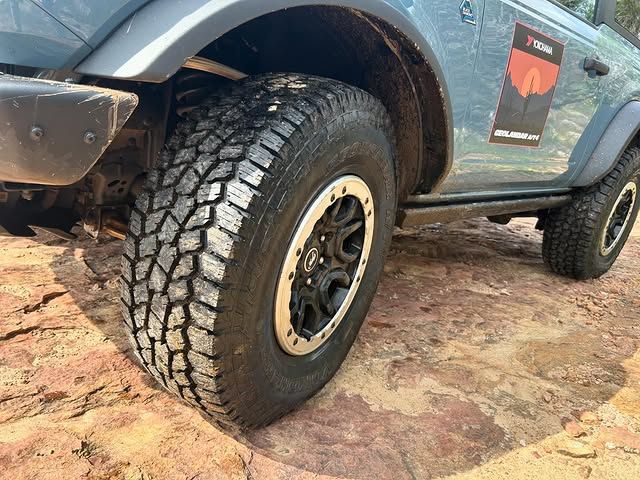
      Close-up of a Yokohama Geolandar AT4 all-terrain tire mounted on a rugged SUV, parked on rocky terrain, showing aggressive tread pattern and black alloy wheel.
      Yokohama Geolandar AT4 — engineered for the trail, tuned for the road. 🛞⛰️

      On dry pavement, the Geolandar stops in about 139 feet with 0.70 g cornering, while both KO2 and KO3 take closer to 142 feet at 0.71 g. In practice, that means Yokohama feels smoother and more predictable in daily turns, while the BFGs carry more of that “rugged boot” personality. KO2 in particular feels a little sharper on initial bite, whereas KO3 takes a beat, then locks into a straighter, calmer line once weight is involved.

      Drivers echo the same: Geolandar owners rave about “super smooth, quiet highway manners,” while KO2 fans talk about “planted bite when you lean in.” As a former field test engineer, I see the reason clearly—Yokohama uses balanced ribs and softer edges to keep transitions calm, while BFG’s reinforced shoulders keep the tread blocks from folding, so stability only builds once you’re loaded.

      👉 Verdict: Geolandar is the commuter’s calm companion; KO2 and KO3 feel tougher, with KO3 settling heaviest rigs the straightest.

      Wet Performance — Geolandar impresses, KO3 holds margin, KO2 stretches

      In the rain, Geolandar surprises many: it stops in about 177 feet with 0.47 traction, which actually beats the KO2’s longer 195-foot / 0.43 g result. KO3 sits in the middle at 184 feet / 0.46 g, and while not sporty, it feels more controlled than its older brother. Behind the wheel, Yokohama gives a more composed stop on slick pavement, while KO3 keeps trucks tracking truer once you add weight. KO2, meanwhile, asks for extra space.

      Owners put it in plain words: one Geolandar driver said it “handles rain nicely, with fewer slip surprises than BFGs,” while KO3 owners praised “confidence even in big storms.” KO2 comments often admit it’s “fine if you slow down, but long on panic stops.”

      The trade makes sense: Yokohama’s compound and siping put more rubber down across the slick surface, while KO2 and KO3 lean harder into durability. KO3 refines it a touch, KO2 simply prioritizes toughness over adhesion.

      👉 Verdict: Geolandar wins the lighter-rig wet commute, KO3 steadies things under weight, KO2 trails behind.

      Note from the Expert: When it comes to rain, I always emphasize two things: compound grip and water evacuation. You can see the full details in my analysis, but if you take just one thing away, remember that an AT tire’s stiff nature makes achieving top-tier wet performance a constant battle. This is why the question, Are All-Terrain Tires Good in Rain?, requires a nuanced answer that balances tread design against rubber stiffness.

      Winter & Snow — KO3 dependable on pack, KO2 a deep-snow bruiser, Geolandar the commuter surprise

      Side-by-side comparison shot: Fresh BF Goodrich KO3 on the left, showing off its new tread pattern, and the seasoned KO2 on the right, with visible wear, revealing more voids

      On packed winter roads, KO3 shortens stops to around 72 feet, while KO2 runs a bit longer at 76 feet. Geolandar surprises here, matching KO3 almost stride for stride at 72 feet, though its launch lags slightly. The experience feels different: KO3 grips calmly on polished lanes, KO2 muscles through deeper snowbanks, and Geolandar handles morning commutes with more composure than you’d expect from a road-leaning A/T.

      Drivers say the same—Geolandar owners talk about “unexpected grip in plowed snow, even compared to bigger names.” KO2 drivers praise the “tank-like shove in unplowed roads,” while KO3 owners split the difference, noting “calm, consistent traction when the highway ices up.”

      Technically, the split comes from siping density and rubber mix. KO3 keeps micro-edges biting in the cold, KO2 relies on tread depth and voids to muscle through loose drifts, and Geolandar’s softer-leaning rubber stays pliable in the cold, helping it brake well on commuter roads.

      👉 Verdict: KO3 is the balanced winter pick, KO2 the snow-belt brawler, and Geolandar the quiet achiever for light rigs.

      Note from the Expert: Our discussions often boil down to the core tradeoff. On one hand, you must understand why all-terrain tires are truly effective in deep snow, but not on ice. On the other hand, you face the 3PMSF Paradox—the hidden cost of that badge. The short answer is: The 3PMSF badge certifies traction, but it costs you durability. Dive into our full analysis on the critical 3PMSF rating for severe winter and off-road service, and its hidden costs, before you risk your rig on the trail.

      Ice — KO3 grips first, KO2 steady, Geolandar slides a touch

      When things glaze over, KO3 stops shortest at about 50 feet, KO2 follows close at 51 feet, while Geolandar stretches to around 53 feet. That gap feels bigger in panic stops: KO3 gives earlier bite, KO2 slides a little longer but predictably, and Geolandar tends to wash forward more if you’re not gentle.

      Community voices mirror it: KO3 drivers say “you can actually brake without panic,” KO2 users accept “longer, but always steady,” while Geolandar owners note “fine if you drive careful, but don’t rush it.”

      The reason is rubber again. KO3 uses micro-siping and a compound that flexes more at freezing temps; KO2 is stiffer but still stable; Geolandar has the quieter compound but fewer micro-edges to catch slick surfaces.

      👉 Verdict: KO3 is the ice safety net, KO2 a close second, Geolandar trails but remains predictable if you drive smart.

      Off-Road — KO3 masterclass, KO2 still a workhorse, Geolandar a pavement-first A/T

      Off-road is where the gaps widen. KO3 scores 9.5 across dirt, sand, and rock, with 9.2 in mud; KO2 trails slightly with 9.3–9.5 across the board. Geolandar? More like 6.0 in dirt, 5.5 in mud and rock. On trail, that’s the difference between a tire built to survive ruts, sharp rock, and deep mud versus one tuned for light gravel and occasional dirt roads.

      Forum chatter confirms it: KO3 users rave it’s “bulletproof on rocks, confidence in deep ruts.” KO2 drivers say it “takes abuse for miles, sidewalls never fail.” Geolandar owners? “Perfect for unpaved roads to the cabin, but not for crawling.”

      From a technical seat: KO2 and KO3 have thicker sidewalls, interlocking blocks, and compounds that resist chipping. Geolandar keeps weight and noise down, but with less void depth and armor, it’s not meant for heavy trail punishment.

      👉 Verdict: KO3 leads, KO2 close behind, Geolandar only for mild off-road.

      Note from the Expert: Every successful day on the trail is about preparation and physics, because tire longevity is earned, not given. Before you even start, you must master the critical link between tire pressure and load range for every rig to maximize your contact patch. Once moving, remember your ultimate off-road armor is your sidewall protection against the inevitable pinch flat. And finally, your traction on the obstacle is dictated by choosing the right aggressive vs hybrid tread pattern for your terrain. Master those three steps, and your rig will be ready for anything.

      Comfort & Noise — Geolandar quiet as a church mouse, KO3 steady hum, KO2 the growler

      On the highway, Geolandar posts the highest comfort score, about 8.5/10, riding quiet and smooth. KO3 sits middle of the road at 7.5/10, while KO2 feels rougher at 7.0/10. Think of Geolandar like a new luxury couch—plush and hushed—while KO2 is more like a solid wooden bench, firm and loud, but unbreakable. KO3 tries to split the difference.

      Owners confirm it: Geolandar drivers say “dead quiet, smoother than stock,” KO3 owners admit “hum builds, but blends in on a diesel,” while KO2 users joke “you’ll hear them before you see them.”

      The difference comes from design: Geolandar’s rib layout reduces resonance, KO3 uses sequencing to manage growl, KO2 simply accepts more void noise in exchange for trail grip.

      👉 Verdict: Geolandar wins commuters; KO3 balances toughness with livable noise; KO2 is louder but trades that for durability.

      Note from the Expert: For years, choosing all-terrain meant accepting noise—a true compromise for off-road grip. That’s why the question, Are All-Terrain Tires Louder than Highway Tires?, used to have a simple “yes” answer. Now, with the rise of on-road models, the core issue has shifted from noise to overall refinement. To fully understand which side of the comfort spectrum you’re buying into, you need to determine Are All-Terrain Tires Good for Daily Driving?—a question that depends entirely on the tire’s construction, not just the name.

      Where They Fit Best + Regional Notes

      After 63,000 KM (40,000 miles), KO2 still have most of its tread. You can see the minor chipping. Yet, it's totally fine at this wear level
        • Yokohama Geolandar A/T4: Best if you drive mostly highways and suburban miles, want a quiet tire, and still need 3PMSF winter confidence. Perfect for the Midwest, Southeast, and Sun Belt where off-road is rare but wet weather or mild snow shows up.

        • BFGoodrich KO3: The all-rounder. Stronger than Geolandar in snow, ice, and off-road, but still refined enough for daily use. Best for the Rockies, Northeast, or Great Lakes region where winter and trails both matter.

        • BFGoodrich KO2: The veteran workhorse. Louder and less refined, but with unbeatable toughness and deep-snow ability. Ideal for ranch country, Southwest desert, or anywhere durability outweighs comfort.

        👉 Bottom line: Geolandar is the comfort commuter’s all-terrain. KO3 is the balanced modern benchmark. KO2 is the old-school bruiser that still rules when toughness is the only goal.

      Tire Size Selection: The Basics You Can’t Skip

      Even the best tread design can’t rescue a tire that’s built too weak. Back when I was testing tires at Bridgestone, I saw all-terrain models that should’ve performed but fell short — simply because the basics (size, load strength, and speed rating) weren’t matched to the vehicle.

      P-Metric vs. LT (Light Truck) Tires

      The first step is knowing whether you need LT or passenger tires. LT (Light Truck) tires are built with extra reinforcement and stiff sidewalls, designed for towing, hauling, or off-road use. Passenger (P-metric) tires are lighter, smoother, and tuned for daily comfort and fuel efficiency — but they’ll flex more under load.

      Understanding Tire Load Range: XL vs. E-Load

      Then comes the tire load index and load range — essentially your tire’s strength rating. Here’s where things split between passenger XL and LT E:

      • XL (Extra Load) is a passenger tire with reinforced sidewalls. It can handle a bit more pressure (~41 PSI) than a standard SL tire and is perfect for SUVs, crossovers, or light trucks that carry extra gear, passengers, or small trailers. XL tires ride softer and quieter than LT options, making them ideal for daily use.

      • E Load Range is an LT tire class built with a much thicker casing. E-rated tires can handle far more pressure (up to ~80 PSI) and heavier loads, which makes them essential for ¾-ton and 1-ton trucks towing trailers or hauling close to max capacity. The trade-off is weight, stiffer ride, more road noise, and a small drop in fuel efficiency.

      Put simply: XL is for “extra luggage and family,” while E is for “truck bed full of bricks or a car trailer.”

      Why the Tire Speed Rating Matters for Safety

      Finally, don’t overlook the tire speed rating. It’s not just about top speed — it measures how well a tire handles heat and stress at highway pace. Lower ratings (like S) tend to ride softer and last longer, while higher ratings (H, T) feel more stable and responsive under sharp maneuvers. Heat build-up is the silent killer of tires, and speed rating is your safeguard.

      Bottom line: Match your tire’s construction (LT vs P-metric), load range (XL vs E), and speed rating to your vehicle’s demands. Get those right, and everything else — off-road grip, winter traction, comfort — will finally perform the way it was designed to.

      Final Verdict — Which Tire Should You Buy?

      For suburban drivers who want quiet comfort and light-trail ability, the Geolandar A/T4 is the commuter’s pick. It surprises in the wet, holds its own in mild snow, and stays hushed on highways, making it ideal for Midwest, Southeast, and Sun Belt climates.

      The BFGoodrich KO3 is the all-rounder for mixed use. It steadies heavy trucks, performs reliably in snow and ice, and remains the masterclass off-road without punishing comfort. The KO2 remains the toughest workhorse—best for ranch roads, Southwest deserts, or deep-snow rural areas where durability and raw traction matter more than refinement.

      👉 Bottom line: Geolandar is the comfort commuter’s A/T, KO3 is the balanced benchmark for modern rigs, and KO2 is the proven bruiser when toughness trumps everything else.

      Frequently Asked Questions: Yokohama Geolandar A/T4 vs BFGoodrich KO2 vs KO3

      • Which tire is quietest on the highway?
        Geolandar is the quietest with an 8.5/10 comfort score, KO3 runs a steady hum at 7.5/10, and KO2 is loudest at 7.0/10.

      • Which tire performs best in wet conditions?
        Geolandar stops shorter at 177 ft, KO3 follows at 184 ft, and KO2 stretches to 195 ft, making Geolandar the wet commuter winner.

      • Which tire is strongest in snow?
        KO3 stops at 72 ft and is the balanced snow pick, KO2 digs better in deep drifts, and Geolandar surprises with solid packed-snow braking for a road-leaning A/T.

      • How do they compare on ice?
        KO3 stops shortest at 50 ft, KO2 follows close at 51 ft, and Geolandar lags at 53 ft, though it remains predictable with careful driving.

      • Which tire is better off-road?
        KO3 leads with 9.5 scores across dirt, sand, and rock, KO2 stays nearly as strong, and Geolandar is best kept to gravel and light trails.

      • Who should buy the Geolandar A/T4?
        Drivers who value quiet comfort, predictable wet braking, and light winter security, especially in suburban or mild climates.

      • Who should buy the KO3?
        Drivers needing a balanced A/T for snow, ice, and serious off-road work—especially in the Rockies, Northeast, and Great Lakes regions.

      • Who should buy the KO2?
        Truck owners in rugged, rural, or snow-belt areas who prioritize toughness and deep-snow grip over comfort and noise.

      Filed Under: All Terrain Tires Tagged With: bf goodrich, bf goodrich ko2, BF Goodrich KO3, Comparisons, yokohama, Yokohama Geolandar AT4

      Nitto Recon Grappler vs BFGoodrich KO3 — Sharp Handling vs Winter Durability in 2025

      Updated: November 11, 2025 by Emrecan Gurkan Leave a Comment

      Fresh BFGoodrich All-Terrain T/A KO3 tire stacked in a workshop, with size label LT285/70R17 visible, showcasing aggressive tread pattern for off-road and all-weather traction.
      Fresh from the rack — BFGoodrich KO3, ready for your next adventure.

      Real-world test data, driver impressions, and technical breakdowns — from a former Bridgestone test engineer.

      The BFGoodrich KO3 is BFG’s newest Off-Road A/T tire, carrying forward the KO2’s legacy with stronger sidewalls, tougher chip resistance, and a winter-focused compound certified by the 3PMSF rating. It’s the go-to choice for heavy trucks, tow rigs, and off-roaders who need year-round reliability. For the full evolution story, see my BFGoodrich KO3 vs KO2 breakdown. The Nitto Recon Grappler A/T also sits in the Off-Road A/T category, but takes a different approach — designed with everyday livability in mind. It emphasizes comfort, quieter ride quality, and sharper on-road handling, while still holding enough off-road toughness for weekend trails and light-duty adventure.

      That’s the real split — KO3 for brute durability and four-season strength vs Recon Grappler for balance and daily usability. In the sections ahead, I’ll break down how they compare across dry, wet, snow, and off-road testing. You can also line them up directly in our All-Terrain Tire Decision Tool for quick, vehicle-specific recommendations by SUV, CUV, or truck class.

      🔍 Quick Look

      Nitto Recon Grappler A/T

      Nitto Recon Grappler A/T tire
      Tested Rating: 8.0/10

      Trusted Retailers with Best Deals:

      Tire Rack
      Free road-hazard coverage Backed by Discount Tire
      SimpleTire
      Financing options Local installers
      Amazon
      Prime shipping Direct from brands

      BFGoodrich All-Terrain T/A KO3

      BFGoodrich KO3 tire
      Tested Rating: 8.5/10

      Trusted Retailers with Best Deals:

      Tire Rack
      Free road-hazard coverage Backed by Discount Tire
      Amazon
      Prime shipping Direct from brands

      The Nitto Recon Grappler A/T feels sharper and more responsive on lighter rigs, stopping in 138 ft with 0.72 g cornering and reacting quicker to steering inputs than the KO3. Owners note it “drives surprisingly tight for how blocky it looks.” On weekend trails, it’s capable with mid-8 scores in dirt and mud, while carrying aggressive looks without being overbearing day-to-day. The trade-off comes in longer wet stops (192 ft), a weaker ice margin, and a firmer ride that grows louder as tread wears. It’s a versatile hybrid A/T, but one that demands more respect when the weather turns slick. The BFGoodrich KO3 plays the heavyweight role, built with reinforced shoulders and tougher sidewalls that steady half-tons with trailers and dominate ¾-ton and HD trucks. It stops shorter in the wet (184 ft), runs calmer on ice (46.2 ft), and steadies salted highways better in winter. Off-road, it’s the benchmark, with 9+ scores across dirt, sand, and rock, earning its “bulletproof” reputation. Comfort is firm but steadier long-term (7.5/10), with more uniform noise as miles build. The KO3 isn’t flashy, but for hauling, snow-belt commutes, and punishing trails, it’s the dependable choice.

        Raw Test Data

        Tire Test Data

        Pick categories to show metrics, then open ☰ to pick tires. Optional chart is hidden by default.

        Parentheses show the rank among the currently displayed tires (1 = best for that metric).
        Left axis lists metrics. Top axis is used for g-force metrics so they scale clearly.
        Note: Lower is better for Stopping & Acceleration; higher is better for g-force, comfort, traction & off-road ratings. Parentheses show the rank among the currently displayed tires (1 = best for that metric).
        Sources worth checking
        Tire Rack AT Tire Test Tire Rack On-Road A/T Ratings Tire Rack Off-Road A/T Ratings SimpleTire Reviews Amazon SUV/LT Tires

        Dry Performance — Recon quicker, KO3 steadier once loaded

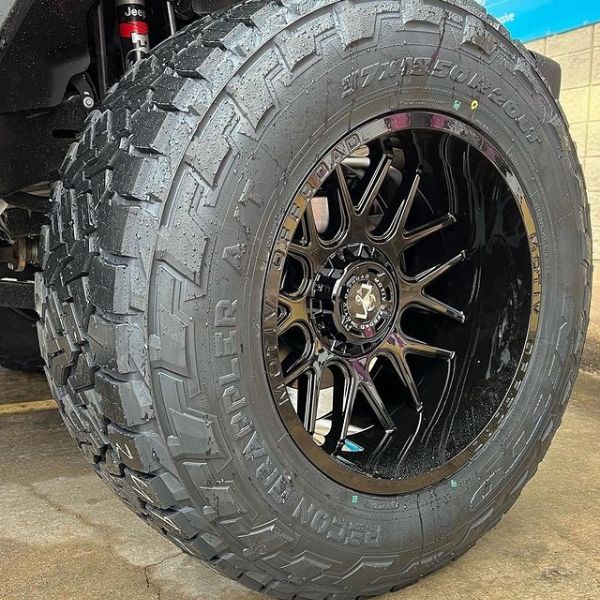
        Nitto Recon Grappler shares a similar tread pattern with Ridge Grappler. Yet, it lasts longer due to its stiffer compound and light-weight.

        On dry pavement, the Recon Grappler stops at 138 ft with 0.72 g cornering, while KO3 stretches longer at 140 ft with 0.72 g. That small gap feels bigger behind the wheel: Recon reacts quicker on steering inputs, while KO3 takes an extra breath before settling. Owners of Recon often mention it “drives surprisingly tight for how blocky it looks,” while KO3 drivers describe it as “calm but never fast-reacting.”

        From an engineering standpoint, Recon’s hybrid-like tread with smaller center blocks gives faster bite, but with lighter casing strength compared to KO3. KO3, with its reinforced shoulders and heavier-duty construction, sacrifices some nimbleness but plants straighter when trailers or payloads get involved.

        • SUVs & crossovers: Recon feels sharper and more lively.

        • ½-ton trucks: Recon is playful unloaded; KO3 steadier when towing.

        • ¾-ton & HD trucks: KO3 the safer, more predictable match under weight.

        👉 Verdict: Recon wins for sharpness and lighter rigs, KO3 steadies heavy trucks.

        Wet Performance — KO3 keeps margin, Recon stretches

        In the rain, KO3 stops at 184 ft with 0.46 g traction, while Recon pushes longer to 192 ft with 0.43 g. That shows up as earlier ABS engagement and more push through slick intersections on the Recon. Forum feedback lines up: KO3 owners praise it as “predictable in storms,” while Recon drivers often say “fine if you leave space.”

        The reason? KO3’s compound puts more rubber down under braking, even if it’s not silica-rich like road-leaning A/Ts. Recon’s durability-first compound and larger void ratio help resist hydroplaning but don’t bite as firmly on wet asphalt.

        • SUVs & crossovers: KO3 much safer in heavy rain.

        • ½-ton trucks: KO3 inspires confidence; Recon manageable with extra margin.

        • ¾-ton & HD trucks: KO3 steadier with trailers, Recon gets sketchy.

        👉 Verdict: KO3 wins wet braking and stability; Recon demands space.

        Note from the Expert: When it comes to rain, I always emphasize two things: compound grip and water evacuation. You can see the full details in my analysis, but if you take just one thing away, remember that an AT tire’s stiff nature makes achieving top-tier wet performance a constant battle. This is why the question, Are All-Terrain Tires Good in Rain?, requires a nuanced answer that balances tread design against rubber stiffness.

        Winter & Snow — KO3 calmer on pack, Recon claws in deeper

        When snow piles up, KO3 records 72.3 ft to stop and 46.4 ft to launch, while Recon posts 74.0 ft and 45.5 ft. Recon digs harder in deeper drifts but takes longer to stop, KO3 brakes shorter and steadies the truck on polished surfaces.

        Drivers echo this split: Recon owners say it “pulls out of unplowed driveways without drama,” while KO3 users mention “confidence once the road is salted.” I felt the same—Recon’s larger voids help in powder, KO3’s siping pattern and compound keep grip more consistent on hardpack.

        • SUVs & crossovers: KO3 the safer daily winter tire.

        • ½-ton trucks: Recon feels better in loose snow; KO3 steadier on commutes.

        • ¾-ton & HD trucks: KO3 steadies trailers and big loads; Recon less sure-footed on plowed ice.

        👉 Verdict: Recon stronger in loose drifts, KO3 the clear pick for salted highways.

        Note from the Expert: Our discussions often boil down to the core tradeoff. On one hand, you must understand why all-terrain tires are truly effective in deep snow, but not on ice. On the other hand, you face the 3PMSF Paradox—the hidden cost of that badge. The short answer is: The 3PMSF badge certifies traction, but it costs you durability. Dive into our full analysis on the critical 3PMSF rating for severe winter and off-road service, and its hidden costs, before you risk your rig on the trail.

        Ice — KO3 grips sooner, Recon slides longer

        KO3’s 46.2 ft ice stop beats Recon’s 46.5 ft, not a huge margin, but in practice KO3 grips earlier and fades predictably, while Recon tends to let go and slide further. Owners of KO3 say it “brakes without panic even in frost,” while Recon drivers admit “it’s fine if you tip-toe.”

        From the engineering lens, KO3’s micro-siping and compound flexibility at near-freezing temps help claw in, while Recon’s harder compound and wider voids don’t generate as much micro-bite.

        • SUVs & crossovers: KO3 gives a safer ice margin.

        • ½-ton trucks: KO3 steadier; Recon needs careful throttle.

        • ¾-ton & HD trucks: KO3 clearly safer, especially with payload.

        👉 Verdict: KO3 edges Recon in ice safety margin.

        Off-Road — Recon versatile, KO3 the masterclass

        Looking at the BF Goodrich All-Terrain KO3 on the left and the KO2 on the other left, you'll notice a subtle difference—specifically, the KO3 has a slightly higher land-to-groove ratio. This means the KO3 features more rubber in contact with the road, which contributes to its improved on-road performance.

        Recon’s trail scores land at 8.2 dirt / 8.0 sand / 8.3 mud / 8.1 rock, while KO3 towers with 9.5 dirt / 9.5 sand / 9.2 mud / 9.5 rock. Recon feels strong on gravel and weekend trails, but KO3 remains the benchmark when terrain gets nasty.

        Community voices underline this: Recon drivers often say it “grips well on fire roads and washes,” while KO3 fans call it “bulletproof on rocks and ruts.” Recon’s lighter build helps keep road comfort, but KO3’s tougher sidewalls, interlocking blocks, and stone ejectors let it stay planted under punishment.

        • SUVs & crossovers: Recon fine for weekend trails; KO3 feels overkill.

        • ½-ton trucks: Recon works for mild off-road; KO3 dominates if trails get technical.

        • ¾-ton & HD trucks: KO3 unmatched — tougher, steadier, more resistant to punctures.

        👉 Verdict: Recon balances road manners with weekend off-road. KO3 is the trail benchmark.

        Note from the Expert: Every successful day on the trail is about preparation and physics, because tire longevity is earned, not given. Before you even start, you must master the critical link between tire pressure and load range for every rig to maximize your contact patch. Once moving, remember your ultimate off-road armor is your sidewall protection against the inevitable pinch flat. And finally, your traction on the obstacle is dictated by choosing the right aggressive vs hybrid tread pattern for your terrain. Master those three steps, and your rig will be ready for anything.

        Comfort & Noise — Recon firmer, KO3 steadier with wear

        Huge flotation sizes looks DOOOPEE!

        Recon posts 7.3/10 comfort, while KO3 is slightly better at 7.5/10. On the highway, Recon feels firm and growls as tread wears, KO3 is also firm but steadier and less prone to uneven noise.

        Drivers describe Recon as “quiet for the first 10k, then louder,” while KO3 users say “noise blends into the truck after break-in.” Technically, Recon’s aggressive voids generate more resonance as miles build; KO3’s pitch sequencing and heavier-duty build keep noise more uniform.

        • SUVs & crossovers: KO3 less intrusive, Recon rougher.

        • ½-ton trucks: Recon livable; KO3 smoother on long trips.

        • ¾-ton & HD trucks: KO3 noise fades into the background of diesel rumble.

        👉 Verdict: KO3 holds refinement longer, Recon grows louder with age.

        Note from the Expert: For years, choosing all-terrain meant accepting noise—a true compromise for off-road grip. That’s why the question, Are All-Terrain Tires Louder than Highway Tires?, used to have a simple “yes” answer. Now, with the rise of on-road models, the core issue has shifted from noise to overall refinement. To fully understand which side of the comfort spectrum you’re buying into, you need to determine Are All-Terrain Tires Good for Daily Driving?—a question that depends entirely on the tire’s construction, not just the name.

        Where They Fit Best

        • Nitto Recon Grappler A/T: Best for drivers who want aggressive looks and weekend trail use without fully sacrificing road comfort. Works well in dry conditions, fine for light snow, but needs margin in wet and ice. Good choice for SUVs and ½-ton trucks in drier climates or lighter-duty off-road.

          BFGoodrich KO3: The standard for toughness and consistency. Safer in wet, stronger in snow/ice, and unmatched off-road. Perfect for ¾-ton and 1-ton trucks, snow-belt drivers, and anyone towing, hauling, or spending serious time off-road.

          👉 Bottom line: Recon Grappler is the sharper, more versatile hybrid for lighter rigs. KO3 is the heavyweight built for real winter, real loads, and serious off-road duty.

        Tire Size Selection: The Basics You Can’t Skip

        Even the best tread design can’t rescue a tire that’s built too weak. Back when I was testing tires at Bridgestone, I saw all-terrain models that should’ve performed but fell short — simply because the basics (size, load strength, and speed rating) weren’t matched to the vehicle.

        P-Metric vs. LT (Light Truck) Tires

        The first step is knowing whether you need LT or passenger tires. LT (Light Truck) tires are built with extra reinforcement and stiff sidewalls, designed for towing, hauling, or off-road use. Passenger (P-metric) tires are lighter, smoother, and tuned for daily comfort and fuel efficiency — but they’ll flex more under load.

        Understanding Tire Load Range: XL vs. E-Load

        Then comes the tire load index and load range — essentially your tire’s strength rating. Here’s where things split between passenger XL and LT E:

        • XL (Extra Load) is a passenger tire with reinforced sidewalls. It can handle a bit more pressure (~41 PSI) than a standard SL tire and is perfect for SUVs, crossovers, or light trucks that carry extra gear, passengers, or small trailers. XL tires ride softer and quieter than LT options, making them ideal for daily use.

        • E Load Range is an LT tire class built with a much thicker casing. E-rated tires can handle far more pressure (up to ~80 PSI) and heavier loads, which makes them essential for ¾-ton and 1-ton trucks towing trailers or hauling close to max capacity. The trade-off is weight, stiffer ride, more road noise, and a small drop in fuel efficiency.

        Put simply: XL is for “extra luggage and family,” while E is for “truck bed full of bricks or a car trailer.”

        Why the Tire Speed Rating Matters for Safety

        Finally, don’t overlook the tire speed rating. It’s not just about top speed — it measures how well a tire handles heat and stress at highway pace. Lower ratings (like S) tend to ride softer and last longer, while higher ratings (H, T) feel more stable and responsive under sharp maneuvers. Heat build-up is the silent killer of tires, and speed rating is your safeguard.

        Bottom line: Match your tire’s construction (LT vs P-metric), load range (XL vs E), and speed rating to your vehicle’s demands. Get those right, and everything else — off-road grip, winter traction, comfort — will finally perform the way it was designed to.

        Final Verdict — Which Should You Buy?

        If you want sharper steering and a tire that feels more playful on lighter rigs, the Nitto Recon Grappler delivers. It’s fine for SUVs and half-tons in drier regions, capable enough for gravel and light trails, and carries rugged looks without KO3’s heaviness. Just be ready to give it more braking space in the wet or on ice.

        The BFGoodrich KO3 is the safer all-around choice for drivers who demand stability under load, consistent winter grip, and maximum off-road toughness. It’s a natural fit for ¾-ton and 1-ton trucks, snow-belt drivers, and anyone towing or tackling rocky trails.

        👉 Bottom line: Recon Grappler is the sharper hybrid for lighter rigs; KO3 is the heavyweight built for winter safety, towing stability, and serious off-road duty.

        Frequently Asked Questions: Nitto Recon Grappler A/T vs BFGoodrich KO3

        • Which tire handles better on dry pavement?
          Recon feels sharper with a 138-ft stop and 0.72 g cornering, while KO3 is steadier once loaded.

        • How do they compare in wet conditions?
          KO3 stops shorter at 184 ft with 0.46 traction, while Recon stretches to 192 ft with 0.43 traction.

        • Which tire is better in snow?
          Recon claws better in loose drifts, but KO3 stops shorter on packed or salted roads, making it safer for daily winter commutes.

        • Which tire is safer on ice?
          KO3 edges Recon with a 46.2-ft stop versus 46.5 ft, and feels more predictable under load.

        • How do they compare off-road?
          KO3 dominates with 9+ scores in dirt, sand, and rock, while Recon is versatile but tuned more for balanced road/trail use.

        • Which tire is quieter and more comfortable?
          KO3 holds refinement longer (7.5/10), while Recon (7.3/10) rides firmer and grows louder as it wears.

        • Who should buy the Recon Grappler?
          Drivers of SUVs and ½-ton trucks in drier regions who want sharper handling, aggressive looks, and weekend trail ability.

        • Who should buy the KO3?
          Snow-belt drivers, ¾-ton and HD truck owners, and anyone who tows or wheels hard off-road should pick KO3 for its toughness and winter safety.

        Filed Under: All Terrain Tires Tagged With: bf goodrich, BF Goodrich KO3, Comparisons, nitto, Nitto Recon Grappler

        Nitto Ridge Grappler vs Recon Grappler — Off-Road Strength vs Winter Safety in 2025

        Updated: November 11, 2025 by Emrecan Gurkan Leave a Comment

        Nitto Recon Grappler shares a similar tread pattern with Ridge Grappler. Yet, it lasts longer due to its stiffer compound and light-weight.

        Real-world test data, driver impressions, and technical breakdowns — from a former Bridgestone test engineer.

        The Nitto Recon Grappler A/T sits in the Off-Road A/T category, designed for drivers who want everyday livability with a touch of trail readiness. With balanced wet grip, snow-certified 3PMSF traction, and a smoother ride than most aggressive A/Ts, it’s the more practical option in Nitto’s lineup for light trucks, SUVs, and Jeeps. The Nitto Ridge Grappler, by contrast, belongs to the Rugged-Terrain category — a hybrid between all-terrain and mud-terrain. It brings blockier tread, sharper dry-road handling, and extra bite in mud and sand, though it sacrifices some wet braking, icy grip, and day-to-day comfort in exchange for that extra aggression.

        That’s the decision buyers face — Recon for balance and versatility vs Ridge for hybrid toughness and looks. In the sections ahead, I’ll break down how they compare across dry, wet, snow, and off-road testing. You can also line them up directly in our All-Terrain Tire Decision Tool for quick, vehicle-specific recommendations by SUV, CUV, or truck class.

        🔍 Quick Look

        Nitto Recon Grappler A/T

        Nitto Recon Grappler A/T tire
        Tested Rating: 8.0/10

        Trusted Retailers with Best Deals:

        Tire Rack
        Free road-hazard coverage Backed by Discount Tire
        SimpleTire
        Financing options Local installers
        Amazon
        Prime shipping Direct from brands

        Nitto Ridge Grappler

        Nitto Ridge Grappler tire
        Tested Rating: 8.2/10

        Trusted Retailers with Best Deals:

        Tire Rack
        Free road-hazard coverage Backed by Discount Tire
        SimpleTire
        Financing options Local installers
        Amazon
        Prime shipping Direct from brands

        The Nitto Ridge Grappler puts its best foot forward on dry roads and rugged trails. With a 130-ft stop and 0.75 g cornering, it bites harder and holds a firmer line than the Recon. Off-road, it’s built like a hammer, posting 9.0+ in dirt, mud, and rock, backed by blocky shoulders and a hybrid carcass that dig in when things get rough. Owners call it “locked in like a street tire” until tossed, and a “beast in mud.” The trade-off shows in the wet and winter, where its 203-ft wet stops and 55.7-ft ice stops demand extra margin and care. The Nitto Recon Grappler A/T, by contrast, is the calmer, safer everyday tire. Its 192-ft wet stop and 74-ft snow stop beat the Ridge, while a 46.5-ft ice stop highlights its safer edge in slick conditions. Drivers describe it as “predictable in commutes, no surprises,” with smoother ride quality (7.3/10 comfort). Recon isn’t weak off-road — mid-8 scores in dirt and mud prove it can handle trails and hunting roads — but it prioritizes civility, comfort, and wet/winter security over brute trail force. A tire tuned for balance and livability, especially in snowy or rainy regions.

          Raw Test Data

          Tire Test Data

          Pick categories to show metrics, then open ☰ to pick tires. Optional chart is hidden by default.

          Parentheses show the rank among the currently displayed tires (1 = best for that metric).
          Left axis lists metrics. Top axis is used for g-force metrics so they scale clearly.
          Note: Lower is better for Stopping & Acceleration; higher is better for g-force, comfort, traction & off-road ratings. Parentheses show the rank among the currently displayed tires (1 = best for that metric).
          Sources worth checking
          Tire Rack AT Tire Test Tire Rack On-Road A/T Ratings Tire Rack Off-Road A/T Ratings SimpleTire Reviews Amazon SUV/LT Tires

          Dry Performance — Ridge more aggressive, Recon tuned for ride

          Nitto Recon Grappler is a great option for towing due to its 3-ply sidewalls

          Recon Grappler A/T stops at 138 ft with 0.72 g cornering, while Ridge Grappler clocks in around 130 ft / 0.75 g. On paper, Ridge has the better stopping distance and lateral grip. In real drive-feel, you notice Ridge eagerly bites into corner turn-in; Recon feels smoother, more tamed, less abrupt.

          From forum discussions: several users say Recon “feels more highway friendly, quieter, less harsh” than Ridge. Others admit the Ridge looks tougher, with more aggressive tread blocks, and gives better performance when steering hard into curves.

          Engineering angle: Ridge Grappler’s larger block edges and stiffer shoulder design mean quicker response in dry cornering and braking. Recon uses more moderate block shaping and smoother transitions to reduce vibration, improving ride comfort. Rubber compound differences: Ridge tends to use a more durable, possibly harder shoulder compound that resists squirm, whereas Recon’s rubbers are tuned more for compliance and road manners.

          • SUVs & crossovers: Recon more comfortable; Ridge more fun.

          • ½-tons: Ridge stronger under load; Recon more pleasant for daily driving.

          • ¾-tons & HD trucks: Ridge keeps control; Recon usable but less grip under heavy mass.

          👉 Verdict: Ridge wins on raw dry grip; Recon wins livability on pavement.

          Wet Performance — Recon safer, Ridge stretches long

          Wet data flips the story. Ridge runs a 203 ft stop with 0.47 traction, while Recon shortens that to 192 ft with 0.43 traction. Neither matches road-focused A/Ts, but Recon delivers a safer margin when rain comes hard.

          Community feedback reflects this: Ridge drivers admit it’s “fine if you leave plenty of space,” while Recon owners note it feels “a little less drama in the rain.” The reasoning is simple: Ridge is tuned for toughness, and that comes at the expense of adhesion. Recon’s compound keeps more rubber planted under braking, helping it pull up shorter even if cornering grip isn’t stellar.

          • SUVs & crossovers: Recon inspires more confidence.

          • ½-tons: Recon gives safer braking, Ridge requires more margin.

          • ¾-ton & HD: Recon steadies better in storms; Ridge needs respect.

          👉 Verdict: Recon is the safer wet-weather pick; Ridge stretches braking distance.

          Note from the Expert: When it comes to rain, I always emphasize two things: compound grip and water evacuation. You can see the full details in my analysis, but if you take just one thing away, remember that an AT tire’s stiff nature makes achieving top-tier wet performance a constant battle. This is why the question, Are All-Terrain Tires Good in Rain?, requires a nuanced answer that balances tread design against rubber stiffness.

          Winter & Snow — Recon steadier, Ridge struggles more

          Montster Ridge Grappler!

          Snow data favors Recon. It stops at 74 ft and accelerates in 45.5 ft, compared to Ridge’s 78 ft and 47.7 ft. In practice, that means Recon is the calmer tire on plowed or packed roads. Ridge, with its bigger voids, can dig in when snow is deep, but it slides longer when the road is icy or salted.

          Forum voices match: Ridge drivers say it “powers through unplowed driveways” but feels loose once the roads are polished. Recon users note it’s “predictable on winter commutes, no surprises.” From my short drive, I’d agree — Ridge claws better in loose drifts, but Recon is the tire you want when you hit the brakes in traffic.

          • SUVs & crossovers: Recon better for daily snow routes.

          • ½-tons: Ridge usable in powder, Recon safer in plowed city use.

          • ¾-ton & HD: Recon steadies more predictably under weight.

          👉 Verdict: Recon is the stronger winter choice for control; Ridge shines only in loose powder.

          Note from the Expert: Our discussions often boil down to the core tradeoff. On one hand, you must understand why all-terrain tires are truly effective in deep snow, but not on ice. On the other hand, you face the 3PMSF Paradox—the hidden cost of that badge. The short answer is: The 3PMSF badge certifies traction, but it costs you durability. Dive into our full analysis on the critical 3PMSF rating for severe winter and off-road service, and its hidden costs, before you risk your rig on the trail.

          Ice — Recon holds, Ridge slides

          On ice, the data is clear. Recon stops in 46.5 ft, Ridge drags out to 55.7 ft. That’s the difference between keeping a straight line and sliding through an intersection.

          Drivers back it up: Ridge owners warn “creep, don’t rush” in icy conditions. Recon fans say it “lets you brake without panic.” The explanation lies in siping — Recon’s tread keeps micro edges active, while Ridge’s blocky, durability-focused design sacrifices that bite.

          • SUVs & crossovers: Recon the safer choice.

          • ½-tons: Recon gives braking confidence; Ridge less forgiving.

          • ¾-ton & HD: Recon steadies under weight, Ridge can’t match it.

          👉 Verdict: Recon beats Ridge clearly on ice security.

          Off-Road — Ridge tougher, Recon versatile

          Nitto Ridge Grappler is a purpose-oriented tire and it's great option for those who like severe weekend adventures

          Off-road is where Ridge reclaims ground. It scores 9.0 dirt / 8.5 sand / 9.3 mud / 9.2 rock, higher across the board than Recon’s 8.2 / 8.0 / 8.3 / 8.1. Ridge feels like it was born for mud and rock crawling — tougher sidewalls, deeper voids, and aggressive shoulders. Recon is still plenty capable, but it’s tuned more for a balance of on-road civility and weekend trail use.

          Owners describe Ridge as “a beast in mud, with real bite on rocks.” Recon users say it’s “good for trails, gravel, and hunting roads — not extreme, but reliable.” From my perspective, Ridge’s hybrid build simply digs harder, while Recon favors balance over brute strength.

          • SUVs & crossovers: Recon’s versatility fits daily use; Ridge overbuilt.

          • ½-tons: Ridge gives adventure-ready bite; Recon better for mixed daily/off-road.

          • ¾-ton & HD: Ridge dominates heavy trail abuse.

          👉 Verdict: Ridge is the tougher off-road partner; Recon trades some muscle for road comfort.

          Note from the Expert: Every successful day on the trail is about preparation and physics, because tire longevity is earned, not given. Before you even start, you must master the critical link between tire pressure and load range for every rig to maximize your contact patch. Once moving, remember your ultimate off-road armor is your sidewall protection against the inevitable pinch flat. And finally, your traction on the obstacle is dictated by choosing the right aggressive vs hybrid tread pattern for your terrain. Master those three steps, and your rig will be ready for anything.

          Comfort & Noise — Recon smoother, Ridge rougher

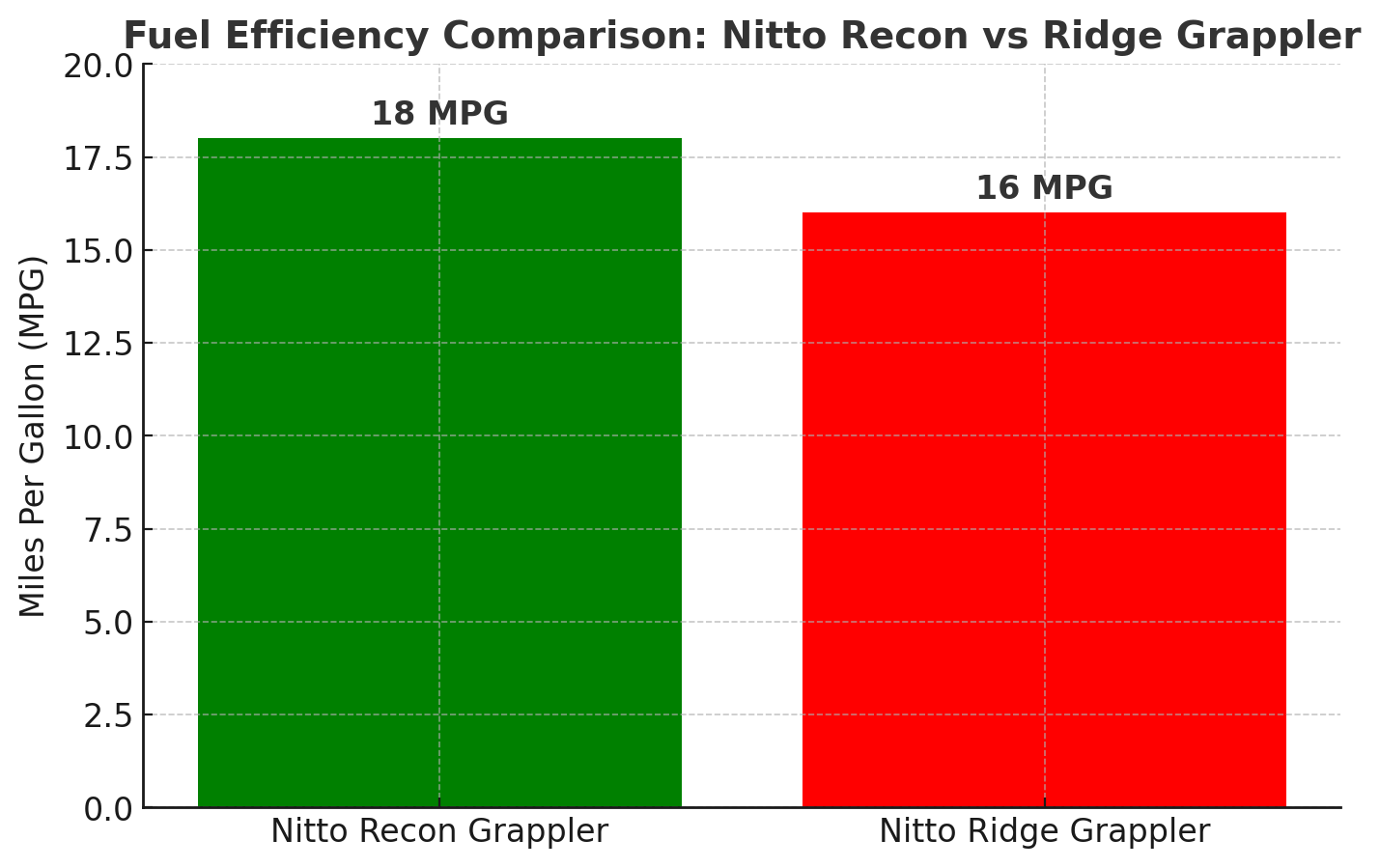
          Bar chart comparing fuel efficiency between Nitto Recon Grappler and Nitto Ridge Grappler tires. The Recon Grappler shows 18 MPG in green, while the Ridge Grappler shows 16 MPG in red.
          Recon Grappler wins on efficiency — 18 MPG vs Ridge Grappler’s 16 MPG. 🛞⛽

          Comfort scores highlight the difference: Recon rates 7.3/10, Ridge lower at 6.8/10. Recon rides smoother, quieter, and feels less punishing on daily commutes. Ridge starts out relatively quiet for how it looks, but hums more as tread wears.

          Community chatter: Recon is described as “civilized for a tough tire,” while Ridge owners note “quiet at first, louder over time.” The engineering trade-off is straightforward: Ridge’s aggressive voids and hybrid carcass hum louder, Recon’s lighter block design dampens road resonance.

          • SUVs & crossovers: Recon clearly wins for comfort.

          • ½-tons: Recon smoother highway ride; Ridge acceptable but firmer.

          • ¾-ton & HD: Ridge blends into background noise, but Recon still smoother.

          👉 Verdict: Recon is more livable day-to-day; Ridge grows rougher with miles.

          Note from the Expert: For years, choosing all-terrain meant accepting noise—a true compromise for off-road grip. That’s why the question, Are All-Terrain Tires Louder than Highway Tires?, used to have a simple “yes” answer. Now, with the rise of on-road models, the core issue has shifted from noise to overall refinement. To fully understand which side of the comfort spectrum you’re buying into, you need to determine Are All-Terrain Tires Good for Daily Driving?—a question that depends entirely on the tire’s construction, not just the name.

          Longevity

          Driver Feedback:
          At ~15,000 miles, Recon showed even tread wear. Ridge, however, feathered its shoulders faster when rotation was skipped.

          🧠 Root Cause:
          Recon’s balanced tread stiffness prevents uneven wear. Ridge’s aggressive voids put stress on shoulders.

          🏁 Verdict:
          Recon is more rotation-friendly and longer-lasting. Ridge demands strict maintenance.

          Where They Fit Best

          • Nitto Recon Grappler A/T: Best for drivers who want Nitto’s rugged styling but prioritize wet, winter, and ice security alongside comfort. A strong fit for SUVs and ½-ton trucks that see mixed conditions and mild trails, especially in snow-belt or rainy regions.

          • Nitto Ridge Grappler: The tougher hybrid for drivers who need serious off-road grip and sharper dry handling, and who don’t mind longer wet/ice stops or more cabin noise. Ideal for ½-ton and ¾-ton trucks in Southwest deserts, rocky trails, and mud-heavy terrain.

          👉 Bottom line: Recon is the more balanced, winter-safe Nitto; Ridge is the aggressive hybrid built for off-road authority.

          Tire Size Selection: The Basics You Can’t Skip

          Even the best tread design can’t rescue a tire that’s built too weak. Back when I was testing tires at Bridgestone, I saw all-terrain models that should’ve performed but fell short — simply because the basics (size, load strength, and speed rating) weren’t matched to the vehicle.

          P-Metric vs. LT (Light Truck) Tires

          The first step is knowing whether you need LT or passenger tires. LT (Light Truck) tires are built with extra reinforcement and stiff sidewalls, designed for towing, hauling, or off-road use. Passenger (P-metric) tires are lighter, smoother, and tuned for daily comfort and fuel efficiency — but they’ll flex more under load.

          Understanding Tire Load Range: XL vs. E-Load

          Then comes the tire load index and load range — essentially your tire’s strength rating. Here’s where things split between passenger XL and LT E:

          • XL (Extra Load) is a passenger tire with reinforced sidewalls. It can handle a bit more pressure (~41 PSI) than a standard SL tire and is perfect for SUVs, crossovers, or light trucks that carry extra gear, passengers, or small trailers. XL tires ride softer and quieter than LT options, making them ideal for daily use.

          • E Load Range is an LT tire class built with a much thicker casing. E-rated tires can handle far more pressure (up to ~80 PSI) and heavier loads, which makes them essential for ¾-ton and 1-ton trucks towing trailers or hauling close to max capacity. The trade-off is weight, stiffer ride, more road noise, and a small drop in fuel efficiency.

          Put simply: XL is for “extra luggage and family,” while E is for “truck bed full of bricks or a car trailer.”

          Why the Tire Speed Rating Matters for Safety

          Finally, don’t overlook the tire speed rating. It’s not just about top speed — it measures how well a tire handles heat and stress at highway pace. Lower ratings (like S) tend to ride softer and last longer, while higher ratings (H, T) feel more stable and responsive under sharp maneuvers. Heat build-up is the silent killer of tires, and speed rating is your safeguard.

          Bottom line: Match your tire’s construction (LT vs P-metric), load range (XL vs E), and speed rating to your vehicle’s demands. Get those right, and everything else — off-road grip, winter traction, comfort — will finally perform the way it was designed to.

          Final Verdict — Which Should You Buy?

          If you want sharper steering and extreme off-road ability, the Nitto Ridge Grappler is the obvious choice. It excels in dirt, mud, and rocky terrain, feels planted when pushed on dry roads, and suits half-tons and heavier trucks in the Southwest, desert, or muddy backcountry. The cost is comfort, noise, and longer wet/ice stops.

          For drivers who balance city commutes, winter safety, and mild off-road use, the Nitto Recon Grappler is the smarter fit. It stops shorter in rain, snow, and ice, rides smoother, and provides enough trail confidence for gravel, hunting roads, and light adventure. SUVs and ½-tons in the Snow Belt or rainy regions will find Recon the safer and easier daily choice.

          Frequently Asked Questions: Nitto Ridge Grappler vs Nitto Recon Grappler A/T

          • Which tire has better dry performance?
            Ridge Grappler, with a 130-ft stop and 0.75 g cornering, outperforms Recon’s 138 ft and 0.72 g in dry grip.

          • How do they compare in wet conditions?
            Recon stops shorter at 192 ft, while Ridge stretches to 203 ft, making Recon the safer wet-weather choice.

          • Which tire is better in snow and ice?
            Recon is stronger, with a 74-ft snow stop and 46.5-ft ice stop, compared to Ridge’s 78 ft in snow and 55.7 ft on ice.

          • Which tire offers more off-road traction?
            Ridge dominates off-road with scores around 9.0 in dirt, mud, and rock, while Recon averages in the low-8s.

          • Which tire is more comfortable for daily driving?
            Recon rides smoother and quieter with a 7.3/10 comfort score, while Ridge rates lower at 6.8/10 and grows noisier with miles.

          • Who should buy the Nitto Recon Grappler A/T?
            Drivers who want safer wet/winter handling, smoother comfort, and enough off-road versatility for light trails and mixed conditions.

          • Who should buy the Nitto Ridge Grappler?
            Drivers who prioritize dry grip and extreme off-road authority, and don’t mind louder road manners or longer wet/ice stops.

          Filed Under: All Terrain Tires Tagged With: Comparisons, nitto, Recon Grappler, ridge grappler

          Toyo AT3 vs Nitto Terra Grappler G3 — Winter Grip vs Daily Comfort in 2025

          Updated: November 11, 2025 by Emrecan Gurkan Leave a Comment

          A closer look to Toyo Open Country AT3. Sipes works perfectly on light snow conditions
          A closer look to Toyo Open Country AT3. Sipes works perfectly on light snow conditions
          If you're changing from the H/T tires, Toyo AT3 can provide aggressive look. Still, I prefer Ridge Grappler
          If you're changing from the H/T tires, Toyo AT3 can provide aggressive look. Still, I prefer Ridge Grappler
          A weared Nitto Terra Grappler G2 and brand new Nitto Terra Grappler G3
          A weared Nitto Terra Grappler G2 and brand new Nitto Terra Grappler G3

          Real-world test data, technical breakdowns, and use-case recommendations — from a former Bridgestone test engineer.

          The Nitto Terra Grappler G3 fits squarely in the On-Road A/T category, designed for daily-driven SUVs and light trucks that value wet-road confidence, winter traction, and highway comfort. It’s versatile enough for weekend gravel runs but not built for hardcore trails. The Toyo Open Country AT3, by contrast, is a more aggressive Off-Road A/T tire, tuned for stronger dry cornering, sharper steering response, and dependable wet grip. It holds its own off pavement, making it a better fit for drivers who split time between city commutes and light-to-moderate trail use. Both are available with snow-certified 3PMSF ratings, giving them year-round credibility.

          That’s the trade-off — Terra Grappler G3 for comfort-first drivability vs Toyo AT3 for a sharper, more trail-capable balance. In the sections ahead, I’ll show how they compare across dry, wet, snow, and off-road testing. You can also line them up directly in our All-Terrain Tire Decision Tool for quick recommendations tailored by SUV, CUV, or truck class.

          🔍Quick Look

          Toyo Open Country A/T III

          Toyo Open Country A/T III tire
          Tested Rating: 8.5/10

          Trusted Retailers with Best Deals:

          Tire Rack
          Free road-hazard coverage Backed by Discount Tire
          SimpleTire
          Financing options Local installers
          Amazon
          Prime shipping Direct from brands

          Nitto Terra Grappler G3

          Nitto Terra Grappler G3 tire
          Tested Rating: 8.6/10

          Trusted Retailers with Best Deals:

          Tire Rack
          Free road-hazard coverage Backed by Discount Tire
          SimpleTire
          Financing options Local installers
          Amazon
          Prime shipping Direct from brands

          The Toyo Open Country A/T III comes off as the athlete of the two, cornering at 0.78 g with a 131.5-ft dry stop and digging deeper into off-road terrain. It shines in snow with a 74-ft stop and 44-ft launch, and handles ice with more predictability than its spec sheet suggests. Drivers praise its sharper steering feel and stronger grip, while its reinforced shoulders and dense siping make it more confident under load and in rough weather. Firmer on pavement, the Toyo trades a bit of refinement for year-round traction and trail credibility. The Nitto Terra Grappler G3, by contrast, favors the smooth and steady lane. With a 127-ft dry stop and 158-ft wet stop, it surprises with short braking distances and quiet highway manners (8.0/10 comfort). Owners highlight its stability, comfort, and “no drama” behavior in storms, though snow and deeper off-road use expose its limits. Built with a firmer compound and milder tread, the G3 suits commuters and suburban drivers who want predictable braking, quiet rides, and light gravel ability, but don’t often venture into mud or packed snow.

            Raw Test Data

            Tire Test Data

            Pick categories to show metrics, then open ☰ to pick tires. Optional chart is hidden by default.

            Parentheses show the rank among the currently displayed tires (1 = best for that metric).
            Left axis lists metrics. Top axis is used for g-force metrics so they scale clearly.
            Note: Lower is better for Stopping & Acceleration; higher is better for g-force, comfort, traction & off-road ratings. Parentheses show the rank among the currently displayed tires (1 = best for that metric).
            Sources worth checking
            Tire Rack AT Tire Test Tire Rack On-Road A/T Ratings Tire Rack Off-Road A/T Ratings SimpleTire Reviews Amazon SUV/LT Tires

            Dry Performance — Toyo bites harder, G3 steadies under load

            Beefy sidewalls of Toyo AT3

            On the numbers, Toyo A/T III stops at 131.5 ft with 0.78 g cornering, while G3 clocks 127 ft with 0.74 g. The shorter stop belongs to G3, but the higher cornering g goes to Toyo — meaning G3 slams the brakes well in a straight line, Toyo feels sportier when carving turns.

            Owners back it up: Toyo drivers often praise how “stable and sharp” it feels for an all-terrain, comparing it to mild highway tires in dry grip. G3 users emphasize the opposite — “quiet, smooth, stable, no drama,” prioritizing comfort over flash.

            Engineering angle: Toyo’s staggered shoulders and reinforced carcass reduce tread squirm, making it sharper in cornering loads. G3 spreads rubber more evenly across the contact patch, explaining the shorter braking number, especially unloaded.

            • SUVs & crossovers: G3 smoother, Toyo sharper.

            • ½-tons: Toyo gives more cornering confidence; G3 predictable and safe.

            • ¾-tons & HD trucks: G3 calmer under weight; Toyo still confident but less forgiving with trailers.

            👉 Verdict: Toyo the athlete in corners, G3 the steady hand on straights.

            Wet Performance — G3 surprises, Toyo trades grip for toughness

            Wet data flips the story: Toyo stops at 185 ft with 0.50 traction, G3 at 158 ft with 0.57 traction. That’s a big gap — G3 clearly brakes better and grips earlier on slick roads.

            Community impressions fit: Toyo owners admit “needing more distance in heavy rain,” while G3 users say the tire “handles storms with no drama and stays quiet doing it.”

            Engineering view: Toyo prioritizes compound durability — it uses a firmer blend that resists wear but sacrifices adhesion in water films. G3’s footprint keeps more rubber engaged in straight stops, and its siping + groove layout give it more braking bite.

            • SUVs & crossovers: G3 is the safer rain choice.

            • ½-tons: G3 again wins rain confidence; Toyo requires more margin.

            • ¾-tons & HD trucks: G3 stops shorter, though Toyo holds line under weight.

            👉 Verdict: G3 is the better wet-weather tire, Toyo lags here.

            Note from the Expert: When it comes to rain, I always emphasize two things: compound grip and water evacuation. You can see the full details in my analysis, but if you take just one thing away, remember that an AT tire’s stiff nature makes achieving top-tier wet performance a constant battle. This is why the question, Are All-Terrain Tires Good in Rain?, requires a nuanced answer that balances tread design against rubber stiffness.

            Winter & Snow — Toyo predictable, G3 fades when packed

            In snow, Toyo stops at 74 ft and launches in 44.0 ft, while G3 takes 86.9 ft and 45.2 ft. That makes Toyo clearly the stronger winter performer.

            Drivers reinforce this: Toyo owners praise it as “one of the best all-terrain snow tires,” while G3 owners say it’s “fine when new” but traction fades as tread hardens.

            Engineering take: Toyo’s siping density and compound stay pliable at freezing, giving strong bite on packed snow. G3’s compound stiffens faster, which helps wear but reduces snow grip — especially once tread blocks lose their edges.

            • SUVs & crossovers: Toyo better winter safety.

            • ½-tons: Toyo a snow-belt pick, G3 acceptable in light winter.

            • ¾-tons & HD trucks: Toyo steadier, G3 needs patience.

            👉 Verdict: Toyo wins convincingly in real winter duty.

            Note from the Expert: Our discussions often boil down to the core tradeoff. On one hand, you must understand why all-terrain tires are truly effective in deep snow, but not on ice. On the other hand, you face the 3PMSF Paradox—the hidden cost of that badge. The short answer is: The 3PMSF badge certifies traction, but it costs you durability. Dive into our full analysis on the critical 3PMSF rating for severe winter and off-road service, and its hidden costs, before you risk your rig on the trail.

            Ice — Both need care, Toyo grips earlier

            On ice, Toyo stops at 50 ft, G3 at 47.8 ft. The numbers are close, but real-world feedback tilts Toyo’s way: drivers say it gives “more predictable control and smoother braking feel” in slick mornings.

            Engineering note: G3’s firmer rubber means less micro-edge adhesion; it may occasionally stop in a similar distance but feels less communicative in slides. Toyo’s more siped tread makes corrections easier.

            • SUVs & crossovers: Toyo better margin.

            • ½-tons: Both need caution, Toyo inspires more trust.

            • ¾-tons & HD trucks: Toyo steadier, G3 more abrupt.

            👉 Verdict: Toyo safer on ice patches, G3 functional but less secure.

            Off-Road — Toyo digs in, G3 smooth on gravel

            Dataset shows Toyo at 7.8 dirt / 7.7 sand / 7.9 mud / 7.8 rock, while G3 posts 6.8 / 6.8 / 6.5 / 6.7. Toyo’s advantage is clear in tougher off-road, though both are road-leaning compared to true off-road A/Ts.

            Community notes: G3 owners say they “stick to gravel and fire roads, no rock crawling,” while Toyo users highlight its grip in dirt and mud as “surprisingly strong for a tire that rides so well on highway.”

            Engineering take: Toyo’s tie-bars and reinforced tread keep lugs biting when loaded in mud or rock. G3 lacks that reinforcement, making it comfortable but less suited when torque digs deep.

            • SUVs & crossovers: G3 pleasant on gravel; Toyo ready for mild trails.

            • ½-tons: Toyo adds confidence off-road; G3 best for highway + light dirt.

            • ¾-tons & HD trucks: Toyo’s reinforced carcass makes it more reliable; G3 not built for punishment.

            👉 Verdict: Toyo is the stronger off-road partner; G3 prioritizes comfort.

            Note from the Expert: Every successful day on the trail is about preparation and physics, because tire longevity is earned, not given. Before you even start, you must master the critical link between tire pressure and load range for every rig to maximize your contact patch. Once moving, remember your ultimate off-road armor is your sidewall protection against the inevitable pinch flat. And finally, your traction on the obstacle is dictated by choosing the right aggressive vs hybrid tread pattern for your terrain. Master those three steps, and your rig will be ready for anything.

            Comfort & Noise — G3 wins hush, Toyo more rugged

            Comfort numbers: G3 8.0/10, Toyo 8.0/10 — tied on paper. But owners notice differences: G3 praised as “dead quiet, smooth like stock tires,” while Toyo is described as “quiet for an A/T, but firmer, with a little growl.”

            Engineering view: G3’s symmetric tread and lower void shoulders cancel resonance better. Toyo’s deeper biting edges give more feedback, but also transfer more road feel into the cabin.

            • SUVs & crossovers: G3 wins refinement.

            • ½-tons: G3 smoother, Toyo fine if you accept firmer ride.

            • ¾-tons & HD trucks: Noise less critical, both acceptable.

            👉 Verdict: G3 is the quiet highway cruiser; Toyo rides firmer with a bit more hum.

            Note from the Expert: For years, choosing all-terrain meant accepting noise—a true compromise for off-road grip. That’s why the question, Are All-Terrain Tires Louder than Highway Tires?, used to have a simple “yes” answer. Now, with the rise of on-road models, the core issue has shifted from noise to overall refinement. To fully understand which side of the comfort spectrum you’re buying into, you need to determine Are All-Terrain Tires Good for Daily Driving?—a question that depends entirely on the tire’s construction, not just the name.

            Where They Fit Best + Regional Notes

            • Nitto Terra Grappler G3: Perfect for commuters in mild climates — Southeast, Sun Belt, suburban West — who want quiet, predictable manners, strong wet stopping, and towing stability. Great if your “off-road” means gravel or job sites, not mud runs.

            • Toyo Open Country A/T III: Better for snow-belt states, mountain passes, and mixed use drivers. More winter-capable, sharper in corners, and confident in real trail use. A fit for SUVs and trucks that need versatility year-round.

            👉 Bottom line: G3 is the quiet, steady choice for highway life with occasional dirt. Toyo A/T III gives more edge in snow, trails, and dry grip — at the cost of some refinement.

            Tire Size Selection: The Basics You Can’t Skip

            Even the best tread design can’t rescue a tire that’s built too weak. Back when I was testing tires at Bridgestone, I saw all-terrain models that should’ve performed but fell short — simply because the basics (size, load strength, and speed rating) weren’t matched to the vehicle.

            P-Metric vs. LT (Light Truck) Tires

            The first step is knowing whether you need LT or passenger tires. LT (Light Truck) tires are built with extra reinforcement and stiff sidewalls, designed for towing, hauling, or off-road use. Passenger (P-metric) tires are lighter, smoother, and tuned for daily comfort and fuel efficiency — but they’ll flex more under load.

            Understanding Tire Load Range: XL vs. E-Load

            Then comes the tire load index and load range — essentially your tire’s strength rating. Here’s where things split between passenger XL and LT E:

            • XL (Extra Load) is a passenger tire with reinforced sidewalls. It can handle a bit more pressure (~41 PSI) than a standard SL tire and is perfect for SUVs, crossovers, or light trucks that carry extra gear, passengers, or small trailers. XL tires ride softer and quieter than LT options, making them ideal for daily use.

            • E Load Range is an LT tire class built with a much thicker casing. E-rated tires can handle far more pressure (up to ~80 PSI) and heavier loads, which makes them essential for ¾-ton and 1-ton trucks towing trailers or hauling close to max capacity. The trade-off is weight, stiffer ride, more road noise, and a small drop in fuel efficiency.

            Put simply: XL is for “extra luggage and family,” while E is for “truck bed full of bricks or a car trailer.”

            Why the Tire Speed Rating Matters for Safety

            Finally, don’t overlook the tire speed rating. It’s not just about top speed — it measures how well a tire handles heat and stress at highway pace. Lower ratings (like S) tend to ride softer and last longer, while higher ratings (H, T) feel more stable and responsive under sharp maneuvers. Heat build-up is the silent killer of tires, and speed rating is your safeguard.

            Bottom line: Match your tire’s construction (LT vs P-metric), load range (XL vs E), and speed rating to your vehicle’s demands. Get those right, and everything else — off-road grip, winter traction, comfort — will finally perform the way it was designed to.

            Conclusion

            If you drive in snow-belt states or mountain regions and want an all-terrain that can truly serve year-round, the Toyo A/T III is the clear choice. It grips harder in snow and ice, corners sharper on dry roads, and adds enough off-road toughness to tackle real trails.

            For drivers in the Southeast, Sun Belt, or suburban climates where winters are light and comfort matters most, the Nitto Terra Grappler G3 is the smarter pick. It brakes shorter in the wet, runs whisper-quiet on highways, and delivers stable towing and commuting without excess hum.

            👉 Bottom line: Toyo A/T III is the versatile, winter-capable athlete; G3 is the smooth, quiet commuter tire for mild-weather highways.

            Frequently Asked Questions: Toyo Open Country A/T III vs Nitto Terra Grappler G3

            • Which tire stops shorter on dry pavement?
              The Nitto G3 stops shorter at 127 ft, while Toyo comes in at 131.5 ft with stronger cornering grip.

            • How do they compare in wet conditions?
              Nitto G3 performs better, stopping at 158 ft with 0.57 traction compared to Toyo’s 185 ft and 0.50 traction.

            • Which tire is stronger in snow?
              Toyo wins, stopping at 74 ft and launching in 44 ft, while Nitto trails at 86.9 ft and 45.2 ft.

            • How do they perform on ice?
              The numbers are close (G3 at 47.8 ft, Toyo at 50 ft), but drivers report Toyo feels more predictable and secure in steering.

            • Which tire is better off-road?
              Toyo clearly outperforms with higher dirt, mud, sand, and rock scores, while Nitto is more comfortable on gravel and light trails.

            • Which tire is quieter on highways?
              Nitto G3 is quieter and smoother, often compared to stock tires, while Toyo rides firmer with a bit more hum.

            • Who should choose the Toyo A/T III?
              Drivers in snow-belt or mountain regions, or those who need a tire for real trail use and year-round versatility.

            • Who should choose the Nitto G3?
              Commuters in mild climates who value quiet, comfort, and strong wet stopping for highway driving.

            Filed Under: All Terrain Tires Tagged With: Comparisons, nitto, nitto terra grappler g3, Open Country AT3, toyo

            • « Go to Previous Page
            • Page 1
            • Page 2
            • Page 3
            • Page 4
            • Page 5
            • Interim pages omitted …
            • Page 22
            • Go to Next Page »

            Primary Sidebar

            Find Tires

            Contact Channels

            • Email
            • Facebook
            • LinkedIn
            • Twitter

            High-End Tires by Category

            Best All-Terrain Tires

            Best Rugged-Terrain Tires

            Best Mud-Terrain Tires

            Best All-Season Tires for Snow

            Best Tires for Snow Plowing

            Best Semi-Truck Tires

            Categories

            Copyright © 2026

            • Disclaimer
            • About Me
            • Contact
            • Privacy Policy