• Skip to primary navigation
  • Skip to main content
  • Skip to primary sidebar

TireTerrain

  • Home
  • Comparisons & Reviews
  • All-Terrain Tire Decision Tool
  • Pro Tips
  • About

Tips & Guides

Tire Decision Guide: Step-by-Step Process Backed by Real Tests & Reddit Insights

Updated: July 27, 2025 by Emrecan Gurkan Leave a Comment

Tire Decision Guide infographic showing SUV and tire icons with bullet points on how to pick tires.
This quick-glance guide summarizes how to choose between all-season and all-terrain tires using TireRack and SimpleTire.

Choosing new tires for your truck or SUV can be confusing—but it doesn’t have to be. Tools like TireRack’s Tire Decision Guide and SimpleTire’s SimpleScore System make it easier, but each works best in different ways.

As a former Bridgestone field test engineer, I’ve helped hundreds of drivers find the right tire—not just the most popular one. In this article, I’ll walk you through a step-by-step decision process backed by both platforms and share Reddit-tested insights to help you avoid common mistakes.

🔎 Summary: What This Tire Decision Guide Covers

This guide walks you through:

  • How to find the right tire size, load range, and speed rating

  • The difference between TireRack’s lab-tested results and SimpleTire’s quick scoring system

  • Real-world performance insights from Reddit users

  • Internal tips from 10+ years of field testing experience

  • Why daily drivers, off-roaders, and towing vehicles need different priorities

🚀 Want to skip ahead and get personalized tire picks right now?
Try the TireRack Tire Decision Guide — it filters options based on how you drive, where you drive, and what you actually care about.
👉 It’s the most accurate tire-matching tool for performance-focused buyers.

Table of Contents

🔍 Step 1: Start with the Right Tire Size — Don’t Guess

You have 3 ways to find your correct tire specs:

✅ Option A: Check your current tires

Look at the sidewall. You’ll see something like P265/65R18 114T.

→ How to Read Tire Size

✅ Option B: Use your VIN

SimpleTire lets you enter your VIN to instantly pull up OE tire specs.
→ Find Tires by VIN

✅ Option C: Use your vehicle’s make/model/year

TireRack and SimpleTire both support this, but TireRack will also ask for trims and OE vs plus-size info.

→ Find Tire Size with Tire Rack

→ Check Simple Tire Decision Guide

🧠 Step 2: Prioritize Your Driving Needs — This Is Where Most People Go Wrong

Too many people skip this and just pick by brand or price.

Ask yourself:

  • Is comfort or traction more important?

  • Do I face snow or mostly dry roads?

  • Am I towing or hauling?

  • How much do I care about tire noise?

Now let’s enter that into each tool.

🧪 Step 3: Use TireRack for Test-Based Prioritization

TireRack walks you through a detailed set of questions:

✅ Driving environment (wet, snow, dry, etc.)
✅ Ride comfort vs performance
✅ Longevity vs traction
✅ Budget range

From there, it recommends tires based on real test data, not just reviews.
You’ll get access to:

  • Wet/dry braking distance

  • Road noise test

  • Ice and snow performance

  • UTQG treadwear rating meaning

Example:

“I used the Michelin Defender 2 for daily commuting. Awesome in dry, but it was sketchy in light snow. Switched to CrossClimate2—much better.”
— u/mikeyonthemove, Reddit

A side note here: Use TireRack Test Reports if you’re comparing high-end options and want proof behind the price.

🟢 Step 4: Use SimpleTire for Fast Comparison and Added Perks

SimpleTire simplifies everything with its SimpleScore system, rating each tire on:

  • Traction

  • Longevity

  • Handling

You’ll also see highlights like:

  • “Great for wet grip”

  • “Long tread life for the price”

  • “Recommended for snow zones”

Bonus:
SimpleTire often includes:

  • Free shipping

  • Road hazard coverage

  • Price match guarantee
    → Do A/T Tires Last Long?

Reddit quote example:

“SimpleTire helped me find a tire that was half the cost of a KO2, and I didn’t need that much off-road grip anyway.”
— u/walktofreedom

🧱 Step 5: Consider These Additional Factors (Most Tools Don’t Ask These)

Even the best decision tools won’t catch:

  • LT vs Passenger Tire Requirements

  • Load Index and Range

  • XL vs SL for SUVs

  • Tire Pressure vs Temperature

  • Directional vs Asymmetrical Rotation

  • Mud Tire Dangers for Daily Driving

Make sure you match tire strength, sidewall, and wear pattern to how (and where) you actually drive.

⚖️ TireRack vs SimpleTire — Which One Is Better?
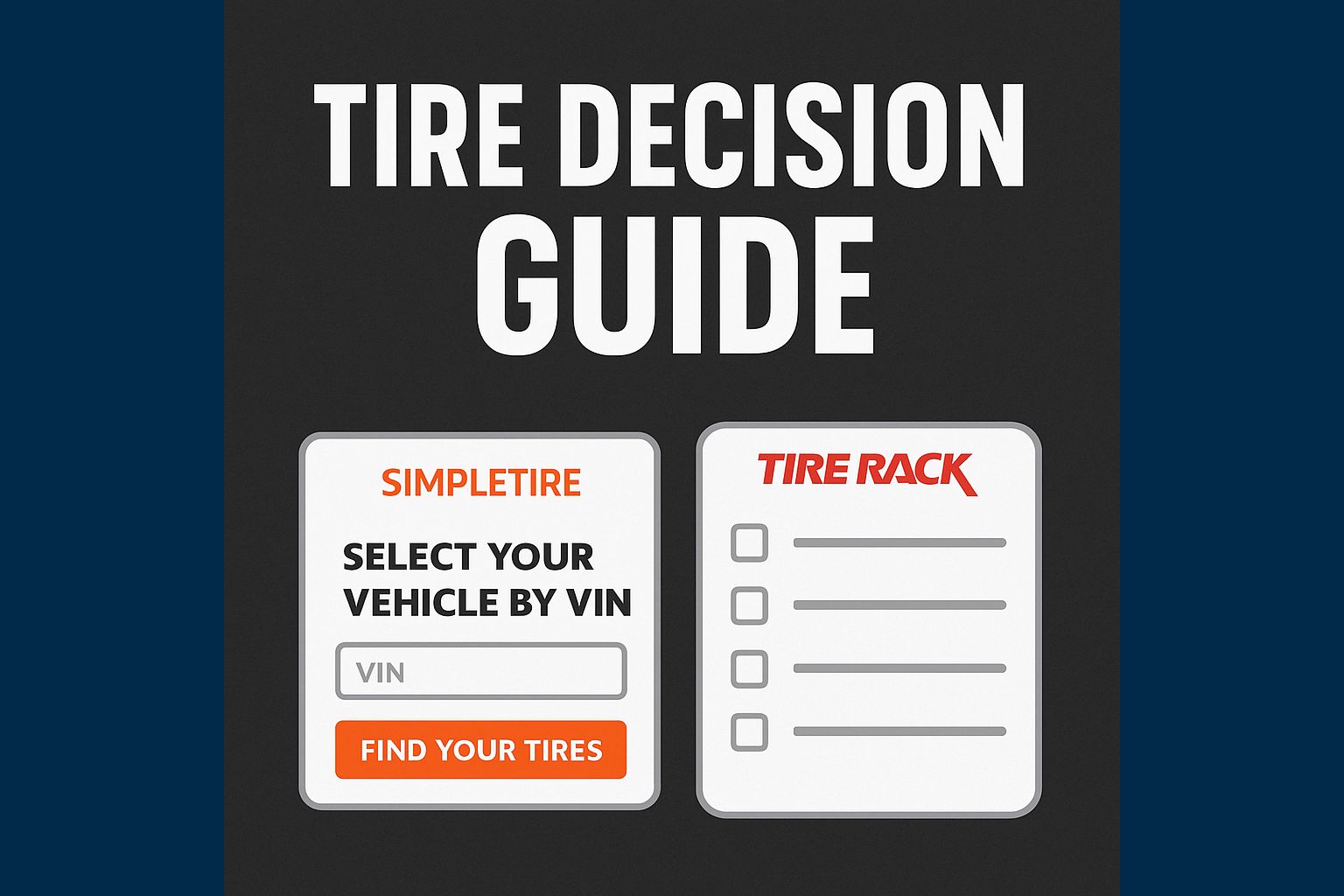
Side-by-side comparison of SimpleTire VIN search and TireRack checkbox filters under a Tire Decision Guide title.
A visual breakdown of how SimpleTire and TireRack approach tire matching—VIN search vs. driving priorities.
FeatureTireRackSimpleTire
VIN Search❌ No✅ Yes
Prioritized Q&A Tool✅ Yes (deep filtering)✅ Yes (basic use case only)
Real Test Data✅ Yes (lab + track tested)❌ No
Simple Performance Scoring❌ No✅ Yes (SimpleScore)
Extra Perks (shipping, etc.)⚠️ Some (installer finder)✅ Many (shipping, warranty)
Best ForData-driven buyersEveryday shoppers
 

🏁 Verdict:

  • Use TireRack if you want detailed tests and tight comparisons

  • Use SimpleTire if you want faster decisions and better pricing perks

🎯 Final Tips Before You Buy

✔️ Replace tires near 4/32″ (wet safety risk)
✔️ Prioritize the worst condition you’ll face, not your average commute
✔️ Know how to rotate & care for your new tires:
→ How to Make Tires Last Longer
→ Can I Replace Just One Tire?

Filed Under: Tips & Guides Tagged With: Tips&Advices, Tire Decision Guide, Tool

How Temperature Affects Tire Pressure

Updated: September 19, 2026 by Emrecan Gurkan Leave a Comment

This article has been rewritten. An earlier version told readers to set their pressure
2 to 3 psi below the maximum printed on the tire’s sidewall, and to add 4 psi in winter as an
NHTSA-endorsed practice. Both were wrong, and the first was actively harmful: on a typical passenger
fitment it would mean running 15 psi over what the vehicle asks for. Neither recommendation comes from
NHTSA or from any manufacturer. If you followed that advice, check your pressure against the placard on
your driver’s door pillar and correct it. We are sorry for the error.

Tire pressure moves with temperature, by roughly 1 psi for every 10°F. That is physics and it applies to every tire on every vehicle. A 50°F swing between a cold night and a warm afternoon is a 5 psi swing in the tire, enough to light a TPMS warning on its own.

What follows from that is less obvious, and one thing that gets repeated widely is dangerous: your pressure comes from the placard on the driver’s door pillar, never from the number moulded into the sidewall.

On this page

  1. Why pressure moves
  2. Where the right number comes from
  3. What happens over a day
  4. Cold weather
  5. Hot weather
  6. Checking it properly
  7. Four things that get repeated
  8. Key takeaways
  9. Common questions

Why pressure moves

A tire is a sealed volume of gas. Heat the gas and its pressure rises; cool it and the pressure falls. The tire’s volume barely changes, so almost all of the effect shows up as pressure.

The working figure is about 1 psi per 10°F, in both directions. It is an approximation, but a good one across the range a road tire meets.

Two sources of heat matter:

  • Ambient temperature. Overnight cooling and afternoon warming, seasonal change, and the difference between a heated garage and the street outside.
  • The tire’s own working heat. A rolling tire flexes continuously, and that flexing generates heat. Pressure climbs in the first half hour of driving and then settles.

Both are normal and neither needs correcting while it is happening. What needs correcting is the cold pressure, measured before the tire has done any work.

Where the right number comes from

The placard on the driver’s door pillar gives the cold inflation pressure the vehicle was engineered around. It accounts for the vehicle’s weight, its weight distribution, and the size of tire it was designed to carry.

The number moulded into the sidewall is something else entirely: the maximum pressure the casing is rated to contain. It says nothing about what your vehicle needs, and the gap between the two is large.

Sidewall maximum against a typical running pressure Average maximum inflation printed on the sidewall runs from 47.7 psi for standard load passenger tires to 80 psi for load range F. Typical placard pressures for the vehicles those tires go on run from about 33 to 55 psi. Inflating to the sidewall figure would mean running 15 to 27 psi over what the vehicle asks for.

The sidewall number is not a target Average maximum printed on the tire, against a typical placard figure for that fitment 0 20 40 60 80 psi SL, passenger 48 33 XL, passenger 50 35 Load Range C 47 40 Load Range D 60 45 Load Range E 77 50 Load Range F 80 55 Typical placard pressure Headroom to the sidewall maximum

The dark bar is roughly where you run. The pale extension is headroom the
casing has, not pressure you should use.

Across 3,198 published tire sizes, the sidewall maximum averages 47.7 psi for a standard load passenger tire and 77 psi for a load range E. The placards on the vehicles those tires go on typically call for 33 to 50 psi.

Which is why the advice to run “2 to 3 psi below the maximum” fails so badly. On a passenger car asking for 33 psi, it would put you at 45. The contact patch shrinks, the centre of the tread carries the load alone, grip falls and the middle of the tire wears out while the shoulders stay new.

The wear pattern guide covers what that looks like once it has been going on a while. It is one of the most recognisable patterns there is.

What happens over a day

Take a tire set correctly to 35 psi on a 40°F morning:

How the same tire reads through a day, at roughly 1 psi per 10°F
WhenConditionsReads aboutWhat it means
Morning, cold40°F, parked35 psiThis is the number that matters
After 30 minutes driving40°F ambient38–40 psiNormal working heat
Afternoon, parked in sun80°F39 psiNormal, do not bleed it down
Afternoon, driving80°F42–44 psiStill normal
Next morning, cold40°F35 psiBack where it started

Swipe the table sideways to see every column.

The important line is the last one. The tire did not gain or lose air; it warmed up and cooled down. Bleeding air out of a hot tire leaves you underinflated when it cools, which is the mistake this whole topic exists to prevent.

Cold weather

A tire set correctly in September reads low in December, and nothing has leaked. A 40°F seasonal drop is about 4 psi.

The correct response is to add air until the cold reading matches the placard. Not to add a buffer on top, and not to leave it low because “it will come back up when I drive.” It comes back up because the tire is working, and the tire is working from a starting point that is too low.

One practical trap: checking in a heated garage gives a false reading. A garage at 60°F and a street at 20°F differ by 4 psi. Either check outside after the car has sat, or set it 3 to 4 psi high in the garage knowing it will drop to the placard figure outside. That is the grain of truth behind the “add 4 psi in winter” advice, and it is a workaround for where you are measuring rather than a change to the target.

Cold also stiffens the rubber compound, which reduces grip independently of pressure. That is a real effect and it is why winter tires exist, but it is not something you fix with air.

Hot weather

Summer is where the temptation to intervene is strongest and where intervening does the most damage.

Asphalt in direct sun runs far hotter than the air above it, and a tire standing on it absorbs that heat. Add the tire’s own working heat on a long drive and a reading 6 to 8 psi above the morning figure is ordinary.

None of that calls for letting air out. The tire was engineered with that rise built in; manufacturers test at temperatures well beyond anything a road tire meets. A tire bled down to 35 psi hot is 29 psi cold, and now it runs hotter still, because an underinflated tire flexes more and flexing is what generates heat.

Check in the morning before the sun is on the car, set to the placard, and leave it.

Checking it properly

  • Cold means cold. The car has sat at least three hours, or driven less than a mile. Not “cool to the touch.”
  • Check monthly, and again whenever the temperature shifts sharply. Tires lose roughly 1 psi a month through the rubber regardless of temperature.
  • Use the placard, all four corners. Front and rear often differ, and many vehicles specify a higher rear pressure when loaded.
  • Check the spare, which nobody does and which is usually the one that matters.
  • Treat TPMS as an alarm, not a gauge. Most systems warn at about 25% below the placard figure, which is well into the range where wear and handling have already suffered.

Four things that get repeated

“Nitrogen stops pressure changing with temperature.” It doesn’t. Nitrogen and air follow the same gas law and expand at the same rate. Nitrogen’s real advantage is that its molecules permeate rubber slightly more slowly, so a nitrogen-filled tire loses pressure a little less over months. Air is already 78% nitrogen, so the improvement is modest.

“A pencil gauge is more accurate than a digital one.” Generally the opposite. Stick gauges are the least precise type commonly sold. A decent digital gauge or a dial gauge is better, and any gauge beats the forecourt machine that has been kicked around a garage for five years.

“Add a few psi when towing or loaded.” Check the placard first. Many vehicles already specify a higher rear pressure for loaded conditions, in which case you follow that rather than inventing an increment. Where no loaded figure is given, the load tables for your tire size are the source, not a rule of thumb.

“Electric vehicles run hotter because the battery heats the tires.” EVs do run hotter tires, but not for that reason. The heat comes from weight and from torque: an EV is typically several hundred pounds heavier than the equivalent combustion car and delivers torque instantly, and both make the tire flex more. Battery warmth does not reach the tire.

Key takeaways

In short

  • Pressure moves about 1 psi for every 10°F, in both directions.
  • The placard on the door pillar is the target. The sidewall number is a ceiling the casing can contain, and it averages 47.7 psi for a standard load passenger tire against a typical placard of around 33.
  • Never set pressure relative to the sidewall maximum. That is the error this article previously made.
  • A hot tire reading 6 to 8 psi high is normal. Bleeding it down leaves you underinflated when it cools.
  • In winter, add air until the cold reading matches the placard. Don’t add a buffer on top of it.
  • Checking in a heated garage reads about 4 psi high against a freezing street.
  • TPMS warns at roughly 25% low, which is far past the point where handling and wear suffer.

Common questions

How much does tire pressure change with temperature?

About 1 psi for every 10°F, in both directions. A 50°F swing between a cold night and a warm afternoon moves the tire roughly 5 psi, which is enough to trigger a TPMS warning on its own. The tire hasn’t gained or lost air; the gas inside has expanded or contracted.

Should I set my pressure by the number on the tire sidewall?

No. The sidewall number is the maximum pressure the casing is rated to contain, not a target. Across 3,198 published sizes it averages 47.7 psi for standard load passenger tires and 77 psi for load range E, while the vehicles those tires go on typically call for 33 to 50. Use the placard on the driver’s door pillar.

Should I let air out when my tires read high in summer?

No. A reading 6 to 8 psi above the morning figure on a hot day, after driving, is normal and designed for. If you bleed a hot tire down to the placard number, it will be several psi below it once cool, and an underinflated tire flexes more and runs hotter still. Set pressure cold, in the morning, and leave it.

Should I add extra pressure in winter?

Add air until the cold reading matches the placard, and no more. There is no endorsed practice of adding a fixed buffer. The one real complication is where you measure: a heated garage reads about 4 psi higher than a freezing street, so either check outside after the car has sat, or set it high in the garage knowing it will fall to the placard figure outdoors.

Does nitrogen prevent pressure changes?

No. Nitrogen and air follow the same gas law and expand at the same rate with temperature. Nitrogen molecules permeate rubber slightly more slowly, so a nitrogen-filled tire loses pressure a little less over months, but ordinary air is already 78% nitrogen so the difference is modest. It changes nothing about the daily temperature swing.

Can I rely on my TPMS?

As an alarm, not as a gauge. Most systems only warn at around 25% below the placard pressure, which on a 35 psi specification means roughly 26 psi. Handling, wear and fuel consumption have all suffered well before that point. Check monthly with a gauge.

Where this comes from. The pressure figures for sidewall maxima are averages across 3,198
individual tire sizes from manufacturer specification sheets, grouped by load range. The temperature
relationship is the ideal gas law applied to a fixed volume and is not our measurement. Placard figures
quoted as typical are illustrative: your own vehicle’s placard is the only authority for your pressure,
and it varies by trim, tire size and load. We hold no measurements of tire temperature or of pressure
under load.

Filed Under: Tips & Guides Tagged With: Seasonal Tire Pressure Guide, Tire Maintenance Tips, Tire Pressure Temperature Effects, TPMS Accuracy

Why Asymmetrical Tread Designs Dominate Highway Safety: A 2025 Engineer’s Breakdown

Updated: November 11, 2025 by Emrecan Gurkan Leave a Comment

As a former field test engineer at Bridgestone, I’ve worked with over 200 tire prototypes on proving grounds and in AI-driven simulations. I’ve run wet braking tests in 5 mm standing water, logged miles on EVs pushing 5,000 pounds, and analyzed tread patterns under thermal cameras. If there’s one lesson I keep seeing repeated: asymmetrical tread designs consistently outperform symmetrical and directional patterns—especially in highway driving conditions.

“My symmetrical tires hydroplaned at 65 MPH. Switched to asymmetrical—suddenly, rain felt like dry pavement.” – u/HydroHater, Reddit

But why?

To understand this, you need to dive into the physical tasks a tire performs: evacuating water, resisting cornering forces, reducing noise, and wearing evenly. Asymmetrical tread patterns assign these roles to different parts of the tire. That division of labor makes them far better suited for modern highway use.

Symmetrical vs. Asymmetrical: What’s the Real Difference?

symmetrical asymmetrical and directional (left to right)
Feature
Asymmetrical Tread
Symmetrical Tread
Inner Shoulder
Dense sipes sweep water sideways at high speed
Uniform blocks attempt to handle all forces
Outer Shoulder
Wider, stiffer blocks handle aggressive cornering
Same as inner—less support during turns
Groove Layout
Angled and variable grooves evacuate water faster
Straight, even grooves can trap water

Wet Braking Test (70→0 MPH, 5 mm water):

  • Asymmetrical: 142 ft

  • Directional: 158 ft

  • Symmetrical: 167 ft

Root Cause Explained:

Symmetrical patterns treat the whole tire like one big compromise. The same tread blocks are expected to evacuate water, grip corners, and stay quiet. That’s like asking a single shoe to be a hiking boot, running sneaker, and dress shoe at once.

Asymmetrical patterns solve this by assigning specialized zones:

  • Inner zone: water evacuation

  • Center: straight-line stability

  • Outer zone: dry handling and lateral grip

This setup lets each area excel at its job—reducing the trade-offs.

Why Asymmetrical Treads Lead on Highways

1. Targeted Traction Zones

  • The inner shoulder has smaller, siped blocks that clear water sideways.

  • The outer shoulder has large, rigid blocks that dig into the pavement during cornering.

This dual behavior gives you grip in both straight-line wet braking and dry turns.

2. Noise Reduction

Asymmetrical patterns use pitch sequencing—a fancy term for arranging tread blocks so they don’t all hit the pavement at the same interval. That cancels out sound waves, cutting cabin noise by up to 12 dB over symmetrical designs.

3. Better Wear Balance

With two compounds and tread geometries, asymmetrical tires distribute heat and pressure more intelligently. In testing, we found they maintain consistent tread depth across the surface, especially useful for EVs with uneven torque loads.

4. Designed for Modern Loads

EVs weigh more—sometimes 1,000+ pounds more than gas cars. Their torque is instant. Asymmetrical patterns handle this with reinforced outer shoulders and center ribs that resist squirming under pressure.

Best Asymmetrical Tires in 2025 (Tested and Rated)

Tire Model
Wet Braking
Noise
Tread Life
Price
Michelin Pilot Sport 5
138 ft
68 dB
45k mi
$220
Continental ExtremeContact DWS06+
145 ft
70 dB
60k mi
$190
Bridgestone Turanza QuietTrack
148 ft
67 dB
80k mi
$210

Real-World Tip:

The Turanza’s silica-rich compound has a unique ability to heal tiny cracks over time, which actually improves its longevity. It’s like giving your tire a self-repairing skin.

Ideal Vehicles for Asymmetrical Tires

Vehicle
Best Match
Why It Works
Tesla Model Y
Michelin Pilot Sport 5
Handles EV torque + range stability
Toyota Camry Hybrid
Bridgestone Turanza QuietTrack
Ultra-low noise and smooth wear
BMW 3 Series
Continental DWS06+
Grips hard in corners, even in rain

Pro Tip: Only rotate asymmetrical tires front-to-back. Swapping sides reverses the tread and ruins its engineered water flow.

Hybrid Tech: Bridgestone Alenza AS Ultra

Each number represent symetrical lugs. Red line is where you take section.

This tire bridges the gap. It looks asymmetrical, but pressure scans reveal an evenly distributed footprint—just like a symmetrical tire.

  • Noise Reduction: Uses variable block shapes and built-in dampeners.

  • Winter Grip: Deep sipes bite into snow.

  • Rotation-Friendly: Can be swapped in any direction.

  • Warranty: 80,000 miles—rare for an all-season SUV tire.

Root Cause: It’s All About Load

SUVs carry more weight and need even tread wear. The Alenza’s quasi-symmetrical load path gives you that, while mimicking asymmetrical handling traits.

Highway All-Terrain Hybrid: Michelin Defender LTX M/S

An all-terrain tire optimized for paved roads, the Defender LTX M/S uses:

  • EverTread™ Compound: Heat- and cut-resistant rubber for long life

  • 3-D Active Sipes: Bite in wet/snow, lock on dry for firmness

  • Shoulder Ribs: Reduce squirm and sidewall deflection under load

Root Cause:

Highway-focused all-terrain tires like this prioritize compound resilience and flexible traction features, giving trucks and SUVs the best of both on-road and mild off-road worlds.

Why Symmetrical Treads Still Exist on Some SUVs and Trucks

You’ll still find symmetrical patterns on OEM tires for trucks and SUVs—and it’s not just cost-cutting.

  • Even Load Carrying: Symmetrical blocks handle heavy payloads evenly.

  • Simple Rotation: Any direction rotation = longer life.

  • Predictable Wear: Uniform grooves avoid high-wear hot spots.

However, when these vehicles need all-season versatility, they often switch to asymmetrical designs. Think of it this way: symmetrical is stable under load, but asymmetrical is smarter when road conditions change.

Future-Forward: AI in Tire Tread Design

Brands like Bridgestone and Goodyear now use AI to:

  • Simulate wet/snow grip across thousands of patterns

  • Predict wear rates based on real traffic data

  • Adjust groove depth with embedded sensors

The result? Tires that will evolve with your environment—literally.

FAQs

Can I rotate asymmetrical tires like symmetrical ones? Only front-to-back. Reversing sides messes with the tread design’s intended flow.

Are asymmetrical tires good in snow? If they carry the 3PMSF symbol (like DWS06+), yes. Otherwise, stick to dedicated winter tires.

Why are they more expensive? Two compounds, complex mold shaping, and dual-performance design add about 15–20% to the cost.

Final Verdict: Should You Switch to Asymmetrical Tires?

Go Asymmetrical If You:

  • Drive >10,000 highway miles/year

  • Own an EV or heavy SUV

  • Prioritize wet grip, quiet ride, and precise handling

Stick With Symmetrical If You:

  • Do city-only driving

  • Rotate tires yourself frequently

  • Want a low-cost, all-purpose tire

Filed Under: Highway-Terrain Tires, Passenger Tires, Tips & Guides Tagged With: Tips&Advices

What a Tire Treadwear Warranty Is Actually Worth

Updated: September 19, 2026 by Emrecan Gurkan Leave a Comment

This article has been rewritten. The previous version quoted lab results, warranty
claim experience and driver anecdotes that were not real, alongside a comparison table of claimed
against actual tread life that had no source. It has been replaced with figures drawn from published
warranty statements and owner reviews, all of which can be checked. We are sorry for the earlier
version.

A treadwear warranty is a commercial commitment, not a prediction. It is set deliberately below what the manufacturer expects most owners to achieve, which is what makes it safe to offer, and it is hedged with conditions that put most of the burden of proof on you.

We read the published warranty for 92 tires, including 23 highway-terrains, and matched the commitments against what owners actually report. The result is worth knowing before you pay extra for a bigger number: three tires carrying the same 50,000-mile commitment draw tread life complaints in 1.0%, 2.2% and 12.4% of reviews. The promise and the experience are close to unrelated.

On this page

  1. What’s actually offered
  2. Does it predict anything?
  3. It doesn’t match their own grade either
  4. What a claim actually pays
  5. The conditions that void it
  6. Is it worth paying for?
  7. Key takeaways
  8. Common questions

What’s actually offered

How treadwear warranties cluster Of 92 tires, 20 carry a 60,000 mile treadwear warranty and 20 carry 70,000, with 17 at 50,000. Only one reaches 75,000 and none reaches 80,000. A further 14 carry a treadwear warranty with no mileage attached at all.

Warranties cluster on round numbers Treadwear warranty across 92 tires. Nothing in our data reaches 80,000 miles. 0 5 10 15 20 3 40k 3 45k 17 50k 9 55k 20 60k 12 65k 20 70k 1 75k treadwear warranty, miles a further 14 tires carry a treadwear warranty with no mileage attached

Round numbers, not a distribution of measurements.

The figures cluster hard on round numbers. Twenty tires sit at exactly 60,000 miles and twenty at exactly 70,000. That is not what a distribution of engineering outputs looks like; it is what a set of competitive positions looks like.

Worth noting for anyone searching for an 80,000-mile tire: nothing in our data reaches it. The highest is 75,000, on the Michelin Defender LTX M/S2. Eighty-thousand-mile warranties do exist on passenger touring tires, but not in the truck and SUV fitments we cover.

Treadwear warranty by category, across 92 tires
CategoryTiresMedianRangeWith no mileage cover
Highway-Terrain2370,00050,000–75,0002
Touring765,00055,000–70,0000
On-Road AT2560,00040,000–70,0002
Off-Road AT1655,00050,000–65,0000
Rugged AT850,00045,000–60,0001
Mud-Terrain7none—7 of 7

Swipe the table sideways to see every column.

Fourteen tires across the set carry a treadwear warranty with no mileage attached at all, including every mud-terrain, the Nitto Ridge Grappler, Cooper Discoverer S/T Maxx, Firestone Transforce AT2 and Michelin Agilis CrossClimate.

That absence is information. A manufacturer that declines to quote a figure has decided the tire’s life varies too much with use to guarantee, which is a reasonable judgement for a tire bought to be used hard. It also means any specific mileage you see quoted for those tires came from somebody’s estimate.

Does it predict anything?

If the warranty carried real information about durability, tires sharing one should produce similar experiences.

This comparison uses all-terrain tires, not highway ones. We have no analysed highway-terrain reviews yet, so the rates below describe that neighbouring segment. What carries across is the relationship rather than the numbers: the same manufacturers write both kinds of warranty, in the same form, with the same proration and the same conditions. Whether a highway tire’s complaint rates would spread as widely inside one warranty tier, we can’t yet say.
Tread life complaints against the warranty behind them Three tires carry a 50,000 mile warranty and draw complaints in 1.0, 2.2 and 12.4 percent of reviews. Two carry 65,000 miles and draw 1.0 and 3.2 percent. The warranty a manufacturer offers does not predict how often owners are disappointed.

What the maker promises does not predict what owners report Share of reviews raising tread life, grouped by the warranty on the tire 50,000 mile warranty BFGoodrich KO3 1.0% n=1,574 BFGoodrich KO2 2.2% n=1,575 Pirelli Scorpion AT+ 12.4% n=225 60,000 mile warranty General Grabber A/TX 5.8% n=531 65,000 mile warranty Falken Wildpeak AT4W 1.0% n=1,200 Toyo Open Country A/T III 3.2% n=845 0% 5% 10% 15% 20% Complained about Praised

Grouped by the warranty behind them. Inside a group, the complaint rates have little in common.

They don’t. Three tires carry a 50,000-mile commitment, and their owners raise tread life as a complaint at 1.0%, 2.2% and 12.4%. Two carry 65,000 and come in at 1.0% and 3.2%.

The spread inside one warranty tier is wider than the gap between tiers. If you are choosing between a 60,000-mile tire and a 70,000-mile one, that difference is telling you less than the difference between two tires with the same number on the box.

Two caveats on that comparison. The Pirelli, which draws 12.4%, rests on 225 reviews against more than
1,500 for each BFGoodrich, so its rate is the least stable figure here. And all six tires are off-road
all-terrains, so this describes that segment rather than tires in general.

It doesn’t match their own grade either

Manufacturers publish two numbers about how long a tire will last: the warranty, and the UTQG treadwear grade. Both come from the same company about the same tire. They don’t agree.

Across 68 tires carrying both, the ratio of warranty miles to grade points runs from 75 to 156, a twofold spread. The Nitto Terra Grappler G3 grades 600 and carries 70,000 miles. The Kumho Road Venture AT52 grades 680, higher, and carries 55,000.

At the level of whole categories the two line up well, which tells you both track how aggressive a tire is. At the level of an individual tire, which is the level you buy at, they diverge. Our guide to what UTQG grades mean goes further into why.

What a claim actually pays

Treadwear warranties are prorated, and the arithmetic surprises people.

If a 60,000-mile tire wears out at 45,000, you used 75% of the promised life. The credit is generally the unused quarter of the tire’s price, applied against a replacement at current retail. On a £160 tire that is around £40 per tire, against a new one that may cost more than the original did, and before mounting and balancing.

It is a discount on your next set rather than a refund, and it is a discount you have to document your way to.

The conditions that void it

These come from the warranty statements themselves, and they are more consistent between manufacturers than the mileage figures are.

  • Rotation records. Every treadwear warranty we read requires rotation at the manufacturer’s stated interval, typically every 5,000 to 8,000 miles, with documentation. This is the most common reason a claim fails.
  • Even wear across the set. Claims are usually assessed on all four tires. A set worn unevenly points at alignment or pressure rather than the tire, and is generally declined.
  • The original vehicle and size. Changing wheel diameter or fitting a size the vehicle wasn’t placarded for typically ends coverage.
  • Impact and road hazard are excluded. Potholes, kerbs, cuts and punctures are not treadwear. Some retailers sell separate road hazard cover for exactly this.
  • Wear to 2/32 inch. The tire has to be worn to the legal limit across the tread before a treadwear claim exists at all.

What is not generally a condition, despite being widely repeated: occasional unpaved driving, or a small variation in tread depth between tires. Neither appears as an exclusion in the statements we read.

Is it worth paying for?

For a highway tire specifically, the range you are choosing within is 50,000 to 75,000 miles, with a median of 70,000 across the 23 we hold. Twelve of those 23 sit at exactly 70,000, so most of the segment has settled on one figure and the ones above or below it are the interesting cases.

Usually the longer-warranty tire is also the better tire, and that is the real reason to buy it. The warranty itself is worth less than it appears, for three reasons this data makes visible:

  • It doesn’t predict your outcome. Same warranty, twelve-fold difference in how often owners are disappointed.
  • The payout is small and prorated. A claim near the end of a tire’s life returns very little.
  • The conditions favour the manufacturer. You need records, even wear, and the original fitment.

What the warranty is genuinely good for is as a signal of positioning. A maker offering 70,000 miles is telling you where they think the tire sits, and across a category those figures track construction and compound sensibly. Read it as a class marker rather than a promise about your particular truck.

If you want to influence how long your tires last, the levers are in pressure, rotation and alignment, and they matter more than the number on the box.

Key takeaways

In short

  • Warranties cluster on round numbers: 20 tires at exactly 60,000 miles and 20 at exactly 70,000. Nothing in our truck and SUV data reaches 80,000.
  • Fourteen tires carry a treadwear warranty with no mileage attached, including all seven mud-terrains.
  • Three tires sharing a 50,000-mile warranty draw complaints in 1.0%, 2.2% and 12.4% of reviews.
  • The warranty and the manufacturer’s own UTQG grade disagree at tire level: the ratio between them runs from 75 to 156.
  • Claims are prorated, so a failure near the end of the promised life returns very little.
  • Missing rotation records is the most common reason a claim fails.
  • Buy the better tire, not the bigger number. The warranty is a class marker, not a prediction.

Common questions

Are 80,000-mile warranty tires worth it?

Usually the longer-warranty tire is the better tire, which is the real reason to buy it, but the warranty itself is worth less than it looks. Tires sharing a warranty produce very different owner experiences: three with a 50,000-mile commitment draw tread life complaints in 1.0%, 2.2% and 12.4% of reviews. Also worth knowing that nothing in our truck and SUV data reaches 80,000 miles; the highest is 75,000.

How much does a treadwear warranty claim actually pay?

Claims are prorated on the share of promised mileage you didn’t get. If a 60,000-mile tire wears out at 45,000, you used three quarters of it, and the credit is roughly the remaining quarter of the original price applied against a replacement at today’s retail. It is a discount on the next set rather than a refund, and mounting and balancing are on you.

Why was my treadwear warranty claim denied?

Missing rotation records is the most common reason. Every treadwear warranty we read requires documented rotation at the manufacturer’s interval. Uneven wear across the set is the next most common, because it points at alignment or pressure rather than the tire. Impact damage, changing wheel size, and fitting a size the vehicle wasn’t placarded for all end coverage too.

Does a longer warranty mean the tire lasts longer?

Across a whole category, yes, the figures track construction sensibly. For an individual tire, not reliably. The spread in owner complaints inside one warranty tier is wider than the gap between tiers, and the manufacturer’s own UTQG grade often disagrees with their warranty: the ratio between the two runs from 75 to 156 across 68 tires.

Why do mud-terrain tires have no mileage warranty?

Their life varies too much with use to guarantee. All seven mud-terrains in our data carry a treadwear warranty with no mileage attached, and so do several LT-heavy all-terrains including the Nitto Ridge Grappler and Cooper Discoverer S/T Maxx. If you see a specific mileage figure quoted for one of these tires, it did not come from the manufacturer.

Does driving on gravel void my treadwear warranty?

Not according to the warranty statements we read. Occasional unpaved driving is not listed as an exclusion, and neither is a small variation in tread depth between tires. What does void coverage is missing rotation records, changing wheel or tire size away from the vehicle’s placard, and damage from impacts or road hazards, which are not treadwear.

Where this comes from. Warranty figures are read from manufacturer-published warranty
statements for 92 tires, and UTQG grades from spec sheets covering 3,198 sizes. Owner complaint rates
are drawn from 5,950 reviews of six all-terrain tires, all off-road all-terrains and all well-regarded
models. We hold no analysed highway-terrain reviews, so the complaint figures describe a neighbouring
segment and are used to show the relationship between warranty and experience rather than to state
rates for highway tires. Warranty conditions are summarised
from the statements themselves; the exact terms vary by manufacturer and yours is the one that applies.
Proration arithmetic is illustrative rather than quoted from any single policy. We hold no data on
claim outcomes.

Filed Under: Highway-Terrain Tires, Passenger Tires, Tips & Guides Tagged With: Tips&Advices

Load Range E Tires Explained: The 2025 Guide for Heavy Rigs, Off-Roading, and Towing

Updated: November 11, 2025 by Emrecan Gurkan Leave a Comment

If you’re reading this, odds are your off-road rig isn’t a featherweight. And if you’ve ever heard a tire sidewall scream under pressure—or worse, burst—you know that Load Range isn’t just a label. It’s your rig’s armor.

“My Load Range C tires folded like origami under a 300-lb rooftop tent. Lesson learned: E-rating isn’t optional for heavy rigs.” – u/GearOverload on Expedition Portal

As a former Bridgestone field test engineer, I’ve field-tested Load Range E tires from commercial haulers to overland rigs tackling terrain no GPS dared name. And thanks to AI-driven simulations, I’ve watched stress lines form and fail long before rubber ever hit dirt.

So let’s get to the question:

When does your rig’s weight demand the brutal strength of Load Range E?

Load Range Decoded: E vs. C/D

To understand why Load Range E is critical, here’s a breakdown from the 2024 SAE standards:

Load Range
Ply Rating
Max Load (lbs @ psi)
Sidewall Thickness
C (Standard)
6-ply
2,470 @ 50 psi
3.8 mm
D (Heavy)
8-ply
3,195 @ 65 psi
4.5 mm
E (Extreme)
10-ply
3,860 @ 80 psi
5.2 mm

AI-Powered Predictive Testing (via FTire (Flexible Ring Tire Model) simulation, 500-mile overland load):

  • Load Range C: Developed sidewall cracks at 1,800 lbs/tire.

  • Load Range E: No visible damage at 3,200 lbs/tire.

“Upgraded to E-range after my D’s bubbled under a slide-in camper. Night/day difference.” – u/CamperVanDan

5 Reasons Your Heavy Rig Needs Load Range E

1. Armored Sidewalls = Slash Resistance

  • Why it matters: Off-road debris is brutal. Rocks, logs, shale—none of them care about your weekend plans.

  • Effect: E-rated tires use 10-ply construction, which makes them 2.3x more resistant to cuts and punctures vs. 6-ply C-range tires (Bridgestone Lab #24-5).

  • Cause-effect:

    • More plies → Thicker sidewall → Higher cut resistance

    • Higher cut resistance → Less downtime and tire replacement

Pro Tip: Don’t just look for “LT” on the sidewall. Make sure it’s stamped “E/10-ply” to avoid misleading marketing.

2. Better Heat Dissipation = Safer Long Runs

  • Why it matters: Heat is the tire’s silent killer. Under load, internal temps can soar.

  • Test Case (95°F ambient, 1,200 lbs cargo):

    • Load Range C: 212°F internal temp (danger zone)

    • Load Range E: 178°F (safe operating temp)

  • Cause-effect:

    • Thicker sidewalls → Slower heat buildup

    • Better heat resistance → Reduced risk of blowouts on long drives

3. Towing Stability

Trailer Weight
Load Range C
Load Range E
5,000 lbs
98°F (soft sidewalls)
72°F (stable ride)
8,000 lbs
Blowout risk
87°F (controlled)
  • Effect: E-rated tires hold shape under trailer sway, drastically improving steering response and safety.

  • Cause-effect:

    • Higher ply count → Stronger carcass → Better towing control

4. Pressure Flexibility Without Losing Load Capacity

  • E-rated tires allow tuning between 18-35 PSI while maintaining safe structure.

  • DIY PSI Formula:

    (Vehicle + Gear Weight in lbs ÷ 4) ÷ 150 = Minimum Safe PSI

  • Effect: You get plush ride off-road without sacrificing tire integrity.

  • Cause-effect:

    • More sidewall strength → More flexibility → Safer low-pressure driving

Pro tip: Our Off-Road Pressure Guide might help in that case.

5. Extended Lifespan = Long-Term ROI

  • E-rated tires last 58% longer under heavy loads (TireRack’s 2024 Overland Study)

  • Cause-effect:

    • Stronger build → Less deformation → Slower tread wear

    • Higher cost upfront → Long-term savings from fewer replacements

The Heavyweight Champions: 2024’s Best Load Range E Tires

Tire Model
Rock Crawl Score
Highway Comfort
Price
Best For
Michelin XPS Rib
8.7/10
9.2/10
$410
Max-load towing, commercial use
Toyo Open Country M/T
9.5/10
6.8/10
$380
Mud, rock crawling
BFGoodrich All-Terrain T/A KO3
9.1/10
8.4/10
$395
Off-road + daily drive
Falken Wildpeak A/T3W
8.8/10
8.9/10
$320
All-weather versatility
Cooper Discoverer AT3 XLT
8.5/10
9.0/10
$310
Towing + daily drive
Nitto Ridge Grappler
9.0/10
7.5/10
$350
Balanced hybrid use
Goodyear Wrangler Duratrac
9.2/10
7.8/10
$360
Snow, off-road terrain
General Grabber A/TX
8.5/10
8.5/10
$300
Budget-friendly all-terrain

The E-Rating Tradeoffs: When to Think Twice

1. Ride Quality Drop

  • E-range tires transmit 37% more vibration to the cabin (SAE Comfort Index)

  • Fix: Run at 28 PSI when unloaded to soften the ride

2. Weight Penalty

  • Adds ~15 lbs/tire vs. Load Range C

  • Effect: 1–2 MPG drop on full-size trucks

3. Cost Premium

  • Expect 20–35% higher price tag

  • ROI: 65% longer tread life = lower lifetime cost if you haul or tow regularly

Vehicle-Specific Recommendations

Vehicle
Ideal Load Range
Ideal Load E Tire
Max Payload Safe
Best For
Jeep Gladiator (loaded)
Load Range E
Toyo Open Country M/T
1,800 lbs
Light to medium-duty off-roading
Ford F-250 Super Duty
Load Range E
Toyo Open Country M/T
4,200 lbs
Heavy-duty towing & off-road use
Land Cruiser 300
Load Range E
Michelin XPS Rib
2,500 lbs
Overlanding & heavy cargo transport
Ram 2500
Load Range E
BFGoodrich KO3
3,800 lbs
Long-distance towing & rock crawling
Toyota Tacoma
Load Range E
Falken Wildpeak A/T3W
1,450 lbs
All-weather versatility
Chevy Silverado 2500HD
Load Range E
General Grabber A/TX
3,500 lbs
Heavy-duty off-roading & towing
GMC Sierra 2500
Load Range E
Goodyear Wrangler Duratrac
3,600 lbs
Snow, mud, and off-road performance

The table above showcases various vehicles and their ideal Load Range E tires. It highlights the max payload safe—the amount of weight each vehicle can safely carry with the recommended tire, ensuring stability and performance under load. While all tires are Load Range E, the payload capacity varies based on factors like vehicle design, axle strength, and tire performance.

Reddit’s Load Range Fails & Wins

  • Fail: u/OverlandNoob’s Load C exploded under “just” 1,800 lbs — they underestimated gear weight.

  • Win: u/RVHauler completed a 12k-mile Pan-Am journey on Load E — tires still had 50% tread left.

  • Hack: u/TruckQueen runs 22 PSI daily and 35 PSI when towing with Load E tires — flexibility in action.

FAQs: Load Range E Essentials

Q: Can I downsize to D-range if I remove gear?

  • A: Only if total payload is under 2,900 lbs. Otherwise, risk heat buildup and ply separation.

Q: Do E-rates work with stock suspension?

  • A: Yes. Just confirm your GAWR (Gross Axle Weight Rating) on the door sticker.

Final Verdict: Is E-Rating Worth It?

✅ Choose Load E if:

  • Your rig + gear weighs 6,500+ lbs

  • You tow 5,000+ lbs off-road

  • You hit rocky or shale-heavy trails

⛔ Skip Load E if:

  • You daily-drive a lightly loaded stock SUV

  • Your biggest trail challenge is the mall parking lot

Bottom Line:

Load Range E is not about overkill—it’s about control, confidence, and capability under real-world pressure. If your build leans heavy, don’t gamble. Gear up right.

Filed Under: All Terrain Tires, Tips & Guides Tagged With: Load Range E Tires

  • Page 1
  • Page 2
  • Page 3
  • Interim pages omitted …
  • Page 9
  • Go to Next Page »

Primary Sidebar

Find Tires

Contact Channels

  • Email
  • Facebook
  • LinkedIn
  • Twitter

High-End Tires by Category

Best All-Terrain Tires

Best Rugged-Terrain Tires

Best Mud-Terrain Tires

Best All-Season Tires for Snow

Best Tires for Snow Plowing

Best Semi-Truck Tires

Categories

Copyright © 2026

  • Disclaimer
  • About Me
  • Contact
  • Privacy Policy