
Real-world test data, driver impressions, and technical breakdowns — from a former Bridgestone test engineer.
The Nitto Recon Grappler A/T sits in the Off-Road A/T category, designed for drivers who want everyday livability with a touch of trail readiness. With balanced wet grip, snow-certified 3PMSF traction, and a smoother ride than most aggressive A/Ts, it’s the more practical option in Nitto’s lineup for light trucks, SUVs, and Jeeps. The Nitto Ridge Grappler, by contrast, belongs to the Rugged-Terrain category — a hybrid between all-terrain and mud-terrain. It brings blockier tread, sharper dry-road handling, and extra bite in mud and sand, though it sacrifices some wet braking, icy grip, and day-to-day comfort in exchange for that extra aggression.
That’s the decision buyers face — Recon for balance and versatility vs Ridge for hybrid toughness and looks. In the sections ahead, I’ll break down how they compare across dry, wet, snow, and off-road testing. You can also line them up directly in our All-Terrain Tire Decision Tool for quick, vehicle-specific recommendations by SUV, CUV, or truck class.
🔍 Quick Look
Nitto Recon Grappler A/T

Nitto Ridge Grappler

The Nitto Ridge Grappler puts its best foot forward on dry roads and rugged trails. With a 130-ft stop and 0.75 g cornering, it bites harder and holds a firmer line than the Recon. Off-road, it’s built like a hammer, posting 9.0+ in dirt, mud, and rock, backed by blocky shoulders and a hybrid carcass that dig in when things get rough. Owners call it “locked in like a street tire” until tossed, and a “beast in mud.” The trade-off shows in the wet and winter, where its 203-ft wet stops and 55.7-ft ice stops demand extra margin and care. The Nitto Recon Grappler A/T, by contrast, is the calmer, safer everyday tire. Its 192-ft wet stop and 74-ft snow stop beat the Ridge, while a 46.5-ft ice stop highlights its safer edge in slick conditions. Drivers describe it as “predictable in commutes, no surprises,” with smoother ride quality (7.3/10 comfort). Recon isn’t weak off-road — mid-8 scores in dirt and mud prove it can handle trails and hunting roads — but it prioritizes civility, comfort, and wet/winter security over brute trail force. A tire tuned for balance and livability, especially in snowy or rainy regions.
Shop Smart: Compare Deals
Limited Time Offers – Updated Weekly
Raw Test Data
Tire Test Data
Pick categories to show metrics, then open ☰ to pick tires. Optional chart is hidden by default.
Dry Performance — Ridge more aggressive, Recon tuned for ride

Recon Grappler A/T stops at 138 ft with 0.72 g cornering, while Ridge Grappler clocks in around 130 ft / 0.75 g. On paper, Ridge has the better stopping distance and lateral grip. In real drive-feel, you notice Ridge eagerly bites into corner turn-in; Recon feels smoother, more tamed, less abrupt.
From forum discussions: several users say Recon “feels more highway friendly, quieter, less harsh” than Ridge. Others admit the Ridge looks tougher, with more aggressive tread blocks, and gives better performance when steering hard into curves.
Engineering angle: Ridge Grappler’s larger block edges and stiffer shoulder design mean quicker response in dry cornering and braking. Recon uses more moderate block shaping and smoother transitions to reduce vibration, improving ride comfort. Rubber compound differences: Ridge tends to use a more durable, possibly harder shoulder compound that resists squirm, whereas Recon’s rubbers are tuned more for compliance and road manners.
SUVs & crossovers: Recon more comfortable; Ridge more fun.
½-tons: Ridge stronger under load; Recon more pleasant for daily driving.
¾-tons & HD trucks: Ridge keeps control; Recon usable but less grip under heavy mass.
👉 Verdict: Ridge wins on raw dry grip; Recon wins livability on pavement.
Wet Performance — Recon safer, Ridge stretches long
Wet data flips the story. Ridge runs a 203 ft stop with 0.47 traction, while Recon shortens that to 192 ft with 0.43 traction. Neither matches road-focused A/Ts, but Recon delivers a safer margin when rain comes hard.
Community feedback reflects this: Ridge drivers admit it’s “fine if you leave plenty of space,” while Recon owners note it feels “a little less drama in the rain.” The reasoning is simple: Ridge is tuned for toughness, and that comes at the expense of adhesion. Recon’s compound keeps more rubber planted under braking, helping it pull up shorter even if cornering grip isn’t stellar.
SUVs & crossovers: Recon inspires more confidence.
½-tons: Recon gives safer braking, Ridge requires more margin.
¾-ton & HD: Recon steadies better in storms; Ridge needs respect.
👉 Verdict: Recon is the safer wet-weather pick; Ridge stretches braking distance.
Note from the Expert: When it comes to rain, I always emphasize two things: compound grip and water evacuation. You can see the full details in my analysis, but if you take just one thing away, remember that an AT tire’s stiff nature makes achieving top-tier wet performance a constant battle. This is why the question, Are All-Terrain Tires Good in Rain?, requires a nuanced answer that balances tread design against rubber stiffness.
Winter & Snow — Recon steadier, Ridge struggles more

Snow data favors Recon. It stops at 74 ft and accelerates in 45.5 ft, compared to Ridge’s 78 ft and 47.7 ft. In practice, that means Recon is the calmer tire on plowed or packed roads. Ridge, with its bigger voids, can dig in when snow is deep, but it slides longer when the road is icy or salted.
Forum voices match: Ridge drivers say it “powers through unplowed driveways” but feels loose once the roads are polished. Recon users note it’s “predictable on winter commutes, no surprises.” From my short drive, I’d agree — Ridge claws better in loose drifts, but Recon is the tire you want when you hit the brakes in traffic.
SUVs & crossovers: Recon better for daily snow routes.
½-tons: Ridge usable in powder, Recon safer in plowed city use.
¾-ton & HD: Recon steadies more predictably under weight.
👉 Verdict: Recon is the stronger winter choice for control; Ridge shines only in loose powder.
Note from the Expert: Our discussions often boil down to the core tradeoff. On one hand, you must understand why all-terrain tires are truly effective in deep snow, but not on ice. On the other hand, you face the 3PMSF Paradox—the hidden cost of that badge. The short answer is: The 3PMSF badge certifies traction, but it costs you durability. Dive into our full analysis on the critical 3PMSF rating for severe winter and off-road service, and its hidden costs, before you risk your rig on the trail.
Ice — Recon holds, Ridge slides
On ice, the data is clear. Recon stops in 46.5 ft, Ridge drags out to 55.7 ft. That’s the difference between keeping a straight line and sliding through an intersection.
Drivers back it up: Ridge owners warn “creep, don’t rush” in icy conditions. Recon fans say it “lets you brake without panic.” The explanation lies in siping — Recon’s tread keeps micro edges active, while Ridge’s blocky, durability-focused design sacrifices that bite.
SUVs & crossovers: Recon the safer choice.
½-tons: Recon gives braking confidence; Ridge less forgiving.
¾-ton & HD: Recon steadies under weight, Ridge can’t match it.
👉 Verdict: Recon beats Ridge clearly on ice security.
Off-Road — Ridge tougher, Recon versatile

Off-road is where Ridge reclaims ground. It scores 9.0 dirt / 8.5 sand / 9.3 mud / 9.2 rock, higher across the board than Recon’s 8.2 / 8.0 / 8.3 / 8.1. Ridge feels like it was born for mud and rock crawling — tougher sidewalls, deeper voids, and aggressive shoulders. Recon is still plenty capable, but it’s tuned more for a balance of on-road civility and weekend trail use.
Owners describe Ridge as “a beast in mud, with real bite on rocks.” Recon users say it’s “good for trails, gravel, and hunting roads — not extreme, but reliable.” From my perspective, Ridge’s hybrid build simply digs harder, while Recon favors balance over brute strength.
SUVs & crossovers: Recon’s versatility fits daily use; Ridge overbuilt.
½-tons: Ridge gives adventure-ready bite; Recon better for mixed daily/off-road.
¾-ton & HD: Ridge dominates heavy trail abuse.
👉 Verdict: Ridge is the tougher off-road partner; Recon trades some muscle for road comfort.
Note from the Expert: Every successful day on the trail is about preparation and physics, because tire longevity is earned, not given. Before you even start, you must master the critical link between tire pressure and load range for every rig to maximize your contact patch. Once moving, remember your ultimate off-road armor is your sidewall protection against the inevitable pinch flat. And finally, your traction on the obstacle is dictated by choosing the right aggressive vs hybrid tread pattern for your terrain. Master those three steps, and your rig will be ready for anything.
Comfort & Noise — Recon smoother, Ridge rougher
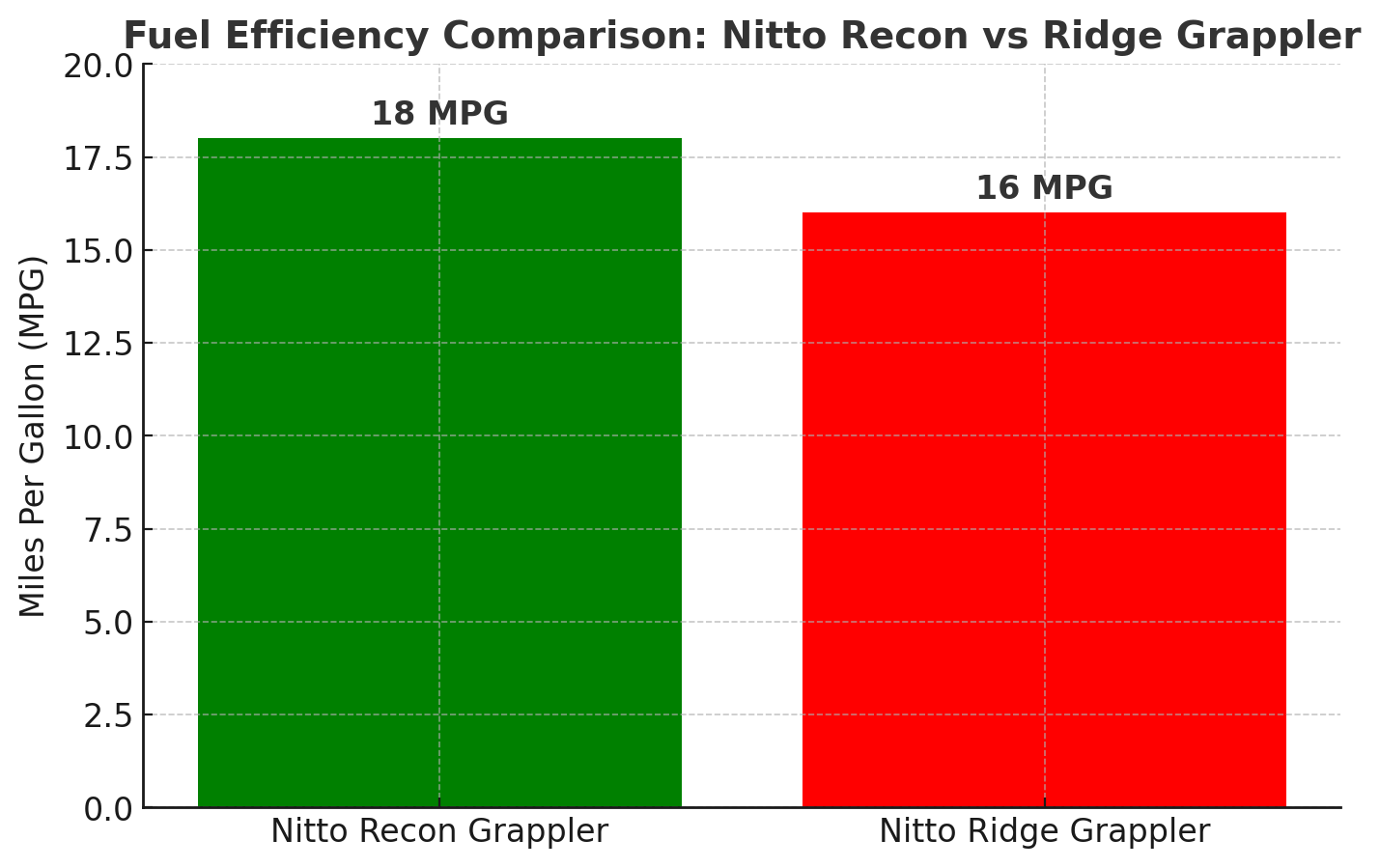
Comfort scores highlight the difference: Recon rates 7.3/10, Ridge lower at 6.8/10. Recon rides smoother, quieter, and feels less punishing on daily commutes. Ridge starts out relatively quiet for how it looks, but hums more as tread wears.
Community chatter: Recon is described as “civilized for a tough tire,” while Ridge owners note “quiet at first, louder over time.” The engineering trade-off is straightforward: Ridge’s aggressive voids and hybrid carcass hum louder, Recon’s lighter block design dampens road resonance.
SUVs & crossovers: Recon clearly wins for comfort.
½-tons: Recon smoother highway ride; Ridge acceptable but firmer.
¾-ton & HD: Ridge blends into background noise, but Recon still smoother.
👉 Verdict: Recon is more livable day-to-day; Ridge grows rougher with miles.
Note from the Expert: For years, choosing all-terrain meant accepting noise—a true compromise for off-road grip. That’s why the question, Are All-Terrain Tires Louder than Highway Tires?, used to have a simple “yes” answer. Now, with the rise of on-road models, the core issue has shifted from noise to overall refinement. To fully understand which side of the comfort spectrum you’re buying into, you need to determine Are All-Terrain Tires Good for Daily Driving?—a question that depends entirely on the tire’s construction, not just the name.
Longevity
Driver Feedback:
At ~15,000 miles, Recon showed even tread wear. Ridge, however, feathered its shoulders faster when rotation was skipped.
🧠 Root Cause:
Recon’s balanced tread stiffness prevents uneven wear. Ridge’s aggressive voids put stress on shoulders.
🏁 Verdict:
Recon is more rotation-friendly and longer-lasting. Ridge demands strict maintenance.
Where They Fit Best
Nitto Recon Grappler A/T: Best for drivers who want Nitto’s rugged styling but prioritize wet, winter, and ice security alongside comfort. A strong fit for SUVs and ½-ton trucks that see mixed conditions and mild trails, especially in snow-belt or rainy regions.
Nitto Ridge Grappler: The tougher hybrid for drivers who need serious off-road grip and sharper dry handling, and who don’t mind longer wet/ice stops or more cabin noise. Ideal for ½-ton and ¾-ton trucks in Southwest deserts, rocky trails, and mud-heavy terrain.
👉 Bottom line: Recon is the more balanced, winter-safe Nitto; Ridge is the aggressive hybrid built for off-road authority.
Tire Size Selection: The Basics You Can’t Skip
Even the best tread design can’t rescue a tire that’s built too weak. Back when I was testing tires at Bridgestone, I saw all-terrain models that should’ve performed but fell short — simply because the basics (size, load strength, and speed rating) weren’t matched to the vehicle.
P-Metric vs. LT (Light Truck) Tires
The first step is knowing whether you need LT or passenger tires. LT (Light Truck) tires are built with extra reinforcement and stiff sidewalls, designed for towing, hauling, or off-road use. Passenger (P-metric) tires are lighter, smoother, and tuned for daily comfort and fuel efficiency — but they’ll flex more under load.
Understanding Tire Load Range: XL vs. E-Load
Then comes the tire load index and load range — essentially your tire’s strength rating. Here’s where things split between passenger XL and LT E:
XL (Extra Load) is a passenger tire with reinforced sidewalls. It can handle a bit more pressure (~41 PSI) than a standard SL tire and is perfect for SUVs, crossovers, or light trucks that carry extra gear, passengers, or small trailers. XL tires ride softer and quieter than LT options, making them ideal for daily use.
E Load Range is an LT tire class built with a much thicker casing. E-rated tires can handle far more pressure (up to ~80 PSI) and heavier loads, which makes them essential for ¾-ton and 1-ton trucks towing trailers or hauling close to max capacity. The trade-off is weight, stiffer ride, more road noise, and a small drop in fuel efficiency.
Put simply: XL is for “extra luggage and family,” while E is for “truck bed full of bricks or a car trailer.”
Why the Tire Speed Rating Matters for Safety
Finally, don’t overlook the tire speed rating. It’s not just about top speed — it measures how well a tire handles heat and stress at highway pace. Lower ratings (like S) tend to ride softer and last longer, while higher ratings (H, T) feel more stable and responsive under sharp maneuvers. Heat build-up is the silent killer of tires, and speed rating is your safeguard.
Bottom line: Match your tire’s construction (LT vs P-metric), load range (XL vs E), and speed rating to your vehicle’s demands. Get those right, and everything else — off-road grip, winter traction, comfort — will finally perform the way it was designed to.
Final Verdict — Which Should You Buy?
If you want sharper steering and extreme off-road ability, the Nitto Ridge Grappler is the obvious choice. It excels in dirt, mud, and rocky terrain, feels planted when pushed on dry roads, and suits half-tons and heavier trucks in the Southwest, desert, or muddy backcountry. The cost is comfort, noise, and longer wet/ice stops.
For drivers who balance city commutes, winter safety, and mild off-road use, the Nitto Recon Grappler is the smarter fit. It stops shorter in rain, snow, and ice, rides smoother, and provides enough trail confidence for gravel, hunting roads, and light adventure. SUVs and ½-tons in the Snow Belt or rainy regions will find Recon the safer and easier daily choice.
Frequently Asked Questions: Nitto Ridge Grappler vs Nitto Recon Grappler A/T
Which tire has better dry performance?
Ridge Grappler, with a 130-ft stop and 0.75 g cornering, outperforms Recon’s 138 ft and 0.72 g in dry grip.How do they compare in wet conditions?
Recon stops shorter at 192 ft, while Ridge stretches to 203 ft, making Recon the safer wet-weather choice.Which tire is better in snow and ice?
Recon is stronger, with a 74-ft snow stop and 46.5-ft ice stop, compared to Ridge’s 78 ft in snow and 55.7 ft on ice.Which tire offers more off-road traction?
Ridge dominates off-road with scores around 9.0 in dirt, mud, and rock, while Recon averages in the low-8s.Which tire is more comfortable for daily driving?
Recon rides smoother and quieter with a 7.3/10 comfort score, while Ridge rates lower at 6.8/10 and grows noisier with miles.Who should buy the Nitto Recon Grappler A/T?
Drivers who want safer wet/winter handling, smoother comfort, and enough off-road versatility for light trails and mixed conditions.Who should buy the Nitto Ridge Grappler?
Drivers who prioritize dry grip and extreme off-road authority, and don’t mind louder road manners or longer wet/ice stops.
For those who prefer to see whole market analyze:
- https://tireterrain.com/best-all-terrain-tires/
- https://tireterrain.com/best-all-terrain-tires-for-snow/
- https://tireterrain.com/best-1-2-ton-truck-tires/
- https://tireterrain.com/best-3-4-ton-truck-tires/
- https://tireterrain.com/best-rt-tires/
- https://tireterrain.com/best-tires-for-snow-plowing/
- https://tireterrain.com/on-road-all-terrain-tires-highway/
A couple of popular size analyses:
- https://tireterrain.com/best-35x12-50r20-all-terrain-tires/
- https://tireterrain.com/best-285-70r17-all-terrain-tires/
- https://tireterrain.com/best-275-55r20-all-terrain-tires/
- https://tireterrain.com/best-275-65r18-all-terrain-tires/
Want to learn more about all-terrain tires:
- https://tireterrain.com/highway-tires-vs-all-terrain-vs-mud-terrain/
- https://tireterrain.com/all-season-vs-all-terrain-tires/
- https://tireterrain.com/tire-load-index-and-load-range/
- https://tireterrain.com/lt-tires-vs-passenger-tires/
- https://tireterrain.com/are-all-terrain-tires-good-for-daily-driving/
- https://tireterrain.com/are-all-terrain-tires-good-in-snow/
- https://tireterrain.com/are-all-terrain-tires-loud/
- https://tireterrain.com/how-long-do-all-terrain-tires-last/
- https://tireterrain.com/are-all-terrain-tires-good-in-rain/
- https://tireterrain.com/off-road-tire-pressure-load-range-for-every-rig/
Leave a Reply