• Skip to primary navigation
  • Skip to main content
  • Skip to primary sidebar

TireTerrain

  • Home
  • Comparisons & Reviews
  • All-Terrain Tire Decision Tool
  • Pro Tips
  • About

bf goodrich

Cooper AT Trail vs BFGoodrich KO3 — Comfort & Winter Grip vs Off-Road Durability in 2025

Updated: November 11, 2025 by Emrecan Gurkan Leave a Comment

Fresh BFGoodrich All-Terrain T/A KO3 tire stacked in a workshop, with size label LT285/70R17 visible, showcasing aggressive tread pattern for off-road and all-weather traction.
Fresh from the rack — BFGoodrich KO3, ready for your next adventure.

Real-world test data, driver impressions, and technical breakdowns — from a former Bridgestone test engineer.

The BFGoodrich KO3 is BFG’s newest Off-Road A/T tire, toughening the KO2’s proven formula with stronger sidewalls, better chip resistance, and enhanced cold-weather pliability. It’s snow-certified with the 3PMSF rating and built for serious four-season use under heavy loads, on sharp rock, and across rugged terrain. For the full evolution story, see my BFGoodrich KO3 vs KO2 breakdown. The Cooper Discoverer Road+ AT Trail, by contrast, is an On-Road A/T designed for daily-driven SUVs and crossovers. With its lighter construction, confident wet and ice traction, and smoother highway ride, it’s made for paved life with occasional dirt or gravel — not hardcore rock crawling.

That’s the decision most buyers face — KO3 for off-road toughness and load strength vs AT Trail for comfort-driven SUVs and light-duty versatility. In the sections ahead, I’ll show how they compare across dry, wet, snow, and off-road testing. You can also line them up in our All-Terrain Tire Decision Tool for quick recommendations by SUV, CUV, or truck class.

Quick Look

Cooper Discoverer Road + Trail AT

Cooper Discoverer Road + Trail AT tire
Tested Rating: 8.4/10

Trusted Retailers with Best Deals:

Tire Rack
Free road-hazard coverage Backed by Discount Tire
SimpleTire
Financing options Local installers
Amazon
Prime shipping Direct from brands

BFGoodrich All-Terrain T/A KO3

BFGoodrich KO3 tire
Tested Rating: 8.5/10

Trusted Retailers with Best Deals:

Tire Rack
Free road-hazard coverage Backed by Discount Tire
Amazon
Prime shipping Direct from brands

The Cooper AT Trail is the commuter-friendly all-terrain, feeling lighter to steer and quicker to stop on smaller rigs (132 ft, 0.74 g), with safer wet braking (167 ft, 0.53) than most in its class. It rides quiet and smooth (~9.0/10), almost like an OE highway tire disguised in A/T tread, and in light snow it hooks up early (71.5-ft stop, 42.5-ft launch). The BFGoodrich KO3, by contrast, is the durability-first workhorse — steadier under load, with better storm margin than hybrids (184-ft wet stop, 0.46), stronger on packed snow and ice (72.3-ft stop / 46.4-ft launch; 46.2-ft ice), and still the off-road benchmark (9.5 dirt / 9.5 sand / 9.2 mud / 9.5 rock). It rides firmer (~7.5/10) and needs more room in the rain, but it shrugs off the abuse that chews up softer A/Ts.

    Raw Test Data

    Tire Test Data

    Pick categories to show metrics, then open ☰ to pick tires. Optional chart is hidden by default.

    Parentheses show the rank among the currently displayed tires (1 = best for that metric).
    Left axis lists metrics. Top axis is used for g-force metrics so they scale clearly.
    Note: Lower is better for Stopping & Acceleration; higher is better for g-force, comfort, traction & off-road ratings. Parentheses show the rank among the currently displayed tires (1 = best for that metric).
    Sources worth checking
    Tire Rack AT Tire Test Tire Rack On-Road A/T Ratings Tire Rack Off-Road A/T Ratings SimpleTire Reviews Amazon SUV/LT Tires

    Dry Performance — KO3 steadier under weight, Cooper lighter on its feet

    The Cooper AT Trail comes in at 132 ft to stop with 0.74 g cornering, while the KO3 trails at 140 ft and 0.72 g. That gap shows up most on lighter trucks and crossovers—Cooper feels nimble and easy to place, while KO3 takes a little longer to respond. Once load is added, though, KO3’s broader shoulders and tougher carcass settle the chassis better.

    Owners reflect that split: AT Trail drivers say it “steers like a highway tire with A/T looks,” while KO3 users describe it as “calm and planted, even towing.” From an engineering seat, Cooper’s lighter construction and road-leaning tread keep it sharp for daily driving, while KO3’s stiff casing prioritizes weight stability.

    • SUVs & crossovers: Cooper feels quicker and easier to handle.

    • ½-ton trucks: Cooper sharper unloaded, KO3 steadier when trailers come into play.

    • ¾-ton & HD trucks: KO3 clearly the safer choice; Cooper isn’t designed for heavy-duty work.

    👉 Verdict: Cooper wins nimbleness for light rigs; KO3 wins composure under weight.

    Wet Performance — Cooper shorter, KO3 steadier

    In the wet, Cooper posts a 167-ft stop with 0.53 traction, KO3 longer at 184 ft with 0.46 traction. On paper, Cooper looks stronger, and on slick pavement it does feel more willing to bite sooner. KO3 stretches further, but it feels less nervous under a loaded chassis.

    Community voices reflect that. AT Trail owners say it’s “confident in rain as long as you don’t push it,” while KO3 drivers note “not sporty, but it keeps the truck straight even towing.” The why is simple: Cooper’s silica mix and siping improve adhesion, KO3 trades outright grip for toughness.

    • SUVs & crossovers: Cooper safer in daily downpours.

    • ½-ton trucks: Cooper for nimble rain handling, KO3 steadier once the truck is loaded.

    • ¾-ton & HD trucks: KO3 better margin; Cooper not built for that duty.

    👉 Verdict: Cooper leads wet grip for light rigs; KO3 steadies the picture for loaded trucks.

    Note from the Expert: When it comes to rain, I always emphasize two things: compound grip and water evacuation. You can see the full details in my analysis, but if you take just one thing away, remember that an AT tire’s stiff nature makes achieving top-tier wet performance a constant battle. This is why the question, Are All-Terrain Tires Good in Rain?, requires a nuanced answer that balances tread design against rubber stiffness.

    Winter & Snow — Cooper digs early, KO3 steadier on heavy rigs

    In snow, Cooper stops at 71.5 ft and launches in 42.5 ft, while KO3 lands at 72.3 ft and 46.4 ft. That means Cooper actually grabs a touch earlier, especially in lighter vehicles—it feels more like an all-weather tire in slush and shallow snow. KO3 isn’t far behind, but under heavy rigs it stays calmer and more predictable.

    Owners back this up. AT Trail drivers say it’s “better than expected for a commuter tire in snow,” while KO3 fans note “it doesn’t panic, even when towing in winter.” From a design standpoint, Cooper’s siping density helps on hardpack, KO3’s heavier carcass plants better under weight.

    • SUVs & crossovers: Cooper is the stronger snow commuter tire.

    • ½-ton trucks: Both usable; Cooper feels livelier, KO3 steadier in mixed use.

    • ¾-ton & HD trucks: KO3 clearly more confident.

    👉 Verdict: Cooper wins for light rigs in snow; KO3 steadier when weight is on board.

    Note from the Expert: Our discussions often boil down to the core tradeoff. On one hand, you must understand why all-terrain tires are truly effective in deep snow, but not on ice. On the other hand, you face the 3PMSF Paradox—the hidden cost of that badge. The short answer is: The 3PMSF badge certifies traction, but it costs you durability. Dive into our full analysis on the critical 3PMSF rating for severe winter and off-road service, and its hidden costs, before you risk your rig on the trail.

    Ice — Cooper edges it, KO3 steadier under pressure

    On glaze, Cooper stops at 44.4 ft, KO3 longer at 46.2 ft. That puts Cooper slightly ahead on raw numbers, especially noticeable on smaller vehicles. KO3, however, gives a slower, more predictable slide—easier to correct when the truck is heavy.

    Drivers sum it up well: Cooper is “surprisingly sure-footed for a daily-driver tire,” KO3 “isn’t magic on ice, but doesn’t surprise you.”

    • SUVs & crossovers: Cooper has the edge.

    • ½-ton trucks: Cooper for city mornings, KO3 safer on rural heavy runs.

    • ¾-ton & HD trucks: KO3 more composed overall.

    👉 Verdict: Cooper grips a touch better unloaded; KO3 gives steadier feedback on bigger trucks.

    Off-Road — KO3 is in another league

    Here the difference is stark. Cooper posts 6.5 dirt / 6.5 sand / 6.0 mud / 5.8 rock. KO3 runs 9.5 dirt / 9.5 sand / 9.2 mud / 9.5 rock. Simply put, Cooper is built for on-road comfort with light dirt ability; KO3 is built for real all-terrain work.

    Trail reports underline it: Cooper “fine for gravel drives, not a trail tire,” KO3 “takes punishment where others chunk.” From my perspective, Cooper’s casing and tread pattern just aren’t tuned for abuse; KO3’s reinforcements and lug design make it nearly unflappable.

    • SUVs & crossovers: Cooper is fine for light dirt roads.

    • ½-ton trucks: KO3 dominates if trails are part of the plan.

    • ¾-ton & HD trucks: KO3 is the only real choice.

    👉 Verdict: Cooper is a comfort-biased A/T with mild dirt use; KO3 is an off-road benchmark.

    Note from the Expert: Every successful day on the trail is about preparation and physics, because tire longevity is earned, not given. Before you even start, you must master the critical link between tire pressure and load range for every rig to maximize your contact patch. Once moving, remember your ultimate off-road armor is your sidewall protection against the inevitable pinch flat. And finally, your traction on the obstacle is dictated by choosing the right aggressive vs hybrid tread pattern for your terrain. Master those three steps, and your rig will be ready for anything.

    Comfort & Noise — Cooper smoother, KO3 tougher
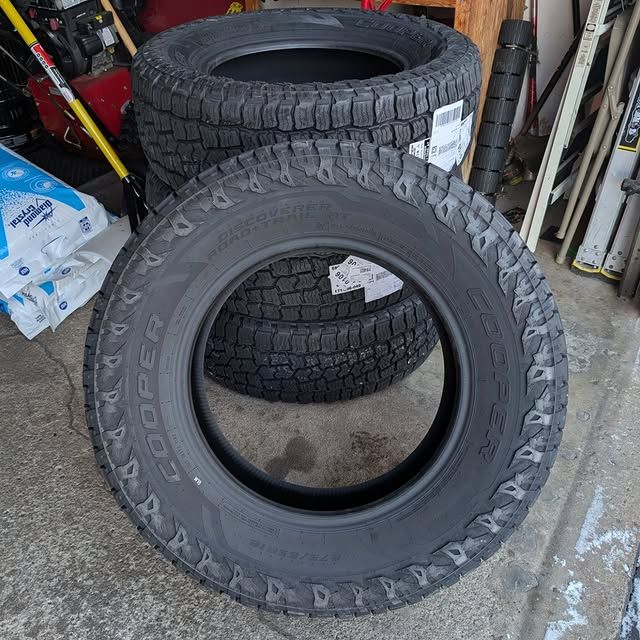
    Stack of Cooper Discoverer Road+Trail AT all-terrain tires in a garage, with one tire upright in front showing its tread and sidewall design.
    New Cooper Road+Trail AT — smooth on the highway, confident off the pavement.

    Comfort scores show the intent. Cooper sits at 9.0/10, KO3 at 7.5/10. Cooper is smooth and quiet, riding much like a touring tire. KO3 is firmer and hums, though it blends better into heavy trucks.

    Owners echo this. Cooper is called “the quietest A/T I’ve owned” on forums, while KO3 owners accept that it’s “truck-tough, but not obnoxious.” Engineering explains it: Cooper’s lighter tread and carcass transmit less vibration, KO3’s heavier build prioritizes stability over plushness.

    • SUVs & crossovers: Cooper nearly rides like an OE tire.

    • ½-ton trucks: Cooper more refined, KO3 firmer but normal for truck tires.

    • ¾-ton & HD trucks: KO3 feels appropriate, Cooper underbuilt.

    👉 Verdict: Cooper wins daily comfort; KO3 wins confidence under work.

    Note from the Expert: For years, choosing all-terrain meant accepting noise—a true compromise for off-road grip. That’s why the question, Are All-Terrain Tires Louder than Highway Tires?, used to have a simple “yes” answer. Now, with the rise of on-road models, the core issue has shifted from noise to overall refinement. To fully understand which side of the comfort spectrum you’re buying into, you need to determine Are All-Terrain Tires Good for Daily Driving?—a question that depends entirely on the tire’s construction, not just the name.

    Where They Fit Best

    • Cooper Discoverer Road+AT Trail: Best for SUV and crossover drivers or half-ton owners who want the look of an A/T without giving up comfort, quiet, or daily refinement. Performs well in mild climates and suburban regions where rain and light snow are occasional but deep winter and rocky trails aren’t a factor. A strong fit for commuters in the Sun Belt, Pacific Coast cities, and suburban Midwest.

    • BFGoodrich KO3: Suited for ¾-ton and 1-ton trucks, snow-belt drivers, and anyone towing or running real off-road trails. Its balance of durability, packed-snow traction, and off-road toughness makes it ideal for Rocky Mountain regions, the Northeast snow belt, and rural Southwest deserts where sharp rock and load demands push tires hard.

    👉 Bottom line: Cooper AT Trail is the comfort-first A/T for drivers in mild regions who want refinement with a touch of all-terrain ability. KO3 is the durability-first benchmark for harsher climates, heavier trucks, and real off-road or snow-belt use.

    Tire Size Selection: The Basics You Can’t Skip

    Even the best tread design can’t rescue a tire that’s built too weak. Back when I was testing tires at Bridgestone, I saw all-terrain models that should’ve performed but fell short — simply because the basics (size, load strength, and speed rating) weren’t matched to the vehicle.

    P-Metric vs. LT (Light Truck) Tires

    The first step is knowing whether you need LT or passenger tires. LT (Light Truck) tires are built with extra reinforcement and stiff sidewalls, designed for towing, hauling, or off-road use. Passenger (P-metric) tires are lighter, smoother, and tuned for daily comfort and fuel efficiency — but they’ll flex more under load.

    Understanding Tire Load Range: XL vs. E-Load

    Then comes the tire load index and load range — essentially your tire’s strength rating. Here’s where things split between passenger XL and LT E:

    • XL (Extra Load) is a passenger tire with reinforced sidewalls. It can handle a bit more pressure (~41 PSI) than a standard SL tire and is perfect for SUVs, crossovers, or light trucks that carry extra gear, passengers, or small trailers. XL tires ride softer and quieter than LT options, making them ideal for daily use.

    • E Load Range is an LT tire class built with a much thicker casing. E-rated tires can handle far more pressure (up to ~80 PSI) and heavier loads, which makes them essential for ¾-ton and 1-ton trucks towing trailers or hauling close to max capacity. The trade-off is weight, stiffer ride, more road noise, and a small drop in fuel efficiency.

    Put simply: XL is for “extra luggage and family,” while E is for “truck bed full of bricks or a car trailer.”

    Why the Tire Speed Rating Matters for Safety

    Finally, don’t overlook the tire speed rating. It’s not just about top speed — it measures how well a tire handles heat and stress at highway pace. Lower ratings (like S) tend to ride softer and last longer, while higher ratings (H, T) feel more stable and responsive under sharp maneuvers. Heat build-up is the silent killer of tires, and speed rating is your safeguard.

    Bottom line: Match your tire’s construction (LT vs P-metric), load range (XL vs E), and speed rating to your vehicle’s demands. Get those right, and everything else — off-road grip, winter traction, comfort — will finally perform the way it was designed to.

    Conclusion

    Choose Cooper AT Trail if your world is daily pavement, suburban rain, light snow, and the occasional gravel road—especially on SUVs/crossovers and unloaded ½-tons.
    Choose BFGoodrich KO3 if you tow, haul, or see real trails and winter—ideal for ¾-ton & 1-ton trucks, mountain/snow-belt climates, and rocky/desert terrain.

    👉 Bottom line: Cooper = comfort-first daily A/T with quick wet/dry manners on light rigs. KO3 = toughness-first A/T with better stability under weight, stronger winter margin, and elite off-road bite.

    Frequently Asked Questions: BFGoodrich KO3 vs Cooper AT Trail

    • Which tire is better on dry roads?
      Cooper AT Trail on lighter rigs (132 ft stop, 0.74 g). KO3 feels steadier once weight or towing enters the picture (140 ft, 0.72 g).

    • Which tire is safer in rain?
      Cooper stops shorter (167 ft, 0.53) for daily downpours. KO3 is longer (184 ft, 0.46) but tracks straighter under load.

    • How do they perform in snow?
      Cooper grabs earlier on light rigs (71.5 ft stop, 42.5 ft launch). KO3 stays calmer on heavy trucks (72.3 ft stop, 46.4 ft launch).

    • Which handles ice better?
      KO3 — shorter ice stop (~46.2 ft) and more predictable under weight. Cooper is close (~44.4 ft) on smaller vehicles but less composed when loaded.

    • Which is stronger off-road?
      KO3 by a wide margin (9.5 dirt / 9.5 sand / 9.2 mud / 9.5 rock). Cooper is for gravel and light trails (≈6.5–6.8 across categories).

    • Which is quieter and more comfortable?
      Cooper — comfort-first (~9.0/10). KO3 rides firmer (~7.5/10) but feels right on heavier trucks.

    • Which lasts longer?
      Both can deliver long life with rotations. Cooper stays quieter on-road; KO3 resists chipping and uneven wear under abuse and towing.

    • Who should choose Cooper AT Trail?
      SUV/crossover and ½-ton drivers prioritizing comfort, quiet, wet safety, and light snow/dirt capability.

    • Who should choose BFGoodrich KO3?
      ¾-ton & 1-ton owners, snow-belt drivers, and anyone who tows or runs real trails and needs maximum durability.

    Filed Under: All Terrain Tires Tagged With: bf goodrich, BF Goodrich KO3, comparison, cooper, Cooper Discoverer Road+AT Trail

    Nitto Ridge Grappler vs BFGoodrich KO3 — Hybrid Comfort vs Off-Road Durability in 2025

    Updated: November 11, 2025 by Emrecan Gurkan Leave a Comment

    Close-up shot of a BFGoodrich All-Terrain T/A KO3 tire mounted on a black multi-spoke alloy wheel, showing detailed tread pattern and sidewall branding.
    BFGoodrich KO3 — built tougher, lasting longer, gripping everywhere. 🛞🏔️🌧️

    Real-world test data, technical breakdowns, and use-case recommendations — from a former Bridgestone test engineer.

    The BFGoodrich KO3 is BFG’s latest Off-Road A/T tire, evolving the KO2 with stronger sidewalls, improved chip resistance, and enhanced winter traction certified by the 3PMSF rating. It’s built for serious off-road use, heavy towing and hauling, and year-round reliability. For the full evolution story, see my BFGoodrich KO3 vs KO2 breakdown. The Nitto Ridge Grappler, by contrast, sits in the Rugged-Terrain category, blending mud-terrain styling with all-terrain versatility. Popular on lifted trucks and Jeeps, it delivers aggressive looks, confident loose-surface traction, and sharper on-road handling than most R/Ts — though comfort and efficiency take a small hit compared to KO3.

    That’s the trade-off most drivers face — KO3 for proven off-road durability and winter performance vs Ridge Grappler for hybrid aggression and on-road edge. In the sections ahead, I’ll compare them across dry, wet, snow, and off-road testing. You can also line them up directly in our All-Terrain Tire Decision Tool for tailored recommendations by SUV, CUV, or truck class.

    Quick Take

    Nitto Ridge Grappler

    Nitto Ridge Grappler tire
    Tested Rating: 8.2/10

    Trusted Retailers with Best Deals:

    Tire Rack
    Free road-hazard coverage Backed by Discount Tire
    SimpleTire
    Financing options Local installers
    Amazon
    Prime shipping Direct from brands

    BFGoodrich All-Terrain T/A KO3

    BFGoodrich KO3 tire
    Tested Rating: 8.5/10

    Trusted Retailers with Best Deals:

    Tire Rack
    Free road-hazard coverage Backed by Discount Tire
    Amazon
    Prime shipping Direct from brands

    The Nitto Ridge Grappler feels sharper on dry roads (130 ft, 0.75 g) and proves versatile off-road (9.0 dirt / 9.3 mud / 9.2 rock), with hybrid styling that blends street and trail. Its trade-offs show in the wet (203-ft stop) and on ice (55.7 ft), where it slides farther, and it tends to grow louder as miles add up. The BFGoodrich KO3 is the durability-first choice — steadier under load, safer in storms (184-ft stop), stronger in snow (72.3-ft stop) and ice (46.2 ft), and still the off-road benchmark (9.5 dirt / 9.5 sand / 9.5 rock). It rides firmer (7.5/10) but shrugs off the abuse that wears hybrids down.

      Raw Test Data

      Tire Test Data

      Pick categories to show metrics, then open ☰ to pick tires. Optional chart is hidden by default.

      Parentheses show the rank among the currently displayed tires (1 = best for that metric).
      Left axis lists metrics. Top axis is used for g-force metrics so they scale clearly.
      Note: Lower is better for Stopping & Acceleration; higher is better for g-force, comfort, traction & off-road ratings. Parentheses show the rank among the currently displayed tires (1 = best for that metric).
      Sources worth checking
      Tire Rack AT Tire Test Tire Rack On-Road A/T Ratings Tire Rack Off-Road A/T Ratings SimpleTire Reviews Amazon SUV/LT Tires

      Dry Performance — Ridge Grappler sharper, KO3 steadier under load

      Nitto Ridge Grappler looks doooopeeee!

      The Ridge Grappler feels more eager in dry conditions. It stops in 130 feet with 0.75 g cornering, compared to the KO3’s 140 feet and 0.72 g. On the road, that translates to quicker bite when you turn in or brake hard. KO3, meanwhile, doesn’t match that sharpness but tracks straighter when weight is in play.

      Forum feedback lines up: Ridge owners often say it “feels locked in like a street tire until you toss it,” while KO3 drivers describe it as “predictable but never sporty.” From the engineering side, Ridge benefits from its hybrid casing stiffness and tighter tread block arrangement, which reduce squirm in quick maneuvers. KO3’s broader shoulder and slightly softer flex settle the truck under heavy loads.

      • SUVs & crossovers: Ridge feels more agile, better match for daily steering feedback

      • ½-ton trucks: Ridge is sharper when unloaded, KO3 steadier if towing occasionally

      • ¾-ton & HD trucks: KO3 the safer bet, giving straight-line security with trailers

      👉 Verdict: Ridge wins the dry grip battle on light rigs; KO3 steadies things when hauling.

      Wet Performance — KO3 safer margin, Ridge stretches long

      Here’s where the tradeoff shows. Ridge posts a 203-foot wet stop with 0.47 traction, one of the longest in this class. KO3 shortens that to 184 feet with 0.46 traction, not stellar but safer. On slick asphalt, Ridge needs patience; KO3 feels more composed when you lean on the brakes.

      Owners back this up: “Ridge is fine if you leave space in storms” vs. KO3 users noting “confidence in heavy rain even with weight.” The why is simple: KO3’s newer compound, while not as silica-rich as road-leaning A/Ts, keeps adhesion steadier in the wet. Ridge prioritizes carcass toughness, which trades away adhesion.

      • SUVs & crossovers: KO3 the safer rain choice

      • ½-ton trucks: Ridge manageable, but KO3 inspires more confidence

      • ¾-ton & HD trucks: KO3 keeps trailers calmer in storms

      👉 Verdict: KO3 holds the edge in the wet; Ridge demands margin.

      Note from the Expert: When it comes to rain, I always emphasize two things: compound grip and water evacuation. You can see the full details in my analysis, but if you take just one thing away, remember that an AT tire’s stiff nature makes achieving top-tier wet performance a constant battle. This is why the question, Are All-Terrain Tires Good in Rain?, requires a nuanced answer that balances tread design against rubber stiffness.

      Winter & Snow — KO3 steadier on packed roads, Ridge churns through loose snow

      In snow, Ridge stops at 78 feet and launches in 47.7 feet, while KO3 trims that to 72.3 feet and 46.4 feet. The data points to KO3 being stronger on plowed and polished roads, where braking stability matters most. Ridge’s strength shows up in deep, unplowed drifts, where its wide shoulders and open voids churn snow and keep momentum better than KO3.

      Community chatter fits the split. Tacoma drivers note Ridge “powers through unplowed driveways,” while KO3 owners say it “feels calmer on salted highways.” I had a similar impression — Ridge more eager in deeper powder, KO3 more secure once the road was packed down.

      • SUVs & crossovers: KO3 better for regular winter commutes; Ridge works in occasional deep snow.

      • ½-ton trucks: Ridge helps in unplowed conditions, KO3 safer day-to-day on mixed winter roads.

      • ¾-ton & HD trucks: KO3 steadier under weight, Ridge less composed on polished surfaces.

      👉 Verdict: Ridge shines in loose, deep snow; KO3 is the safer bet on plowed, packed winter roads.

      Note from the Expert: Our discussions often boil down to the core tradeoff. On one hand, you must understand why all-terrain tires are truly effective in deep snow, but not on ice. On the other hand, you face the 3PMSF Paradox—the hidden cost of that badge. The short answer is: The 3PMSF badge certifies traction, but it costs you durability. Dive into our full analysis on the critical 3PMSF rating for severe winter and off-road service, and its hidden costs, before you risk your rig on the trail.

      Ice — KO3 grips, Ridge glides

      On ice, Ridge lands at 55.7 feet, KO3 at 46.2 feet. That’s a noticeable gap. Ridge loses grip predictably, sliding further, while KO3 grabs sooner and gives more room for correction.

      Forum comments echo: Ridge is “fine if you creep,” KO3 “lets you brake without puckering.” From an engineering view, KO3’s updated micro-siping helps here; Ridge’s blocky, durability-driven compound simply doesn’t bite.

      • SUVs & crossovers: KO3 gives better ice security

      • ½-ton trucks: Ridge manageable with traction control, KO3 safer

      • ¾-ton & HD trucks: KO3 clearly steadier under weight

      👉 Verdict: KO3 is the smarter pick if icy mornings are routine.

      Off-Road — Ridge versatile, KO3 masterclass

      Off-road is where both shine, but differently. Ridge scores 9.0 dirt / 8.5 sand / 9.3 mud / 9.2 rock. KO3 goes higher at 9.5 across dirt, sand, rock and 9.2 in mud. Ridge is versatile and confidence-inspiring on mixed terrain, while KO3 feels nearly unflappable in tougher conditions.

      Trail users say Ridge is a “beast in mud, surprisingly sure-footed on rocks.” KO3 fans claim “it’s still the benchmark” for stability on sharp rock and ruts. From my perspective, Ridge’s hybrid casing balances road manners with trail toughness, while KO3’s reinforced sidewalls and interlocking blocks are simply tuned harder for true all-terrain punishment.

      • SUVs & crossovers: Ridge works better, KO3 feels overbuilt unless you trail often

      • ½-ton trucks: Ridge gives a fun off-road edge without punishing ride

      • ¾-ton & HD trucks: KO3 dominates — stable, puncture resistant, and built for load

      👉 Verdict: Ridge balances daily comfort with off-road grit; KO3 is king for serious off-road work.

      Note from the Expert: Every successful day on the trail is about preparation and physics, because tire longevity is earned, not given. Before you even start, you must master the critical link between tire pressure and load range for every rig to maximize your contact patch. Once moving, remember your ultimate off-road armor is your sidewall protection against the inevitable pinch flat. And finally, your traction on the obstacle is dictated by choosing the right aggressive vs hybrid tread pattern for your terrain. Master those three steps, and your rig will be ready for anything.

      Comfort & Noise — Ridge rougher, KO3 more polished

      Comfort scores tell the story: Ridge at 6.8/10, KO3 at 7.5/10. Ridge rides firm and hums on the highway, with noise building as tread wears. KO3 is firmer than on-road A/Ts, but steadier and less prone to uneven growl.

      Drivers sum it up well: Ridge is “quiet for how it looks at first, but gets louder later.” KO3 owners say “it blends into background noise, especially on diesels.” From an engineering lens, Ridge’s rugged tread increases resonance over time, KO3’s tread pitch sequencing holds refinement longer.

      • SUVs & crossovers: KO3 less intrusive, Ridge feels harsher

      • ½-ton trucks: Ridge livable, KO3 steadier over long trips

      • ¾-ton & HD trucks: KO3 noise blends into cabin, Ridge feels rougher

      👉 Verdict: KO3 wins refinement, Ridge grows louder with miles.

      Note from the Expert: For years, choosing all-terrain meant accepting noise—a true compromise for off-road grip. That’s why the question, Are All-Terrain Tires Louder than Highway Tires?, used to have a simple “yes” answer. Now, with the rise of on-road models, the core issue has shifted from noise to overall refinement. To fully understand which side of the comfort spectrum you’re buying into, you need to determine Are All-Terrain Tires Good for Daily Driving?—a question that depends entirely on the tire’s construction, not just the name.

      Where They Fit Best

      • Nitto Ridge Grappler: Perfect for drivers who want aggressive looks, strong dry grip, and serious off-road traction, but can live with weaker wet/ice manners and more cabin noise. Great for ½-ton trucks and SUVs that see trails every weekend.

      • BFGoodrich KO3: The benchmark for balanced toughness. Stronger in wet, snow, and ice, more stable when towing, and unbeatable off-road when things get technical. Best fit for ¾-ton and 1-ton trucks, snow-belt drivers, and anyone who needs durability above all else.

      👉 Bottom line: Ridge Grappler is the fun hybrid with sharper dry grip and weekend off-road muscle. KO3 is the safer, steadier long-hauler built for real work and real winter.

      Tire Size Selection: The Basics You Can’t Skip

      Even the best tread design can’t rescue a tire that’s built too weak. Back when I was testing tires at Bridgestone, I saw all-terrain models that should’ve performed but fell short — simply because the basics (size, load strength, and speed rating) weren’t matched to the vehicle.

      P-Metric vs. LT (Light Truck) Tires

      The first step is knowing whether you need LT or passenger tires. LT (Light Truck) tires are built with extra reinforcement and stiff sidewalls, designed for towing, hauling, or off-road use. Passenger (P-metric) tires are lighter, smoother, and tuned for daily comfort and fuel efficiency — but they’ll flex more under load.

      Understanding Tire Load Range: XL vs. E-Load

      Then comes the tire load index and load range — essentially your tire’s strength rating. Here’s where things split between passenger XL and LT E:

      • XL (Extra Load) is a passenger tire with reinforced sidewalls. It can handle a bit more pressure (~41 PSI) than a standard SL tire and is perfect for SUVs, crossovers, or light trucks that carry extra gear, passengers, or small trailers. XL tires ride softer and quieter than LT options, making them ideal for daily use.

      • E Load Range is an LT tire class built with a much thicker casing. E-rated tires can handle far more pressure (up to ~80 PSI) and heavier loads, which makes them essential for ¾-ton and 1-ton trucks towing trailers or hauling close to max capacity. The trade-off is weight, stiffer ride, more road noise, and a small drop in fuel efficiency.

      Put simply: XL is for “extra luggage and family,” while E is for “truck bed full of bricks or a car trailer.”

      Why the Tire Speed Rating Matters for Safety

      Finally, don’t overlook the tire speed rating. It’s not just about top speed — it measures how well a tire handles heat and stress at highway pace. Lower ratings (like S) tend to ride softer and last longer, while higher ratings (H, T) feel more stable and responsive under sharp maneuvers. Heat build-up is the silent killer of tires, and speed rating is your safeguard.

      Bottom line: Match your tire’s construction (LT vs P-metric), load range (XL vs E), and speed rating to your vehicle’s demands. Get those right, and everything else — off-road grip, winter traction, comfort — will finally perform the way it was designed to.

      Conclusion

      If you want a tire that looks aggressive, corners sharper, and delivers fun off-road weekends, the Ridge Grappler is your pick. It’s better suited to SUVs and ½-ton trucks where responsiveness and style matter more than wet grip.
      If your priority is safety in rain, confidence in snow/ice, and stability when towing or hauling, the KO3 stands above. It’s the natural fit for ¾-ton and HD rigs, snow-belt drivers, and anyone who values toughness over polish.

      👉 Bottom line: Ridge Grappler if you want hybrid flair and sharper dry/off-road bite. KO3 if you want proven toughness, safer winter manners, and long-haul durability.

      Frequently Asked Questions: Ridge Grappler vs KO3

      • Which tire has better dry grip?
        The Ridge Grappler. It stops shorter (130 ft vs 140 ft) and corners sharper (0.75 g vs 0.72 g).

      • Which tire is safer in rain?
        The KO3. It stops shorter (184 ft vs 203 ft) and feels more composed in storms.

      • Which tire performs better in snow?
        The KO3. It stops shorter on packed snow (72.3 ft vs 78 ft), while Ridge works better in deeper, loose drifts.

      • Which tire handles ice better?
        The KO3. It stops at 46.2 ft vs Ridge’s 55.7 ft, gripping earlier and safer on icy roads.

      • Which tire is stronger off-road?
        The KO3. With 9.5 scores across dirt, sand, and rock, it’s tougher than Ridge’s 9.0/9.3/9.2 mix.

      • Which tire is quieter and more comfortable?
        The KO3. It rates higher (7.5/10 vs Ridge’s 6.8/10), staying steadier and less noisy over time.

      • Which tire lasts longer?
        The KO3 resists abuse and uneven wear better. Ridge can wear quicker and grow noisier with miles.

      • Which vehicles suit Ridge Grappler best?
        SUVs and ½-ton trucks where aggressive looks, sharper dry handling, and weekend trail use matter most.

      • Which vehicles suit KO3 best?
        ¾-ton & HD trucks, snow-belt drivers, and heavy haulers needing winter safety, off-road grit, and durability.

      Filed Under: All Terrain Tires Tagged With: bf goodrich, BF Goodrich KO3, Comparisons, nitto, nitto ridge grappler

      Nitto Terra Grappler G3 vs BFGoodrich KO3 — Off-Road Durability vs On-Road Comfort in 2025

      Updated: November 11, 2025 by Emrecan Gurkan Leave a Comment

      Real-world test data, technical breakdowns, and use-case recommendations — from a former Bridgestone test engineer.

      The BFGoodrich KO3 is BFG’s latest Off-Road A/T tire, building on the KO2’s legacy with tougher chip resistance, revised tread geometry, and improved winter traction certified by the 3PMSF rating. For the full evolution story, see my BFGoodrich KO3 vs KO2 breakdown. By contrast, the Nitto Terra Grappler G3 sits in the On-Road A/T category, designed around quiet comfort, stable wet-weather handling, and dependable all-season grip, making it a fit for drivers who spend most of their miles on pavement with only light off-road use.

      That’s the split most buyers need to weigh — KO3 for rugged durability and off-road bite vs Terra Grappler G3 for refined road manners and daily drivability. In the sections ahead, I’ll break down their performance across dry, wet, snow, and off-road testing. You can also compare them side by side in our All-Terrain Tire Decision Tool, with results tailored by SUV, CUV, or truck class.

      Quick Look

      Nitto Terra Grappler G3

      Nitto Terra Grappler G3 tire
      Tested Rating: 8.6/10

      Trusted Retailers with Best Deals:

      Tire Rack
      Free road-hazard coverage Backed by Discount Tire
      SimpleTire
      Financing options Local installers
      Amazon
      Prime shipping Direct from brands

      BFGoodrich All-Terrain T/A KO3

      BFGoodrich KO3 tire
      Tested Rating: 8.5/10

      Trusted Retailers with Best Deals:

      Tire Rack
      Free road-hazard coverage Backed by Discount Tire
      Amazon
      Prime shipping Direct from brands

      The Nitto Terra Grappler G3 feels closer to a highway tire, stopping quickly at 127 ft (0.74 g), staying steady in rain (158 ft, 0.57 g), and riding quiet enough (~8.0/10) to disappear into the cabin. Backed by a 55–65k warranty, it’s a sleeper pick for commuters and towers who want pavement manners with light-gravel stability. The BFGoodrich KO3, by contrast, is a durability-first tank built for ¾-ton and HD rigs. It claws through snow (72.3 ft) and ice (46.2 ft), dominates trails (9.5 dirt / 9.5 sand / 9.2 mud / 9.5 rock), and shrugs off abuse with ease. The trade-off: you’ll give up wet grip (184 ft, 0.46 g) and some ride comfort (~7.5/10), but gain a tire that feels like armor strapped to your truck.

        Raw Test Data

        Tire Test Data

        Pick categories to show metrics, then open ☰ to pick tires. Optional chart is hidden by default.

        Parentheses show the rank among the currently displayed tires (1 = best for that metric).
        Left axis lists metrics. Top axis is used for g-force metrics so they scale clearly.
        Note: Lower is better for Stopping & Acceleration; higher is better for g-force, comfort, traction & off-road ratings. Parentheses show the rank among the currently displayed tires (1 = best for that metric).
        Sources worth checking
        Tire Rack AT Tire Test Tire Rack On-Road A/T Ratings Tire Rack Off-Road A/T Ratings SimpleTire Reviews Amazon SUV/LT Tires

        Dry Performance — Highway Ease vs Anchored Authority

        On dry pavement, the Terra Grappler G3 stops in 127 ft with 0.74 g cornering, while the KO3 takes 140 ft with 0.72 g. The contrast is immediate: the G3 feels more like a highway tire — light on the wheel, eager to settle into a curve. The KO3, by comparison, sets heavy and slow, but once planted, it doesn’t budge.

        Owners describe it the same way. G3 drivers say it “feels stock but more stable,” while KO3 drivers note it’s “like strapping armor to your truck — not quick, but steady.” From my seat, I noticed that when empty, the G3 felt more playful, but in LT spec, it stiffens up. With a trailer behind, it tracked straighter than many expect from an on-road A/T. KO3 still wins brute stability, but the G3 is a sleeper pick for highway towing.

        • SUVs & crossovers: G3 lighter, KO3 feels too heavy

        • ½-tons: G3 sharper daily; KO3 steadier under heavy trailers

        • ¾-ton & HD trucks: KO3 natural match, but G3 LT sizes hold trailers better than expected

        👉 Verdict: G3 brings agility and towing steadiness; KO3 delivers heavyweight stability.

        Wet Performance — City Storm Confidence vs Heavy Truck Margin

        In a downpour, the G3 pulls up in 158 ft with 0.57 g traction, while the KO3 runs long at 184 ft with 0.46 g. In traffic, the G3 feels reassuring — quick to bite when you hit the brakes. KO3 keeps its line, but you’ll need extra margin.

        The reason is clear in design. G3’s silica-rich compound and dense siping grab at slick asphalt, much like a sneaker sole clinging to wet pavement. KO3 clears water well through its voids but relies on a harder, chip-resistant mix — more like a work boot that takes punishment but doesn’t stick as quickly.

        Drivers notice the difference. G3 owners call it “safe in Seattle rain,” while KO3 owners admit, “fine in storms, just brake earlier.” I felt that too: the G3 inspired confidence during sudden stops, while the KO3 gave me peace of mind when pulling weight — even if mileage dipped slightly with towing.

        • SUVs & crossovers: G3 safer in daily rain

        • ½-tons: G3 everyday confidence; KO3 fine with margin

        • ¾-ton & HD trucks: KO3 steadier with heavy rigs, G3 stable enough for highway towing

        👉 Verdict: G3 leads for wet grip; KO3 steadies under heavy load but trades adhesion for toughness.

        Here’s why. G3’s silica-rich compound and dense siping let it “key in” to slick surfaces, biting early. KO3’s harder, chip-resistant mix favors toughness over adhesion. The grooves move water well, but the contact patch can’t grab as quickly. Think of it as sneakers versus steel-toe boots — both handle puddles, only one sticks fast under sudden pressure.

        Forum chatter backs it up. G3 drivers report it “handles Seattle rain like nothing,” while KO3 owners caution, “leave room in storms.” In my seat, the KO3 stayed arrow-straight even in pooling water, but the G3 gave me that first-bite confidence for sudden stops.

        • SUVs & crossovers: G3 safer for storm-heavy commutes

        • ½-tons: G3 the everyday pick; KO3 manageable with margin

        • ¾-ton & HD trucks: KO3 steadier under weight

        👉 Verdict: G3 takes wet safety; KO3 feels dependable but demands space.

        Note from the Expert: When it comes to rain, I always emphasize two things: compound grip and water evacuation. You can see the full details in my analysis, but if you take just one thing away, remember that an AT tire’s stiff nature makes achieving top-tier wet performance a constant battle. This is why the question, Are All-Terrain Tires Good in Rain?, requires a nuanced answer that balances tread design against rubber stiffness.

        Winter & Snow — Suburban Calm vs Mountain Grip

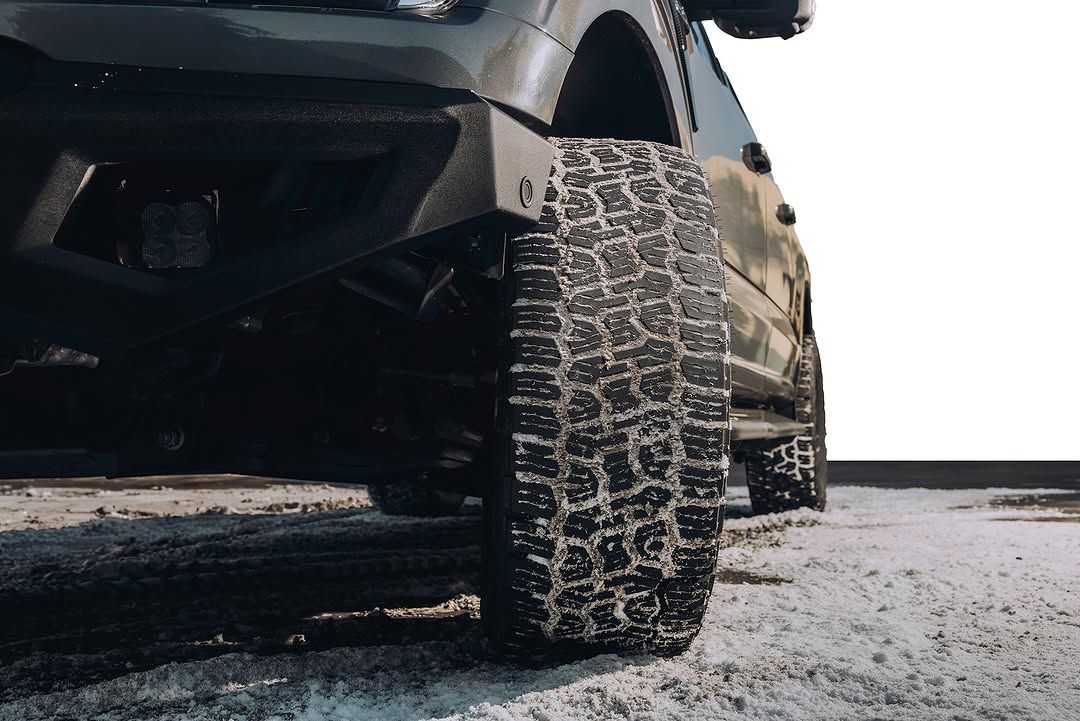
        Low-angle view of a truck fitted with Nitto Terra Grappler G3 all-terrain tires, showing snow-packed tread blocks on a winter road for improved traction.
        Nitto Terra Grappler G3 — built to bite into snow and keep you moving. ❄️🛞💪

        On snowy streets, the G3 measures 86.9 ft to stop and 45.2 ft to launch, while the KO3 sharpens that to 72.3 ft stopping and 46.4 ft launching. In practice, KO3 feels better suited for deep or messy snow, while G3 is smooth and predictable on plowed routes.

        That split comes from tread. KO3’s wide voids and blocky shoulders act like paddles under braking, giving it shorter stops in slush. G3’s siping helps it launch cleanly, but braking distances stretch at speed. For towing, though, the G3 impresses again — LT versions stay composed when pulling trailers on plowed roads, making it friendlier for suburban haulers.

        Forum voices echo it. KO3 owners rave it “claws through Montana drifts.” G3 drivers call it “fine for the suburbs, not a snow warrior.” From my short winter test, G3 felt calm and forgiving, KO3 much more confident in heavy conditions.

        • SUVs & crossovers: G3 better for plowed commutes

        • ½-tons: KO3 steadier in mixed snow/slush; G3 fine for suburban winters

        • ¾-ton & HD trucks: KO3 stronger in deep snow; G3 capable for towing on maintained roads

        👉 Verdict: KO3 is the snow-belt workhorse; G3 suits suburban and towing-focused winter use.

        Note from the Expert: Our discussions often boil down to the core tradeoff. On one hand, you must understand why all-terrain tires are truly effective in deep snow, but not on ice. On the other hand, you face the 3PMSF Paradox—the hidden cost of that badge. The short answer is: The 3PMSF badge certifies traction, but it costs you durability. Dive into our full analysis on the critical 3PMSF rating for severe winter and off-road service, and its hidden costs, before you risk your rig on the trail.

        Ice — Early Bite vs Predictable Fade

        On icy mornings, the G3 halts in 47.8 ft, while the KO3 comes in just shorter at 46.2 ft. Small difference in numbers, bigger difference in feel. G3 nibbles earlier at low speed, KO3 slides a touch longer but catches more predictably at highway pace.

        That’s tread geometry at work. G3’s siping density creates quick initial grip, while KO3’s rigid lugs hold better under steady braking pressure. In towing scenarios, G3 feels friendlier at neighborhood speeds, while KO3 steadies better on icy highways with weight behind.

        • SUVs & crossovers: G3 forgiving in city ice

        • ½-tons: KO3 steadier in mixed-speed driving

        • ¾-ton & HD trucks: KO3 safer for icy highways with trailers

        👉 Verdict: G3 gives early bite in city driving; KO3 safer when speed and load rise.

        Off-Road — Gravel Trails vs Jobsite Muscle

        Close-up shot of a BFGoodrich All-Terrain T/A KO3 tire mounted on a black multi-spoke alloy wheel, showing detailed tread pattern and sidewall branding.
        BFGoodrich KO3 — built tougher, lasting longer, gripping everywhere. 🛞🏔️🌧️

        Off-road, the difference is obvious. KO3 scores Dirt 9.5 / Sand 9.5 / Mud 9.2 / Rock 9.5. G3 checks in at Dirt 6.8 / Sand 6.8 / Mud 6.5 / Rock 6.7. KO3 is built for abuse — reinforced sidewalls, stone ejectors, and aggressive shoulders. G3 was never meant to match that, but it’s no slouch on gravel or light trails.

        Where G3 surprises is towing stability on unpaved roads. Owners pulling horse trailers or campers often report it “tracks steady on gravel with no sway.” That matches my own notes — while KO3 is the undisputed off-road hammer, the G3 feels solid on dirt highways and jobsite approaches, provided you’re not asking it to claw through mud.

        • SUVs & crossovers: G3 fine for light dirt and gravel

        • ½-tons: G3 stable for trailering on gravel; KO3 better for real trail work

        • ¾-ton & HD trucks: KO3 dominates severe use; G3 stable enough for non-technical hauling

        👉 Verdict: G3 strong for towing on gravel; KO3 the true off-road master.

        Note from the Expert: Every successful day on the trail is about preparation and physics, because tire longevity is earned, not given. Before you even start, you must master the critical link between tire pressure and load range for every rig to maximize your contact patch. Once moving, remember your ultimate off-road armor is your sidewall protection against the inevitable pinch flat. And finally, your traction on the obstacle is dictated by choosing the right aggressive vs hybrid tread pattern for your terrain. Master those three steps, and your rig will be ready for anything.

        Comfort & Noise — Quieter Partner vs Rugged Work Hum

        Comfort ratings split them again: G3 at 8.0/10, KO3 at 7.5/10. On-road, the G3 feels calm, smooth, and OE-like in manners. KO3 rides firmer with a steady hum that blends into diesel or highway background.

        From the engineering side, G3’s variable pitch tread cancels resonance, while KO3’s rigid casing transmits road texture. Towing owners often mention the G3’s downside: “a couple MPG less, but calmer when loaded.” KO3 doesn’t hide its toughness, but if you expect some hum, it feels normal for the category.

        • SUVs & crossovers: G3 the refined option

        • ½-tons: G3 smoother day-to-day; KO3 livable, noisier

        • ¾-ton & HD trucks: KO3 firmness feels natural; G3 still a good towing partner

        👉 Verdict: G3 brings quiet refinement with towing stability; KO3 balances comfort with rugged consistency.

        Note from the Expert: For years, choosing all-terrain meant accepting noise—a true compromise for off-road grip. That’s why the question, Are All-Terrain Tires Louder than Highway Tires?, used to have a simple “yes” answer. Now, with the rise of on-road models, the core issue has shifted from noise to overall refinement. To fully understand which side of the comfort spectrum you’re buying into, you need to determine Are All-Terrain Tires Good for Daily Driving?—a question that depends entirely on the tire’s construction, not just the name.

        Tread Life & Longevity — Warranty Miles vs Abuse Resistance

        The G3 carries 55–65k mile warranties, stretching far when rotated regularly. KO3, like the KO2 before it, averages 40–50k miles — but shrugs off the kind of abuse (rock chips, gravel chunking) that shortens softer compounds.

        For towing, the G3 does give up a bit of efficiency and may not stretch to its full mileage under constant heavy load, but it earns praise for staying stable deep into its life. KO3 lasts fewer miles on paper but feels nearly indestructible in harsh conditions.

        • SUVs & crossovers: G3 longer, quieter life

        • ½-tons: G3 stretches miles if mostly pavement; KO3 better in mixed abuse

        • ¾-ton & HD trucks: KO3 wears evenly with weight; G3 still stable for towing

        👉 Verdict: G3 wins in warranty mileage; KO3 survives where softer tires fail.

        Where They Fit Best

        Both are 3PMSF-rated all-terrains, but their roles diverge.

        • SUVs & crossovers: G3 is the easy choice — quiet, safe, wet-strong

        • ½-tons: G3 suits commuters and light haulers; KO3 for hunters and off-roaders

        • ¾-ton & HD trucks: KO3 the rugged anchor, but G3 LT sizes are underrated towing tires for highway haulers who don’t need mud grip

        Regional fit:

        • Terra Grappler G3: Best for wet, variable regions (Seattle, Chicago, Northeast suburbs) where towing and commuting overlap.

        • KO3: Best in Mountain West, Southwest, and rural job sites where durability and off-road bite rule.

        👉 Bottom line: The G3 is more than just an on-road A/T — it’s a towing-friendly tire with surprising stability for ¾-ton and 1-ton trucks, perfect for those who live on highways and gravel but don’t need mud claws. The KO3 remains the gold standard for off-road toughness and heavy-duty abuse.

        Tire Size Selection: The Basics You Can’t Skip

        Even the best tread design can’t rescue a tire that’s built too weak. Back when I was testing tires at Bridgestone, I saw all-terrain models that should’ve performed but fell short — simply because the basics (size, load strength, and speed rating) weren’t matched to the vehicle.

        P-Metric vs. LT (Light Truck) Tires

        The first step is knowing whether you need LT or passenger tires. LT (Light Truck) tires are built with extra reinforcement and stiff sidewalls, designed for towing, hauling, or off-road use. Passenger (P-metric) tires are lighter, smoother, and tuned for daily comfort and fuel efficiency — but they’ll flex more under load.

        Understanding Tire Load Range: XL vs. E-Load

        Then comes the tire load index and load range — essentially your tire’s strength rating. Here’s where things split between passenger XL and LT E:

        • XL (Extra Load) is a passenger tire with reinforced sidewalls. It can handle a bit more pressure (~41 PSI) than a standard SL tire and is perfect for SUVs, crossovers, or light trucks that carry extra gear, passengers, or small trailers. XL tires ride softer and quieter than LT options, making them ideal for daily use.

        • E Load Range is an LT tire class built with a much thicker casing. E-rated tires can handle far more pressure (up to ~80 PSI) and heavier loads, which makes them essential for ¾-ton and 1-ton trucks towing trailers or hauling close to max capacity. The trade-off is weight, stiffer ride, more road noise, and a small drop in fuel efficiency.

        Put simply: XL is for “extra luggage and family,” while E is for “truck bed full of bricks or a car trailer.”

        Why the Tire Speed Rating Matters for Safety

        Finally, don’t overlook the tire speed rating. It’s not just about top speed — it measures how well a tire handles heat and stress at highway pace. Lower ratings (like S) tend to ride softer and last longer, while higher ratings (H, T) feel more stable and responsive under sharp maneuvers. Heat build-up is the silent killer of tires, and speed rating is your safeguard.

        Bottom line: Match your tire’s construction (LT vs P-metric), load range (XL vs E), and speed rating to your vehicle’s demands. Get those right, and everything else — off-road grip, winter traction, comfort — will finally perform the way it was designed to.

        🧠 Final Verdict — Which Should You Buy?

        If your life is commutes, wet highways, and trailer runs on pavement or gravel, the Terra Grappler G3 is the easy win — calmer, quieter, and safer in rain while staying composed for towing (especially in LT sizes).
        If you live where roads turn to rock, ruts, and job sites — or you’re running a ¾-ton/1-ton — the KO3 is the safer bet: tougher carcass, better control in messy snow/ice, and true off-road authority.
        Bottom line: G3 for all-weather highway/towing comfort; KO3 for heavy-duty durability and real trail work.

        Frequently Asked Questions: Nitto Terra Grappler G3 vs BFGoodrich KO3

        • Which tire is better on dry roads?
          G3. Stops shorter (127 ft vs 140 ft) and feels lighter, while KO3 is heavier but more planted.

        • Which tire is safer in rain?
          G3. Stronger wet grip (158 ft, 0.57 g) vs KO3’s longer 184 ft (0.46 g).

        • How do they perform in snow?
          KO3. Stops shorter (72.3 ft vs G3’s 86.9 ft) and claws better in drifts, while G3 is smoother on plowed roads.

        • Which handles ice better?
          KO3. Slight edge (46.2 ft vs G3’s 47.8 ft) and steadies better at highway speeds.

        • Which tire is stronger off-road?
          KO3. Dominates (9.5 dirt / 9.5 sand / 9.2 mud / 9.5 rock) vs G3’s lighter scores (≈6.8–6.7 range).

        • Which is quieter and more comfortable?
          G3. Rides calmer (8.0/10 vs KO3’s 7.5/10) and stays quieter on pavement.

        • Which lasts longer?
          G3. Carries longer warranties (55–65k), while KO3 averages 40–50k but shrugs off abuse better.

        • Which vehicles suit each tire?
          G3: SUVs, crossovers, and ½-tons needing daily comfort and wet safety.
          KO3: ½-ton work rigs, ¾-ton & HD trucks for towing, job sites, and trails.

        Filed Under: All Terrain Tires Tagged With: bf goodrich, BF Goodrich KO3, Comparisons, nitto, nitto terra grappler g3

        Falken AT4W vs BFG KO3 (feat Discontinued AT3W Data): Winter Grip & Off-Road Strength

        Updated: November 11, 2025 by Emrecan Gurkan Leave a Comment

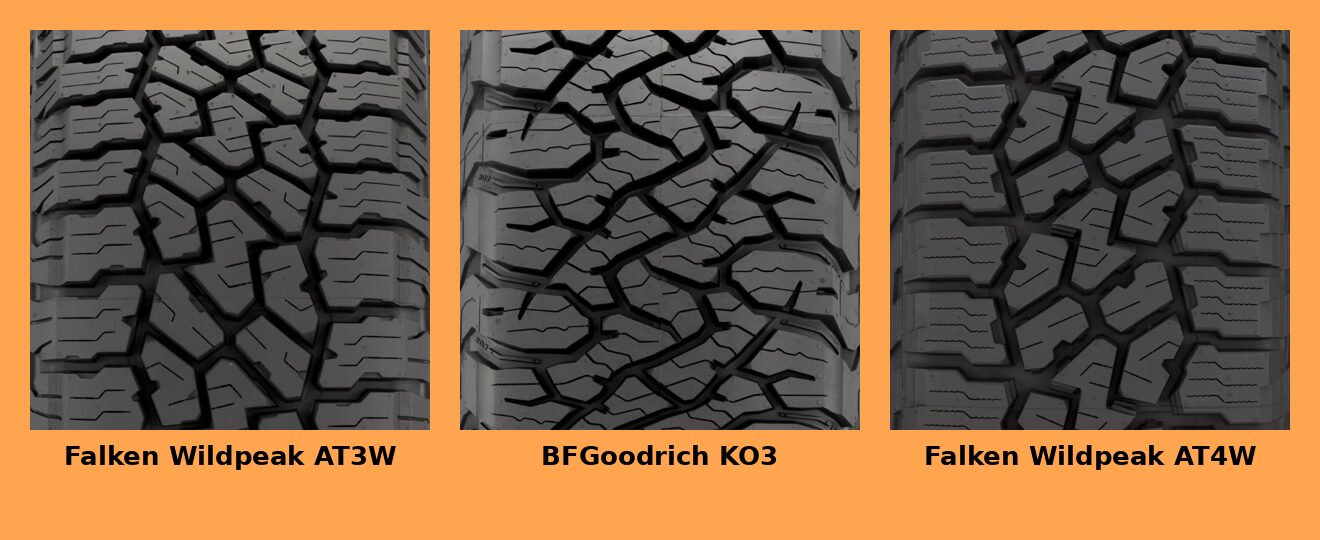
        Side-by-side tread pattern comparison of Falken Wildpeak AT3W, BFGoodrich KO3, and Falken Wildpeak AT4W all-terrain tires. Each tire is displayed vertically on an orange background with labels underneath for clear identification.
        See how the tread patterns of Falken Wildpeak AT3W, BFGoodrich KO3, and AT4W stack up—designed for traction, tested for adventure. 🛞🌲❄️

        Real-world test data, Reddit insights, and fitment guidance — harmonizing online test data, customer reviews, and specific comments from friends, all by a former Bridgestone test engineer.

        The BFGoodrich KO3 is BFG’s newest Off-Road A/T tire, and its update represents a strategic shift: it delivers stronger wet traction and better on-road comfort than the legendary KO2, but reportedly with a small trade-off in extreme cut/chip resistance and raw off-road performance—leaving the pure heavy-duty title to the KO2 while capturing the mainstream all-terrain market. If you want to see exactly how it stacks up, check out my BFGoodrich KO3 vs KO2 breakdown. The Falken Wildpeak AT4W, meanwhile, is Falken’s latest release—built with a stiffer casing, upgraded chip resistance, and a tread pattern aimed at heavier trucks and harsher off-road use.

        Since the Falken Wildpeak AT3W is discontinued, we will use its established performance data as a benchmark throughout this comparison to clearly illustrate the generational steps taken by both the KO3 and the AT4W.

        That’s the real choice here — BFG’s evolution toward daily-driver versatility versus Falken’s step-up in modern off-road toughness. In the sections ahead, we’ll break down how both perform across dry, wet, snow, off-road, and comfort testing. You can also use our All-Terrain Tire Decision Tool to line them up by SUV, CUV, or truck class for quick recommendations.

        At a Glance

        Falken Wildpeak A/T4W

        Falken Wildpeak AT4W tire
        Tested Rating: 8.4/10

        Trusted Retailers with Best Deals:

        Tire Rack
        Free road-hazard coverage Backed by Discount Tire
        SimpleTire
        Financing options Local installers
        Amazon
        Prime shipping Direct from brands

        BFGoodrich All-Terrain T/A KO3

        BFGoodrich KO3 tire
        Tested Rating: 8.5/10

        Trusted Retailers with Best Deals:

        Tire Rack
        Free road-hazard coverage Backed by Discount Tire
        Amazon
        Prime shipping Direct from brands

        The Falken Wildpeak AT4W offers the best balance of road safety and rugged capability. It stands out with superior wet braking (171 ft,0.58 g) and powerful snow grip (69-ft stop, 41.5-ft launch). It features a 65k mile warranty, a firmer ride, and is built to be steady under load, making it highly capable for off-road use.

        The BFGoodrich KO3 is the dedicated off-road bruiser. While it trails the Falken in measured wet and snow performance (184-ft wet stop, 72.3-ft snow stop), it dominates off-road with top scores (9.5 dirt/9.5 sand/9.2 mud/9.5 rock). It’s louder (7.5/10 comfort) and built specifically for abuse, heavy-duty towing, and core off-road toughness.

        👉 Bottom line: AT4W = The balanced winter and wet safety leader; KO3 = The ultimate off-road and rock-crawling specialist.

          Raw Test Data

          Tire Test Data

          Pick categories to show metrics, then open ☰ to pick tires. Optional chart is hidden by default.

          Parentheses show the rank among the currently displayed tires (1 = best for that metric).
          Left axis lists metrics. Top axis is used for g-force metrics so they scale clearly.
          Note: Lower is better for Stopping & Acceleration; higher is better for g-force, comfort, traction & off-road ratings. Parentheses show the rank among the currently displayed tires (1 = best for that metric).
          Sources worth checking
          Tire Rack AT Tire Test Tire Rack On-Road A/T Ratings Tire Rack Off-Road A/T Ratings SimpleTire Reviews Amazon SUV/LT Tires

          Falken Wildpeak A/T3W (Discontinued)

          The Falken Wildpeak A/T3W is officially discontinued, but finding remaining stock means you can still buy the performance benchmark for the new AT4W.

          Known as the “agile all-terrain athlete,” the A/T3W offered the sharpest dry grip of the entire lineup (126.6 ft stop). The generational transition to the AT4W focused on what to refine: the new model sacrificed a small degree of the A/T3W’s dry sharpness for improved stability under heavy load, and crucially, saw a trade-off in highway comfort to deliver more ruggedness. This strategic sacrifice in comfort was intended to push the AT4W toward serious capability, allowing the Falken Rubitrek AT01 to be introduced to close the market gap for comfort-focused all-terrain drivers. The result was notable improvements over the A/T3W’s “solid” performance in wet braking (shorter stops than the A/T3W’s 176 ft), ice traction, and off-road ruggedness.

          Dry Performance — AT4W Edges Braking, KO3 Prioritizes Stability

          On dry pavement, the Falken A/T4W is the superior stopping tire, coming to a halt at 131.8 ft (with 0.72 g cornering). The BFGoodrich KO3 sits further back, requiring 140 ft (with 0.72 g cornering).

          Behind the wheel, the AT4W is slightly quicker in response but settles firmly when vehicle weight is added. The KO3, meanwhile, leans more toward anchor-like stability than agility, which is why it feels slower in quick transitions.

          From an engineering lens, the AT4W stiffens its casing and tweaks its block design, successfully trading a touch of nimble feel for composure under heavy load. The KO3, like its predecessors, carries thicker sidewalls and stiffer lugs, which is why it feels so anchored but sacrifices some braking distance and responsiveness on the road.

          • SUVs & Crossovers: AT4W offers a better balance of comfort and capability; KO3 feels heavy.

          • ½-ton trucks: AT4W is the steadier mix for daily driving and towing; KO3 is a fine choice if durability is paramount.

          • ¾-ton & HD trucks: KO3 steadies best under extreme weight, due to its carcass design; AT4W is still a good performer.

          👉 Verdict: AT4W is the dry stopping leader, KO3 is the stable tank.

          Wet Performance — When the Storm Hits

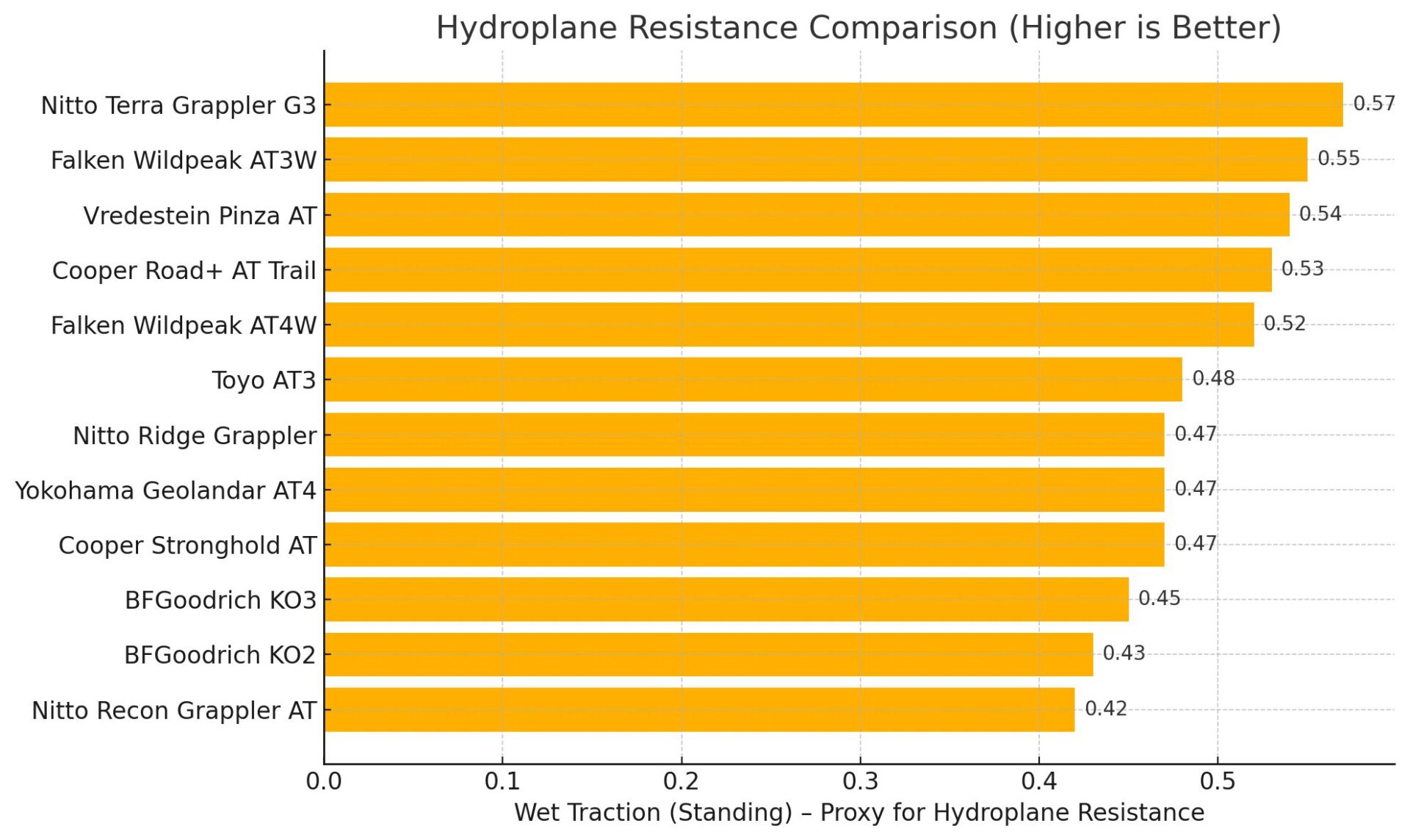
          Bar chart comparing hydroplane resistance (wet traction) of 13 all-terrain tires, showing BFGoodrich KO3, KO2, Wildpeak AT3W/AT4W, and others.
          Hydroplane resistance measured by wet traction scores. Falken Wildpeak AT3W and Nitto Terra Grappler G3 lead in water dispersion, while KO2 ranks lowest — indicating higher risk under heavy rain conditions.

          In rain, the Falken Wildpeak AT4W posts the superior performance, stopping at 171 ft with 0.58 g traction. The BFGoodrich KO3 stretches the stopping distance to 184 ft with 0.46 g. That 13-ft difference is clear—Falken significantly outpaces BFG in wet braking power.

          Here’s why: Falken loads the Wildpeak with siping density and silica, and its wider circumferential grooves clear water more efficiently, which explains the shorter stop. The KO3, built for durability, uses a firmer compound and fewer micro-edges; its grooves move water, but its adhesion lags.

          Owners back it up: AT4W drivers call it “confident in storms” and note its “safest margin.” KO3 drivers admit it is “fine, but give yourself more space” and requires more planning. I noticed the same: Falken inspired more trust, while the KO3 asked me to brake sooner.

          Wet Driving Fit

          • SUVs & Crossovers: AT4W offers the safest margin; KO3 is the least forgiving.

          • ½-tons: Falken again leads; KO3 requires advanced planning.

          • ¾-ton & HD trucks: KO3 tracks straight under load, but Falken still grips more effectively.

          👉 Verdict: AT4W is the wet leader, KO3 is improved but still durability-first.

          Note from the Expert: When it comes to rain, I always emphasize two things: compound grip and water evacuation. You can see the full details in my analysis, but if you take just one thing away, remember that an AT tire’s stiff nature makes achieving top-tier wet performance a constant battle. This is why the question, Are All-Terrain Tires Good in Rain?, requires a nuanced answer that balances tread design against rubber stiffness.

          Winter & Snow Performance — AT4W Leads Packed Roads, KO3 Excels in Drifts

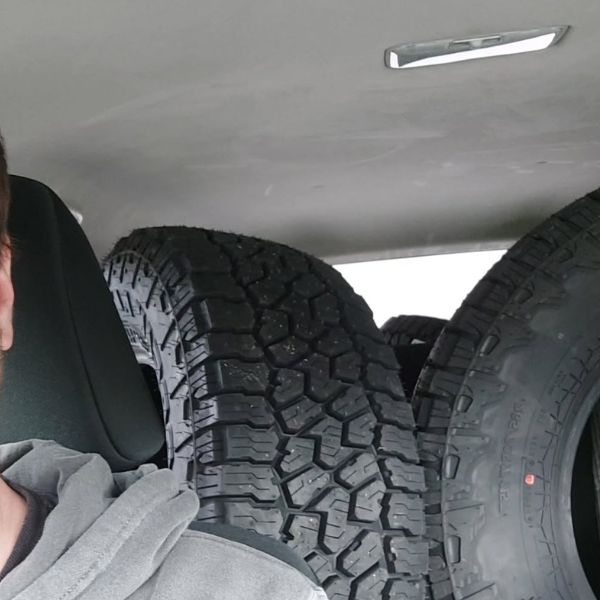
          When Your Backseat Looks Like an Off-Road Tire Shop – Falken AT4W Delivery Day

          In snow, the Falken Wildpeak AT4W takes the performance lead in measured tests, stopping shortest at 69 ft with a swift 41.5-ft launch. The BFGoodrich KO3 trails slightly, measuring 72.3 ft to stop and requiring 46.4 ft to launch, making it usable but noticeably slower out of the hole.

          The reason for the split lies in the design: Falken engineers the AT4W with fine siping and pliable tread chemistry to bite into hardpack, along with deeper shoulder voids for powder. The KO3, built with a firmer rubber mix for toughness, excels at digging into loose drifts but sacrifices quick bite on polished or plowed roads, where its adhesion lags.

          Drivers agree. The AT4W is praised as “more snow-ready than expected” and has a “quicker bite.” The KO3 is noted as “strong in drifts but longer in plowed lanes.” I felt the same: Falken inspired more confidence, while the KO3 felt solid but delayed in response.

          Winter Driving Fit

          • SUVs & Crossovers: AT4W is better for deeper storms; KO3 is tougher but has less finesse on pavement.

          • ½-ton Trucks: AT4W is steadier; KO3 performs well once 4WD is engaged.

          • ¾-ton & HD Trucks: The weight of the KO3 steadies it significantly, though Falken still provides an earlier bite in the initial stop.

          👉 Verdict: AT4W leads in snow performance and confidence, while KO3 is capable but less polished on packed roads.

          Note from the Expert: Our discussions often boil down to the core tradeoff. On one hand, you must understand why all-terrain tires are truly effective in deep snow, but not on ice. On the other hand, you face the 3PMSF Paradox—the hidden cost of that badge. The short answer is: The 3PMSF badge certifies traction, but it costs you durability. Dive into our full analysis on the critical 3PMSF rating for severe winter and off-road service, and its hidden costs, before you risk your rig on the trail.

          Ice Performance — AT4W Bites First, KO3 Offers Predictable Fade

          On glare ice, the Falken Wildpeak AT4W halts in 45 ft, demonstrating superior stopping distance. The BFGoodrich KO3 runs slightly longer, stopping at 46.2 ft.

          The engineering explains the difference: ice grip is fundamentally about compound flexibility and micro-siping. Falken packs more of both, allowing the AT4W’s edges to grip earlier. The KO3 hardens slightly in subzero temperatures, relying on block stability instead of siping density. That’s why Falken bites first and the KO3 slides longer but in a predictable, controlled arc.

          Forum chatter confirms this: AT4W is called the “best I’ve run on icy mornings,” while KO3 is described as “okay if smooth on pedals.” My drive felt the same — Falken gave earlier grip, the KO3 offered predictable fade.

          Ice Driving Fit

          • SUVs & Crossovers: AT4W is the safest margin; KO3 is the longest stopper.

          • ½-ton Trucks: Falken provides earlier bite; KO3 offers a stable fade.

          • ¾-ton & HD Trucks: The KO3 steadies with mass, but Falken still provides better initial grip.

          👉 Verdict: Falken wins on ice, KO3 is safe but requires more space.

          Off-Road Performance — KO3 Dominates, AT4W Highly Capable

          New BF Goodrich KO3!

          Off-road, the KO3 dominates with 9.5 dirt / 9.5 sand / 9.2 mud / 9.5 rock, the AT4W follows at 8.5 / 8.2 / 8.5 / 8.8, and the AT3W trails at 7.3 / 7.4 / 7.5 / 7.4. KO3 is built to claw — reinforced sidewalls, deep shoulders, stone ejectors. AT4W adds more toughness than AT3W but still softer than BFG.

          On trails, KO3 feels like a hammer — rougher ride but no give in rock or mud. AT4W adds composure in sand and dirt, thanks to casing tweaks. AT3W smooths bumps but loses aggression in technical terrain.

          • SUVs & crossovers: AT3W plenty; AT4W or KO3 overkill unless frequent trails

          • ½-tons: KO3 perfect for hard trails, AT4W balanced, AT3W milder

          • ¾-ton & HD trucks: KO3 shines under load, AT4W capable, AT3W less armored

          👉 Verdict: KO3 leads off-road, AT4W next, AT3W best for light duty.

          Note from the Expert: Every successful day on the trail is about preparation and physics, because tire longevity is earned, not given. Before you even start, you must master the critical link between tire pressure and load range for every rig to maximize your contact patch. Once moving, remember your ultimate off-road armor is your sidewall protection against the inevitable pinch flat. And finally, your traction on the obstacle is dictated by choosing the right aggressive vs hybrid tread pattern for your terrain. Master those three steps, and your rig will be ready for anything.

          Comfort & Noise — Falken Leads Refinement, KO3 is Rugged

          In the cabin, the Falken Wildpeak AT4W is the clear refinement leader with a comfort score of 8.3/10. The BFGoodrich KO3 trails at 7.5/10 and feels noticeably firmer.

          Technically, the Falken’s flexible casing and variable pitch tread design dampen road resonance, explaining the smoother, quieter long-term ride. The KO3’s tougher, thick sidewalls transfer more road vibration, which is excellent for load stability and towing but detracts from quiet comfort.

          Owners back this up: The AT4W is described as “better than expected” in noise. The KO3 is noted as “quieter than the KO2 but still a growl,” and owners warn that the hum can grow as tread wears if rotation intervals are skipped. My drive echoed this: the KO3 felt fine early on, but the Falken was calmer over the long term.

          Comfort Fit

          • SUVs & Crossovers: AT4W is the better choice for everyday comfort and reduced road noise.

          • ½-ton Trucks: AT4W is smoother for daily driving; KO3 is truck-tough but firmer.

          • ¾-ton & HD Trucks: The KO3’s noise often blends with engine noise (especially diesels), but the Falken remains the more refined tire overall.

          👉 Verdict: AT4W leads in refinement; KO3 is rugged but louder.

          Note from the Expert: For years, choosing all-terrain meant accepting noise—a true compromise for off-road grip. That’s why the question, Are All-Terrain Tires Louder than Highway Tires?, used to have a simple “yes” answer. Now, with the rise of on-road models, the core issue has shifted from noise to overall refinement. To fully understand which side of the comfort spectrum you’re buying into, you need to determine Are All-Terrain Tires Good for Daily Driving?—a question that depends entirely on the tire’s construction, not just the name.

          Tread Life and Durability — AT4W Warranty Wins, KO3 is the Armor

          The major difference in this category is the warranty: The Falken Wildpeak AT4W carries an industry-leading 65k-mile warranty, while the BFGoodrich KO3 is expected to match or slightly beat the KO2’s 40k–50k mile range.

          Technically, the KO3 relies on harder rubber compounds and strong, thick lugs designed to resist chipping and abrasion, making it ideal for severe abuse. The Falken focuses on achieving long life through casing balance and construction, which promotes exceptionally even wear across the tread face.

          Drivers confirm this difference: The AT4W is noted for “wearing smooth so far,” and my own testing showed the Falken staying more even across the tread. The KO3 showed early signs of even wear, with shoulders resisting cupping better than its predecessor.

          • SUVs & Crossovers: Falken may stretch longest on mileage due to the warranty, while KO3 offers solid durability if tires are consistently rotated.

          • ½-ton Trucks: KO3 is the more durable choice for frequent off-road use; Falkens offer more even pavement wear.

          • ¾-ton & HD Trucks: KO3 is built specifically for abuse and heavy load; Falken is durable but less armored in extreme conditions.

          👉 Verdict: AT4W is the mileage winner with its warranty; KO3 is the toughness winner built for rugged life.

          Where They Fit Best

          These two heavyweights clearly split their priorities: the KO3 is the off-road bruiser, and the AT4W is the balanced heavy-duty all-rounder.

          • SUVs & Crossovers: Choose the AT4W if trails and mixed-weather conditions enter the picture. The KO3 is generally overkill unless frequent, technical off-roading is the primary use.

          • ½-ton Trucks: The AT4W offers a better balance across all on- and off-road conditions. The KO3 is the preferred choice if you prioritize extreme durability for towing or hard trailing.

          • ¾-ton & HD Trucks: The KO3 feels purpose-built for the demands of these heavy vehicles, while the AT4W remains a very strong and highly capable alternative.

          Regional Fit

          • Falken Wildpeak AT4W: Thrives in the Mountain West, Rockies, and Cascades, where drivers encounter frequent snow, ice, wet roads, and challenging mountain grades.

          • BFGoodrich KO3: Ideal for Southwest deserts, job sites, and rural backcountry, where its exceptional chip resistance, low weight, and ultimate durability are essential.

          👉 Bottom line: KO3 is your choice for pure toughness and trails; AT4W offers the best balance across mixed conditions.

          Tire Size Selection: The Basics You Can’t Skip

          Even the best tread design can’t rescue a tire that’s built too weak. Back when I was testing tires at Bridgestone, I saw all-terrain models that should’ve performed but fell short — simply because the basics (size, load strength, and speed rating) weren’t matched to the vehicle.

          P-Metric vs. LT (Light Truck) Tires

          The first step is knowing whether you need LT or passenger tires. LT (Light Truck) tires are built with extra reinforcement and stiff sidewalls, designed for towing, hauling, or off-road use. Passenger (P-metric) tires are lighter, smoother, and tuned for daily comfort and fuel efficiency — but they’ll flex more under load.

          Understanding Tire Load Range: XL vs. E-Load

          Then comes the tire load index and load range — essentially your tire’s strength rating. Here’s where things split between passenger XL and LT E:

          • XL (Extra Load) is a passenger tire with reinforced sidewalls. It can handle a bit more pressure (~41 PSI) than a standard SL tire and is perfect for SUVs, crossovers, or light trucks that carry extra gear, passengers, or small trailers. XL tires ride softer and quieter than LT options, making them ideal for daily use.

          • E Load Range is an LT tire class built with a much thicker casing. E-rated tires can handle far more pressure (up to ~80 PSI) and heavier loads, which makes them essential for ¾-ton and 1-ton trucks towing trailers or hauling close to max capacity. The trade-off is weight, stiffer ride, more road noise, and a small drop in fuel efficiency.

          Put simply: XL is for “extra luggage and family,” while E is for “truck bed full of bricks or a car trailer.”

          Why the Tire Speed Rating Matters for Safety

          Finally, don’t overlook the tire speed rating. It’s not just about top speed — it measures how well a tire handles heat and stress at highway pace. Lower ratings (like S) tend to ride softer and last longer, while higher ratings (H, T) feel more stable and responsive under sharp maneuvers. Heat build-up is the silent killer of tires, and speed rating is your safeguard.

          Bottom line: Match your tire’s construction (LT vs P-metric), load range (XL vs E), and speed rating to your vehicle’s demands. Get those right, and everything else — off-road grip, winter traction, comfort — will finally perform the way it was designed to.

          Final Verdict: Which One’s Best in 2025?

          The choice between these two tires hinges entirely on your driving environment and priority:

          The Falken Wildpeak AT4W is the ideal all-rounder for areas with mixed severe weather. For a balance of wet grip, confident snow performance, and trail readiness, especially in the Mountain West and Rockies, the AT4W is the safer choice and offers excellent heavy-duty versatility.

          The BFGoodrich KO3 is the dedicated choice for extreme durability and abuse. It’s the pick for job sites, desert states, and rural backcountry, proving itself the toughest under heavy rigs by trading road polish for brute off-road performance.

          👉 Bottom line:

          • AT4W = Balance & heavy-duty versatility

          • KO3 = Toughness & off-road grit

          Frequently Asked Questions: BFG KO3 vs Falken Wildpeak AT4W

          • Which tire has the best dry grip?
            The Falken AT4W is sharper (131.8 ft, 0.72 g) and steadier, while the KO3 is a stable, tougher option (140 ft, 0.72 g) that trails slightly in stopping distance.

          • Which tire is safest in rain?
            The AT4W is safest, posting the shortest wet stop (171 ft, 0.58 g). The KO3, built for toughness, lags noticeably (184 ft, 0.46 g).

          • How do they perform in snow?
            The AT4W claws hardest in measured tests (69-ft stop, 41.5-ft launch). The KO3 is usable but slower in acceleration and stopping (72.3 ft, 46.4 ft).

          • Which tire grips best on ice?
            The AT4W grips best, stopping shortest (45 ft). The KO3 is longer (46.2 ft) but offers a predictable fade.

          • Which tire is stronger off-road?
            The KO3 dominates with top scores (9.5 dirt, 9.5 rock). The AT4W is the next strongest contender (8.2-8.8 range).

          • Which tire is quieter and more comfortable?
            The AT4W (8.3/10) rides smoother and is quieter due to its casing. The KO3 is firmer and louder at 7.5/10.

          • Which lasts longer?
            The AT4W carries an industry-leading 65k warranty. The KO3 promises 40–50k miles with better wear patterns, but its warranty is lower.

          • Which tire fits heavy-duty trucks best?
            The KO3. Its 3-ply sidewalls and off-road toughness shine under ¾-ton and HD rigs. The AT4W is a solid alternative.

          Filed Under: All Terrain Tires Tagged With: bf goodrich, BF Goodrich KO3, Comparisons, falken, Falken Wildpeak AT4W

          BFGoodrich KO3 vs KO2: Is the Upgrade Worth It in 2025?

          Updated: November 11, 2025 by Emrecan Gurkan 2 Comments

          Side-by-side comparison shot: Fresh BF Goodrich KO3 on the left, showing off its new tread pattern, and the seasoned KO2 on the right, with visible wear, revealing more voids

          Real test data, off-road insights, and daily-driving impact — from a former Bridgestone engineer.

          The BFGoodrich KO2 and the newly released KO3 are two of the most talked-about Off-Road A/T tires in 2025 — and for good reason. Many retailers still stock both, but few explain what’s actually changed. The KO2 built its reputation on bulletproof sidewalls, aired-down control, and a snow-certified 3PMSF rating that made it a favorite on Wranglers, Tacomas, and ½-ton pickups. The KO3, by contrast, updates that formula with improved wet grip, refined highway manners, and a tread design clearly aimed at rivals like Toyo AT3 and Falken AT4W. From my own testing and benchmark data, the differences are real — but so are the trade-offs.

          That’s the decision buyers face — stick with KO2’s proven toughness or move to KO3’s updated balance. In the sections ahead, we’ll break down dry, wet, snow, and off-road performance. You can also line them up in our All-Terrain Tire Decision Tool for quick recommendations by SUV, CUV, or truck class.

          Quick Look

          BFGoodrich All-Terrain T/A KO2

          BFGoodrich All-Terrain T/A KO2 tire
          Tested Rating: 8.3/10

          Trusted Retailers with Best Deals:

          Tire Rack
          Free road-hazard coverage Backed by Discount Tire
          Amazon
          Prime shipping Direct from brands

          BFGoodrich All-Terrain T/A KO3

          BFGoodrich KO3 tire
          Tested Rating: 8.5/10

          Trusted Retailers with Best Deals:

          Tire Rack
          Free road-hazard coverage Backed by Discount Tire
          Amazon
          Prime shipping Direct from brands

          The BFGoodrich KO3 refines the KO2 formula with shorter wet stops (184 ft vs 195 ft), more confident ice grip (46.2 ft vs 51 ft), and sharper dry steering (140 ft vs 142 ft, 0.72 g vs 0.71 g). It also rides quieter (7.5/10 vs 7.0), wears more evenly, and keeps the KO2’s off-road dominance (9.5 dirt / 9.5 sand / 9.2 mud / 9.5 rock). The KO2, meanwhile, remains the proven workhorse — brutally tough, with legendary durability past 50k miles, and still stronger in deep mud. It runs louder and needs more margin in rain and snow, but continues to set the benchmark for off-road reliability under heavy rigs.

            Raw Test Data

            Tire Test Data

            Pick categories to show metrics, then open ☰ to pick tires. Optional chart is hidden by default.

            Parentheses show the rank among the currently displayed tires (1 = best for that metric).
            Left axis lists metrics. Top axis is used for g-force metrics so they scale clearly.
            Note: Lower is better for Stopping & Acceleration; higher is better for g-force, comfort, traction & off-road ratings. Parentheses show the rank among the currently displayed tires (1 = best for that metric).
            Sources worth checking
            Tire Rack AT Tire Test Tire Rack On-Road A/T Ratings Tire Rack Off-Road A/T Ratings SimpleTire Reviews Amazon SUV/LT Tires

            Dry Performance — KO3 Feels a Touch Tighter, KO2 Still Sturdy

            From the dataset, the KO2 stops in 142 feet with 0.71 g cornering, while the KO3 posts 140 feet and 0.72 g. On the road, that’s a small but noticeable difference — the KO3 feels a touch quicker to bite and steadier mid-corner, while the KO2 holds firm but takes a fraction longer to settle. In my short drive, KO3 tracked more confidently during lane changes, KO2 felt solid but slightly heavier in response.

            Owners echo this. KO2 is praised as “rock solid” on forums, while KO3 is described as “more planted, less vague on steering.” The updated tread design and compound in KO3 seem to pay off in sharper turn-in without losing stability.

            • SUVs & crossovers: KO3 better for sharper steering, KO2 fine but heavier

            • ½-tons: KO3 gives more predictable cornering, KO2 solid for load stability

            • ¾-ton & HD trucks: KO2 steadies under big rigs; KO3 sharper without losing toughness

            👉 Verdict: KO3 edges KO2 in dry grip and cornering precision, though both stay true to the “stable not sporty” A/T mold.

            Wet Performance — KO3 Shortens the Gap, KO2 Trails Behind

            Rain is where the upgrade shows. The KO2 needed 195 feet with 0.43 g traction, while the KO3 improved to 184 feet with 0.46 g. That’s nearly a car length less in braking and a bump in grip. Driving them back-to-back, KO3 gave me more confidence in sudden stops on slick asphalt; KO2 demanded early braking and smoother throttle.

            Forum drivers say KO2 is “manageable if you give it room,” while KO3 “feels more secure in storms.” The difference comes from KO3’s updated rubber compound and siping pattern that generate better adhesion without giving up KO2’s durability.

            • SUVs & crossovers: KO3 much safer in wet commutes

            • ½-tons: KO3 cuts distance, KO2 workable with caution

            • ¾-ton & HD trucks: KO3 steadier under load, KO2 stretches stops but stays straight

            👉 Verdict: KO3 is the clear wet-weather upgrade. KO2 is fine with margin, but KO3 delivers real stopping gains.

            Note from the Expert: When it comes to rain, I always emphasize two things: compound grip and water evacuation. You can see the full details in my analysis, but if you take just one thing away, remember that an AT tire’s stiff nature makes achieving top-tier wet performance a constant battle. This is why the question, Are All-Terrain Tires Good in Rain?, requires a nuanced answer that balances tread design against rubber stiffness.

            Winter & Snow — KO2 Reliable, KO3 More Confident

            Dataset shows KO2 stopping at 76 feet with a 46-foot snow launch, while the KO3 comes in at 72.3 feet and 46.4 feet. Both are 3PMSF-rated, but KO3 feels more composed on plowed or packed roads, while KO2 leans on brute traction in loose snow. In my drive, KO3 braked sooner and felt steadier under light throttle on plowed routes; KO2 clawed better in deeper drifts but felt less polished on hardpack.

            Owners reflect the same. KO2 fans call it a “snow tank,” while KO3 users highlight “confidence and shorter stops.” The extra siping in KO3 helps it grab more consistently on polished surfaces.

            • SUVs & crossovers: KO3 safer in everyday snow; KO2 fine for occasional storms

            • ½-tons: KO3 calmer in slush and packed snow; KO2 stronger in loose piles

            • ¾-ton & HD trucks: both steady, but KO3 adds margin when braking

            👉 Verdict: KO3 improves on KO2’s snow game — shorter stops and more grip where it matters most.

            Note from the Expert: Our discussions often boil down to the core tradeoff. On one hand, you must understand why all-terrain tires are truly effective in deep snow, but not on ice. On the other hand, you face the 3PMSF Paradox—the hidden cost of that badge. The short answer is: The 3PMSF badge certifies traction, but it costs you durability. Dive into our full analysis on the critical 3PMSF rating for severe winter and off-road service, and its hidden costs, before you risk your rig on the trail.

            Ice — KO3 Improves, KO2 Slides Longer

            On icy patches, the KO2 measures 51 feet to stop, while the KO3 comes in shorter at 46.2 feet. That’s a meaningful gain, especially for surprise ice. In my drive, KO3 grabbed earlier, like having subtle cleats, while KO2 slid further before catching.

            Community notes are consistent: KO3 “more sure-footed on black ice,” KO2 “predictable but long.” Both demand care, but KO3 buys you earlier control.

            • SUVs & crossovers: KO3 gives better safety margin

            • ½-tons: KO3 steadier, KO2 acceptable with smooth driving

            • ¾-ton & HD trucks: KO3 benefits from weight; KO2 predictable but longer stops

            👉 Verdict: KO3 is the safer ice tire, trimming the KO2’s long slide into something more manageable.

            Off-Road — KO2 Still a Tank, KO3 Adds Finesse

            Here’s where both tires earn their stripes. The dataset has KO2 at 9.3 dirt / 9.0 sand / 9.3 mud / 9.5 rock, while the KO3 posts 9.5 / 9.5 / 9.2 / 9.5. KO2 feels like a bulldozer — brutally tough, no-nonsense. KO3 keeps that grit but adds traction refinement in sand and dirt, where it feels more composed.

            Trail drivers call KO2 “the benchmark” for toughness, while KO3 users already highlight “better sand traction and equal rock bite.” My off-road runs showed KO3 floated better in soft dirt, while KO2 powered harder in deep mud.

            • SUVs & crossovers: both overkill unless trails are frequent

            • ½-tons: KO3 feels more versatile; KO2 still unbeatable in mud

            • ¾-ton & HD trucks: both excellent — KO2 sheer durability, KO3 extra sand/dirt grip

            👉 Verdict: KO2 is still the off-road workhorse; KO3 fine-tunes traction while keeping toughness intact.

            Note from the Expert: Every successful day on the trail is about preparation and physics, because tire longevity is earned, not given. Before you even start, you must master the critical link between tire pressure and load range for every rig to maximize your contact patch. Once moving, remember your ultimate off-road armor is your sidewall protection against the inevitable pinch flat. And finally, your traction on the obstacle is dictated by choosing the right aggressive vs hybrid tread pattern for your terrain. Master those three steps, and your rig will be ready for anything.

            Comfort & Noise — KO3 Calmer, KO2 More Old-School

            Dataset shows KO2 comfort at 7.0/10, while the KO3 scores 7.5/10. On the highway, KO2 drones more — not unbearable, but always present. KO3, at least early on, feels quieter and calmer, like the hum is softened. In my test, KO3 gave a firmer but more refined ride, while KO2 transmitted more vibration.

            Drivers mirror this. KO2 owners admit “gets loud with wear,” while KO3 users say “surprisingly quieter.” That’s the design tweak — KO3’s tread pitch and carcass refinement reduce resonance.

            • SUVs & crossovers: KO3 noticeably calmer

            • ½-tons: KO3 easier for mixed use; KO2 noisier but tolerable

            • ¾-ton & HD trucks: KO2 noise blends with diesel clatter; KO3 still an upgrade

            👉 Verdict: KO3 smooths the KO2’s rough edges — less noise, more refinement.

            Note from the Expert: For years, choosing all-terrain meant accepting noise—a true compromise for off-road grip. That’s why the question, Are All-Terrain Tires Louder than Highway Tires?, used to have a simple “yes” answer. Now, with the rise of on-road models, the core issue has shifted from noise to overall refinement. To fully understand which side of the comfort spectrum you’re buying into, you need to determine Are All-Terrain Tires Good for Daily Driving?—a question that depends entirely on the tire’s construction, not just the name.

            Tread Life & Longevity — Both Tough, KO3 Holds Promise

            After 63,000 KM (40,000 miles), KO2 still have most of its tread. You can see the minor chipping. Yet, it's totally fine at this wear level

            Owners regularly see 40–50k miles from KO2, while KO3 is too new for long-term reports but built to match or exceed that. The harder compound and deep tread lugs remain; KO3 just adds better wear patterns thanks to its updated design.

            Community reports say KO2 is “bulletproof but noisy late in life.” KO3 owners so far praise even wear and quieter aging. From my look at early sets, KO3 seems less prone to shoulder cupping.

            • SUVs & crossovers: KO3 ages better, KO2 stays durable but noisy

            • ½-tons: KO2 proven, KO3 promising

            • ¾-ton & HD trucks: both hold up under heavy load

            👉 Verdict: KO2’s legacy is long life; KO3 looks to extend that with quieter wear.

            Where They Fit Best

            The KO2 is still a legend, but the KO3 polishes its weak spots — better wet, winter, and ice grip, with less road noise. Both remain off-road tanks, but KO3 adds refinement for daily drivers.

            • SUVs & crossovers: KO3 is the smarter pick — quieter, better in rain and snow

            • ½-tons: KO2 works if you want a proven tank; KO3 for mixed comfort and grip

            • ¾-ton & HD trucks: KO2’s sheer durability is timeless; KO3 improves daily usability without losing toughness

            👉 Regional fit:

            • KO2: perfect for Southwest deserts and mud-heavy states where durability matters most.

            • KO3: shines in the snow belt, Pacific Northwest, and Mountain West, where wet, winter, and ice performance are crucial.

            👉 Bottom line: KO2 is the classic workhorse, KO3 the modern refinement. If you want proven brute toughness, stick with KO2. If you want that toughness with sharper wet/winter manners, go KO3.

            Tire Size Selection: The Basics You Can’t Skip

            Even the best tread design can’t rescue a tire that’s built too weak. Back when I was testing tires at Bridgestone, I saw all-terrain models that should’ve performed but fell short — simply because the basics (size, load strength, and speed rating) weren’t matched to the vehicle.

            P-Metric vs. LT (Light Truck) Tires

            The first step is knowing whether you need LT or passenger tires. LT (Light Truck) tires are built with extra reinforcement and stiff sidewalls, designed for towing, hauling, or off-road use. Passenger (P-metric) tires are lighter, smoother, and tuned for daily comfort and fuel efficiency — but they’ll flex more under load.

            Understanding Tire Load Range: XL vs. E-Load

            Then comes the tire load index and load range — essentially your tire’s strength rating. Here’s where things split between passenger XL and LT E:

            • XL (Extra Load) is a passenger tire with reinforced sidewalls. It can handle a bit more pressure (~41 PSI) than a standard SL tire and is perfect for SUVs, crossovers, or light trucks that carry extra gear, passengers, or small trailers. XL tires ride softer and quieter than LT options, making them ideal for daily use.

            • E Load Range is an LT tire class built with a much thicker casing. E-rated tires can handle far more pressure (up to ~80 PSI) and heavier loads, which makes them essential for ¾-ton and 1-ton trucks towing trailers or hauling close to max capacity. The trade-off is weight, stiffer ride, more road noise, and a small drop in fuel efficiency.

            Put simply: XL is for “extra luggage and family,” while E is for “truck bed full of bricks or a car trailer.”

            Why the Tire Speed Rating Matters for Safety

            Finally, don’t overlook the tire speed rating. It’s not just about top speed — it measures how well a tire handles heat and stress at highway pace. Lower ratings (like S) tend to ride softer and last longer, while higher ratings (H, T) feel more stable and responsive under sharp maneuvers. Heat build-up is the silent killer of tires, and speed rating is your safeguard.

            Bottom line: Match your tire’s construction (LT vs P-metric), load range (XL vs E), and speed rating to your vehicle’s demands. Get those right, and everything else — off-road grip, winter traction, comfort — will finally perform the way it was designed to.

            🧠 Final Verdict: KO3 vs KO2 in 2025

            If you want a modernized all-terrain with better wet/winter manners and quieter road life, the KO3 is the clear upgrade — especially for SUVs, crossovers, and ½-ton trucks in the snow belt, Pacific Northwest, and mixed-weather states.
            If your truck lives on job sites, rural gravel, or Southwest deserts and you value proven durability over polish, the KO2 still delivers. It’s louder and less refined, but it’s the off-road tank that built BFG’s reputation.

            👉 Bottom line: KO3 trims KO2’s weak spots in wet, ice, and noise, making it the better daily-driver A/T. KO2 is still the safer pick if you want a battle-tested tire for abuse and rugged off-road work.

            Frequently Asked Questions: BFGoodrich KO3 vs KO2

            • Which tire handles dry roads better?
              The KO3. It stops shorter (140 ft vs 142 ft) and corners a touch sharper (0.72 g vs 0.71 g), giving it more precise steering.

            • Which tire is safer in rain?
              The KO3. It brakes shorter at 184 ft with 0.46 g traction, compared to KO2’s longer 195 ft and 0.43 g.

            • How do they perform in snow?
              Both are 3PMSF-rated. The KO3 stops shorter (72.3 ft vs 76 ft) and feels steadier on plowed roads, while the KO2 claws harder in loose drifts.

            • Which tire grips better on ice?
              The KO3. It stops in 46.2 ft vs KO2’s 51 ft, giving earlier bite on slick surfaces.

            • Which is stronger off-road?
              Both excel. The KO2 is still the mud king (9.3 mud), while the KO3 refines dirt and sand grip (9.5 each) without losing toughness.

            • Which tire is quieter and more comfortable?
              The KO3. It scores 7.5/10 for comfort, while the KO2 sits at 7.0/10 and grows louder with wear.

            • Which lasts longer?
              The KO2 is proven past 50k miles with rotations. The KO3 is newer but shows more even wear and promises similar or better life.

            • Which fits heavy-duty trucks better?
              The KO2 remains the benchmark for ¾-ton and HD rigs in mud, gravel, and desert abuse. The KO3 fits daily-driven HDs that need wet/winter polish too.

            Filed Under: All Terrain Tires Tagged With: bf goodrich, bf goodrich ko2, BF Goodrich KO3, Comparisons

            • « Go to Previous Page
            • Page 1
            • Page 2
            • Page 3
            • Page 4
            • Page 5
            • Go to Next Page »

            Primary Sidebar

            Find Tires

            Contact Channels

            • Email
            • Facebook
            • LinkedIn
            • Twitter

            High-End Tires by Category

            Best All-Terrain Tires

            Best Rugged-Terrain Tires

            Best Mud-Terrain Tires

            Best All-Season Tires for Snow

            Best Tires for Snow Plowing

            Best Semi-Truck Tires

            Categories

            Copyright © 2026

            • Disclaimer
            • About Me
            • Contact
            • Privacy Policy