

Real-world test data, technical breakdowns, and use-case recommendations — from a former Bridgestone test engineer.
The Falken Wildpeak AT4W is Falken’s newest Off-Road A/T tire, improving on the AT3W with stronger ice stopping, safer wet braking, and impressively low road noise for its class. Snow-certified with the 3PMSF rating, it delivers year-round confidence without punishing drivers on the highway. For the full generational breakdown, check my Falken Wildpeak AT4W vs AT3W guide. The Cooper Discoverer Road+ AT Trail, meanwhile, fits the On-Road A/T category. It isn’t a hardcore off-roader, but it’s tuned for SUVs and crossovers that need secure wet grip, snow traction, and light dirt capability — all while keeping the ride smooth, quiet, and fuel-efficient.
That’s the trade-off buyers face — AT4W for snow-ready toughness and all-terrain balance vs AT Trail for daily-driver comfort and efficiency. In the sections ahead, I’ll compare them across dry, wet, snow, and off-road testing. You can also line them up directly in our All-Terrain Tire Decision Tool for tailored recommendations by SUV, CUV, or truck class.
🔍 Quick Look
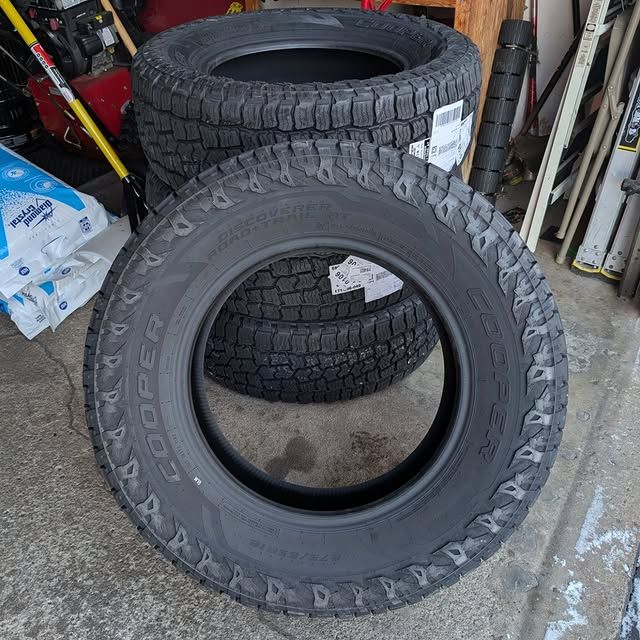
Cooper Discoverer Road + Trail AT

Falken Wildpeak A/T4W

The Falken Wildpeak A/T4W brings sharper reflexes and stronger all-weather muscle, lunging into corners with a 131.8-ft dry stop and 0.72 g grip, steadying itself in storms with a 171-ft wet stop (0.58 traction), and pulling confidently through packed snow at 69 ft. Its silica compound and dense siping keep it calm on ice (45.0-ft stop) and predictable mid-slide. Off-road, it’s trail-ready with 8.5–9.0 scores across dirt, mud, and rock, reinforced by sidewalls tough enough for towing. You’ll hear a hum on the highway, but it’s one most drivers can live with. It’s the tire to choose when storms, trailers, or weekend trails are on the agenda. The Cooper Road+ AT Trail takes a different approach — lighter, smoother, and quieter, with a shorter 167-ft wet stop and a slight edge on ice (44.4-ft stop), though it trades away cornering bite. In dry driving, its 132-ft stop and 0.74 g grip come with calmer, forgiving manners. Comfort is its ace (9.0/10), earning praise for “dead quiet” rides and even noticeable MPG gains. Off-road, it’s more of a gravel and fire-road shoe than a rock boot, scoring 6.0–6.5 in dirt and mud. It’s the daily-friendly A/T for suburban drivers and light pickups.
Table of Contents
Dry Performance — Falken lunges, Cooper eases in
On a dry on-ramp, the personalities split fast. Falken stops at 131.8 ft with 0.72 g cornering; Cooper comes in at 132 ft with 0.74 g. Nearly identical on paper, but they don’t feel the same. Falken is like a dog straining at the leash — quick steering bite, eager to dive. Cooper rolls in smoother, less dramatic, and forgiving if you’re just cruising.
On TacomaWorld, a Wildpeak driver said, “steering responsiveness shockingly good.” On Ranger5G, a Cooper owner praised them as “dead quiet … steer great … feels like less rolling resistance … expect to pick up MPG.”
From a field-test perspective, the difference is design. Falken’s bigger shoulders and tighter block arrangement fire off quicker, so it feels sharper at turn-in. Cooper’s rib-centered tread lays down more rubber evenly, which keeps transitions smooth but less immediate. And while Cooper feels calm for SUVs and lighter pickups, once you introduce load, Falken’s reinforced sidewalls keep the line truer.
SUVs & crossovers: Cooper feels easier and calmer.
½-ton trucks: Falken gives sharper response; Cooper stays comfortable if unloaded.
¾-ton & HD: Falken is the clear choice — stiffer build means better tracking under weight.
👉 Verdict: Falken brings sharper steering and load stability; Cooper stays smooth in lighter, daily use.
Wet Performance — More rubber vs more bite
In the rain, their personalities change again. Cooper halts shorter (167 ft, 0.53 g), while Falken runs 171 ft with stronger lateral traction (0.58 g). Cooper lays down more continuous rubber in a stop, while Falken holds composure better in standing water and sweepers.
On TacomaWorld, a Wildpeak owner said, “Wet traction is very good … noise a bit much but I just turn up the radio.” Meanwhile, Ranger5G users call the Coopers a “very good road tire … handles rain without fuss.”
As an engineer, I’d put it like this: Cooper’s ribs give more rubber-to-asphalt friction in a straight stop. Falken’s silica-rich compound and siping add micro-bite under water film, so while it stops a touch longer, it feels more secure once you’re actually driving through storms.
SUVs & crossovers: Cooper = best brake feel; Falken = steadier at speed.
½-tons: Falken calmer in rain when towing; Cooper still fine for commuters.
¾-ton & HD: Falken steadier under load; Cooper loses composure faster.
👉 Verdict: Cooper wins stoplight braking in the wet; Falken steadies you through real storms.
Note from the Expert: When it comes to rain, I always emphasize two things: compound grip and water evacuation. You can see the full details in my analysis, but if you take just one thing away, remember that an AT tire’s stiff nature makes achieving top-tier wet performance a constant battle. This is why the question, Are All-Terrain Tires Good in Rain?, requires a nuanced answer that balances tread design against rubber stiffness.
Winter & Snow — Both 3PMSF, but tuned differently
Both wear the Three-Peak Mountain Snowflake, but they don’t behave the same. Falken stops shorter on packed snow (69 ft stop / 41.5 ft launch) than Cooper (71.5 / 42.5). In light, shallow snow, Cooper’s rib pattern lays more rubber down — helpful for friction. In deeper pack or drifts, Falken’s compound and siping keep grip longer.
On Trail4Runner, Wildpeak drivers say, “tons of traction in deep snow and packed conditions … incredibly predictable.” On Reddit Overlanding, a Cooper owner described it as a “mild AT … better in winter, quieter, lighter. If you need extra capability, get the Wildpeaks.”
From my sessions, the trade is clear: Cooper feels friendlier in a dusting, but Falken’s softer blend and deeper siping grip plowed surfaces and heavier snow better.
SUVs & crossovers: Cooper fine for light snow; Falken more secure in real winters.
½-tons: Falken wins confidence in salted, plowed lanes.
¾-ton & HD: Falken steadies under trailers; Cooper’s patch can’t keep up under weight.
👉 Verdict: Both are 3PMSF-rated, but Falken is the snow-belt choice; Cooper fits milder winter use.
Note from the Expert: Our discussions often boil down to the core tradeoff. On one hand, you must understand why all-terrain tires are truly effective in deep snow, but not on ice. On the other hand, you face the 3PMSF Paradox—the hidden cost of that badge. The short answer is: The 3PMSF badge certifies traction, but it costs you durability. Dive into our full analysis on the critical 3PMSF rating for severe winter and off-road service, and its hidden costs, before you risk your rig on the trail.
Ice — Spec-sheet edge vs steering calm
On glaze, Cooper stops in 44.4 ft, Falken at 45.0 ft. Straight-line, Cooper edges it. But when you steer, Falken’s pliable rubber lets the sipes hold micro-grip longer — giving smoother breakaway.
Drivers describe it similarly: Cooper grips well if you’re going straight, but Falken feels calmer if you need to steer mid-slide. From a technical view: Cooper’s ribs flatten into more rubber-on-ice for a quick bite, but break quicker. Falken’s softer rubber and sipes stretch grip over a longer window.
SUVs & crossovers: Cooper = best for gentle braking; Falken = steadier for steering inputs.
½-tons: Falken easier to manage on black ice.
¾-ton & HD: Falken holds better with weight; Cooper’s grip feels snappier, less forgiving.
👉 Verdict: Cooper edges the spec sheet; Falken inspires more driver confidence.
Off-Road — Weekend shoes vs trail boots
Numbers tell the story: Falken 8.5 dirt / 8.2 sand / 8.5 mud / 8.8 rock. Cooper 6.5 / 6.5 / 6.0 / 5.8.
On Trail4Runner, Wildpeak owners wrote they felt “planted and stable on rougher, rutted dirt roads … kept slippage to a minimum.” On Ranger5G, a Cooper driver admitted: “forest roads, gravel, occasional muddy stuff. Not looking to rock crawl.”
From my seat, that’s the split: Falken has the shoulders and carcass for mud, rocks, and towing. Cooper stays comfortable on gravel and fire roads, but its construction isn’t built for punishment.
SUVs & crossovers: Cooper for trailheads; Falken for real trails.
½-tons: Falken trail-ready; Cooper fine for gravel.
¾-ton & HD: Falken built for abuse; Cooper isn’t.
👉 Verdict: Falken is the trail boot; Cooper is the suburban sneaker.
Note from the Expert: Every successful day on the trail is about preparation and physics, because tire longevity is earned, not given. Before you even start, you must master the critical link between tire pressure and load range for every rig to maximize your contact patch. Once moving, remember your ultimate off-road armor is your sidewall protection against the inevitable pinch flat. And finally, your traction on the obstacle is dictated by choosing the right aggressive vs hybrid tread pattern for your terrain. Master those three steps, and your rig will be ready for anything.
Comfort & Noise — Library hush vs steady hum
On the highway, Cooper wins decisively. Comfort score: Cooper 9.0 vs Falken’s 8.3.
On Ranger5G, a Cooper driver said they’re “dead quiet … much quieter than stock.” Falken owners on TacomaWorld admitted, “noise is a bit much, but I just turn up the radio.”
The why: Cooper’s ribs put down more rubber evenly, muting resonance. Falken’s voids and blockier shoulders add texture and hum.
SUVs & crossovers: Cooper whisper-quiet.
½-tons: Cooper smoother on interstate; Falken livable with more grip.
¾-ton & HD: Falken hum fades into background, but Cooper is still calmer.
👉 Verdict: Cooper is the comfort winner; Falken hums with intent.
Note from the Expert: For years, choosing all-terrain meant accepting noise—a true compromise for off-road grip. That’s why the question, Are All-Terrain Tires Louder than Highway Tires?, used to have a simple “yes” answer. Now, with the rise of on-road models, the core issue has shifted from noise to overall refinement. To fully understand which side of the comfort spectrum you’re buying into, you need to determine Are All-Terrain Tires Good for Daily Driving?—a question that depends entirely on the tire’s construction, not just the name.
Where They Fit Best
Falken Wildpeak A/T4W
The Wildpeak shines in regions that throw every season at you. In the Northeast and Great Lakes, where snow and slush dominate half the year, its stronger siping and compound inspire confidence on salted highways and plowed roads. Out West, in the Rockies and Pacific Northwest, it balances trail strength with wet-weather grip — perfect for drivers splitting time between mountain passes, logging roads, and heavy rain. In the Southwest, its tougher sidewalls make sense for rocky desert terrain, though some drivers may trade comfort for durability. Best suited for trucks and SUVs that tow, venture off-road, or live in climates where snow is part of the commute.Cooper Discoverer Road+ AT Trail
The Road+ AT Trail is the right fit for drivers living in Sun Belt states like Texas, Florida, or Arizona, where winters are mild and highway miles are the norm. Its quieter ride and better road efficiency stand out on long interstate stretches. In the Midwest plains or suburban regions, where roads stay mostly dry with only occasional snow, the Cooper delivers comfort and predictability without overbuilding for off-road. It’s also a strong match for SUVs and crossovers that want a mild AT look and winter readiness without the harsher ride of a more aggressive design.
👉 Bottom line: Falken is the all-weather warrior — built for mountains, snow belts, and trucks that tow or trail. Cooper is the highway-friendly AT — quiet, efficient, and well-suited to suburban or Sun Belt drivers who still want 3PMSF winter security.
Tire Size Selection: The Basics You Can’t Skip
Even the best tread design can’t rescue a tire that’s built too weak. Back when I was testing tires at Bridgestone, I saw all-terrain models that should’ve performed but fell short — simply because the basics (size, load strength, and speed rating) weren’t matched to the vehicle.
P-Metric vs. LT (Light Truck) Tires
The first step is knowing whether you need LT or passenger tires. LT (Light Truck) tires are built with extra reinforcement and stiff sidewalls, designed for towing, hauling, or off-road use. Passenger (P-metric) tires are lighter, smoother, and tuned for daily comfort and fuel efficiency — but they’ll flex more under load.
Understanding Tire Load Range: XL vs. E-Load
Then comes the tire load index and load range — essentially your tire’s strength rating. Here’s where things split between passenger XL and LT E:
XL (Extra Load) is a passenger tire with reinforced sidewalls. It can handle a bit more pressure (~41 PSI) than a standard SL tire and is perfect for SUVs, crossovers, or light trucks that carry extra gear, passengers, or small trailers. XL tires ride softer and quieter than LT options, making them ideal for daily use.
E Load Range is an LT tire class built with a much thicker casing. E-rated tires can handle far more pressure (up to ~80 PSI) and heavier loads, which makes them essential for ¾-ton and 1-ton trucks towing trailers or hauling close to max capacity. The trade-off is weight, stiffer ride, more road noise, and a small drop in fuel efficiency.
Put simply: XL is for “extra luggage and family,” while E is for “truck bed full of bricks or a car trailer.”
Why the Tire Speed Rating Matters for Safety
Finally, don’t overlook the tire speed rating. It’s not just about top speed — it measures how well a tire handles heat and stress at highway pace. Lower ratings (like S) tend to ride softer and last longer, while higher ratings (H, T) feel more stable and responsive under sharp maneuvers. Heat build-up is the silent killer of tires, and speed rating is your safeguard.
Bottom line: Match your tire’s construction (LT vs P-metric), load range (XL vs E), and speed rating to your vehicle’s demands. Get those right, and everything else — off-road grip, winter traction, comfort — will finally perform the way it was designed to.
Conclusion
For SUVs, crossovers, and ½-ton trucks that live in snow-belt or rainy states, the Falken A/T4W is the safer and steadier pick. It bites earlier in storms, stops shorter in winter, and offers enough off-road strength for drivers who tow or explore on weekends. Heavier trucks especially benefit from its reinforced carcass and planted feel under load.
The Cooper Road+ AT Trail makes more sense for suburban commuters in mild climates. It’s quieter, smoother, and efficient—perfect for SUVs and lighter pickups where noise and comfort matter most, and where trails mean gravel paths, not rock climbs.
👉 Bottom line: Falken is the all-rounder for storms, towing, and trails; Cooper is the calm, quiet commuter AT for mild winters and daily use.
Note: If you’re still weighing your options, our full Falken Wildpeak Buyer’s Guide walks through the AT Trail, AT3W, and AT4W in detail, helping you match the right tire to your vehicle, size, and driving style.
Frequently Asked Questions: Falken Wildpeak A/T4W vs Cooper Road+ AT Trail
Which tire is better in wet conditions?
Cooper stops shorter at 167 ft, while Falken offers steadier traction through standing water and sweepers.How do they compare in winter and snow?
Both are 3PMSF-rated, but Falken stops shorter in packed snow and feels more secure in heavier winter use, while Cooper is fine for light snow.Which tire performs better on ice?
Cooper edges the spec sheet with a 44.4-ft stop, but Falken provides smoother steering control on glare ice.Which tire is more comfortable and quiet?
Cooper is the clear comfort winner, scoring 9.0 with a very quiet ride, while Falken carries a noticeable hum.How do they compare off-road?
Falken scores higher across dirt, mud, and rock, making it trail-ready, while Cooper is best suited for gravel and light off-road use.Which tire fits heavier trucks better?
Falken’s reinforced build tracks truer under load, making it the stronger choice for ¾-ton and HD trucks.Who should choose the Cooper Road+ AT Trail?
Drivers in mild climates who prioritize quiet comfort, efficiency, and suburban commuting will benefit most from the Cooper.Who should choose the Falken Wildpeak A/T4W?
Drivers in snow-belt or wet regions, or those who tow and hit real trails, should pick the Falken for its stability and all-weather grip.