• Skip to primary navigation
  • Skip to main content
  • Skip to primary sidebar

TireTerrain

  • Home
  • Comparisons & Reviews
  • All-Terrain Tire Decision Tool
  • Pro Tips
  • About

ridge grappler

Nitto Ridge Grappler vs Recon Grappler — Off-Road Strength vs Winter Safety in 2025

Updated: November 11, 2025 by Emrecan Gurkan Leave a Comment

Nitto Recon Grappler shares a similar tread pattern with Ridge Grappler. Yet, it lasts longer due to its stiffer compound and light-weight.

Real-world test data, driver impressions, and technical breakdowns — from a former Bridgestone test engineer.

The Nitto Recon Grappler A/T sits in the Off-Road A/T category, designed for drivers who want everyday livability with a touch of trail readiness. With balanced wet grip, snow-certified 3PMSF traction, and a smoother ride than most aggressive A/Ts, it’s the more practical option in Nitto’s lineup for light trucks, SUVs, and Jeeps. The Nitto Ridge Grappler, by contrast, belongs to the Rugged-Terrain category — a hybrid between all-terrain and mud-terrain. It brings blockier tread, sharper dry-road handling, and extra bite in mud and sand, though it sacrifices some wet braking, icy grip, and day-to-day comfort in exchange for that extra aggression.

That’s the decision buyers face — Recon for balance and versatility vs Ridge for hybrid toughness and looks. In the sections ahead, I’ll break down how they compare across dry, wet, snow, and off-road testing. You can also line them up directly in our All-Terrain Tire Decision Tool for quick, vehicle-specific recommendations by SUV, CUV, or truck class.

🔍 Quick Look

Nitto Recon Grappler A/T

Nitto Recon Grappler A/T tire
Tested Rating: 8.0/10

Trusted Retailers with Best Deals:

Tire Rack
Free road-hazard coverage Backed by Discount Tire
SimpleTire
Financing options Local installers
Amazon
Prime shipping Direct from brands

Nitto Ridge Grappler

Nitto Ridge Grappler tire
Tested Rating: 8.2/10

Trusted Retailers with Best Deals:

Tire Rack
Free road-hazard coverage Backed by Discount Tire
SimpleTire
Financing options Local installers
Amazon
Prime shipping Direct from brands

The Nitto Ridge Grappler puts its best foot forward on dry roads and rugged trails. With a 130-ft stop and 0.75 g cornering, it bites harder and holds a firmer line than the Recon. Off-road, it’s built like a hammer, posting 9.0+ in dirt, mud, and rock, backed by blocky shoulders and a hybrid carcass that dig in when things get rough. Owners call it “locked in like a street tire” until tossed, and a “beast in mud.” The trade-off shows in the wet and winter, where its 203-ft wet stops and 55.7-ft ice stops demand extra margin and care. The Nitto Recon Grappler A/T, by contrast, is the calmer, safer everyday tire. Its 192-ft wet stop and 74-ft snow stop beat the Ridge, while a 46.5-ft ice stop highlights its safer edge in slick conditions. Drivers describe it as “predictable in commutes, no surprises,” with smoother ride quality (7.3/10 comfort). Recon isn’t weak off-road — mid-8 scores in dirt and mud prove it can handle trails and hunting roads — but it prioritizes civility, comfort, and wet/winter security over brute trail force. A tire tuned for balance and livability, especially in snowy or rainy regions.

    Raw Test Data

    Tire Test Data

    Pick categories to show metrics, then open ☰ to pick tires. Optional chart is hidden by default.

    Parentheses show the rank among the currently displayed tires (1 = best for that metric).
    Left axis lists metrics. Top axis is used for g-force metrics so they scale clearly.
    Note: Lower is better for Stopping & Acceleration; higher is better for g-force, comfort, traction & off-road ratings. Parentheses show the rank among the currently displayed tires (1 = best for that metric).
    Sources worth checking
    Tire Rack AT Tire Test Tire Rack On-Road A/T Ratings Tire Rack Off-Road A/T Ratings SimpleTire Reviews Amazon SUV/LT Tires

    Dry Performance — Ridge more aggressive, Recon tuned for ride

    Nitto Recon Grappler is a great option for towing due to its 3-ply sidewalls

    Recon Grappler A/T stops at 138 ft with 0.72 g cornering, while Ridge Grappler clocks in around 130 ft / 0.75 g. On paper, Ridge has the better stopping distance and lateral grip. In real drive-feel, you notice Ridge eagerly bites into corner turn-in; Recon feels smoother, more tamed, less abrupt.

    From forum discussions: several users say Recon “feels more highway friendly, quieter, less harsh” than Ridge. Others admit the Ridge looks tougher, with more aggressive tread blocks, and gives better performance when steering hard into curves.

    Engineering angle: Ridge Grappler’s larger block edges and stiffer shoulder design mean quicker response in dry cornering and braking. Recon uses more moderate block shaping and smoother transitions to reduce vibration, improving ride comfort. Rubber compound differences: Ridge tends to use a more durable, possibly harder shoulder compound that resists squirm, whereas Recon’s rubbers are tuned more for compliance and road manners.

    • SUVs & crossovers: Recon more comfortable; Ridge more fun.

    • ½-tons: Ridge stronger under load; Recon more pleasant for daily driving.

    • ¾-tons & HD trucks: Ridge keeps control; Recon usable but less grip under heavy mass.

    👉 Verdict: Ridge wins on raw dry grip; Recon wins livability on pavement.

    Wet Performance — Recon safer, Ridge stretches long

    Wet data flips the story. Ridge runs a 203 ft stop with 0.47 traction, while Recon shortens that to 192 ft with 0.43 traction. Neither matches road-focused A/Ts, but Recon delivers a safer margin when rain comes hard.

    Community feedback reflects this: Ridge drivers admit it’s “fine if you leave plenty of space,” while Recon owners note it feels “a little less drama in the rain.” The reasoning is simple: Ridge is tuned for toughness, and that comes at the expense of adhesion. Recon’s compound keeps more rubber planted under braking, helping it pull up shorter even if cornering grip isn’t stellar.

    • SUVs & crossovers: Recon inspires more confidence.

    • ½-tons: Recon gives safer braking, Ridge requires more margin.

    • ¾-ton & HD: Recon steadies better in storms; Ridge needs respect.

    👉 Verdict: Recon is the safer wet-weather pick; Ridge stretches braking distance.

    Note from the Expert: When it comes to rain, I always emphasize two things: compound grip and water evacuation. You can see the full details in my analysis, but if you take just one thing away, remember that an AT tire’s stiff nature makes achieving top-tier wet performance a constant battle. This is why the question, Are All-Terrain Tires Good in Rain?, requires a nuanced answer that balances tread design against rubber stiffness.

    Winter & Snow — Recon steadier, Ridge struggles more

    Montster Ridge Grappler!

    Snow data favors Recon. It stops at 74 ft and accelerates in 45.5 ft, compared to Ridge’s 78 ft and 47.7 ft. In practice, that means Recon is the calmer tire on plowed or packed roads. Ridge, with its bigger voids, can dig in when snow is deep, but it slides longer when the road is icy or salted.

    Forum voices match: Ridge drivers say it “powers through unplowed driveways” but feels loose once the roads are polished. Recon users note it’s “predictable on winter commutes, no surprises.” From my short drive, I’d agree — Ridge claws better in loose drifts, but Recon is the tire you want when you hit the brakes in traffic.

    • SUVs & crossovers: Recon better for daily snow routes.

    • ½-tons: Ridge usable in powder, Recon safer in plowed city use.

    • ¾-ton & HD: Recon steadies more predictably under weight.

    👉 Verdict: Recon is the stronger winter choice for control; Ridge shines only in loose powder.

    Note from the Expert: Our discussions often boil down to the core tradeoff. On one hand, you must understand why all-terrain tires are truly effective in deep snow, but not on ice. On the other hand, you face the 3PMSF Paradox—the hidden cost of that badge. The short answer is: The 3PMSF badge certifies traction, but it costs you durability. Dive into our full analysis on the critical 3PMSF rating for severe winter and off-road service, and its hidden costs, before you risk your rig on the trail.

    Ice — Recon holds, Ridge slides

    On ice, the data is clear. Recon stops in 46.5 ft, Ridge drags out to 55.7 ft. That’s the difference between keeping a straight line and sliding through an intersection.

    Drivers back it up: Ridge owners warn “creep, don’t rush” in icy conditions. Recon fans say it “lets you brake without panic.” The explanation lies in siping — Recon’s tread keeps micro edges active, while Ridge’s blocky, durability-focused design sacrifices that bite.

    • SUVs & crossovers: Recon the safer choice.

    • ½-tons: Recon gives braking confidence; Ridge less forgiving.

    • ¾-ton & HD: Recon steadies under weight, Ridge can’t match it.

    👉 Verdict: Recon beats Ridge clearly on ice security.

    Off-Road — Ridge tougher, Recon versatile

    Nitto Ridge Grappler is a purpose-oriented tire and it's great option for those who like severe weekend adventures

    Off-road is where Ridge reclaims ground. It scores 9.0 dirt / 8.5 sand / 9.3 mud / 9.2 rock, higher across the board than Recon’s 8.2 / 8.0 / 8.3 / 8.1. Ridge feels like it was born for mud and rock crawling — tougher sidewalls, deeper voids, and aggressive shoulders. Recon is still plenty capable, but it’s tuned more for a balance of on-road civility and weekend trail use.

    Owners describe Ridge as “a beast in mud, with real bite on rocks.” Recon users say it’s “good for trails, gravel, and hunting roads — not extreme, but reliable.” From my perspective, Ridge’s hybrid build simply digs harder, while Recon favors balance over brute strength.

    • SUVs & crossovers: Recon’s versatility fits daily use; Ridge overbuilt.

    • ½-tons: Ridge gives adventure-ready bite; Recon better for mixed daily/off-road.

    • ¾-ton & HD: Ridge dominates heavy trail abuse.

    👉 Verdict: Ridge is the tougher off-road partner; Recon trades some muscle for road comfort.

    Note from the Expert: Every successful day on the trail is about preparation and physics, because tire longevity is earned, not given. Before you even start, you must master the critical link between tire pressure and load range for every rig to maximize your contact patch. Once moving, remember your ultimate off-road armor is your sidewall protection against the inevitable pinch flat. And finally, your traction on the obstacle is dictated by choosing the right aggressive vs hybrid tread pattern for your terrain. Master those three steps, and your rig will be ready for anything.

    Comfort & Noise — Recon smoother, Ridge rougher
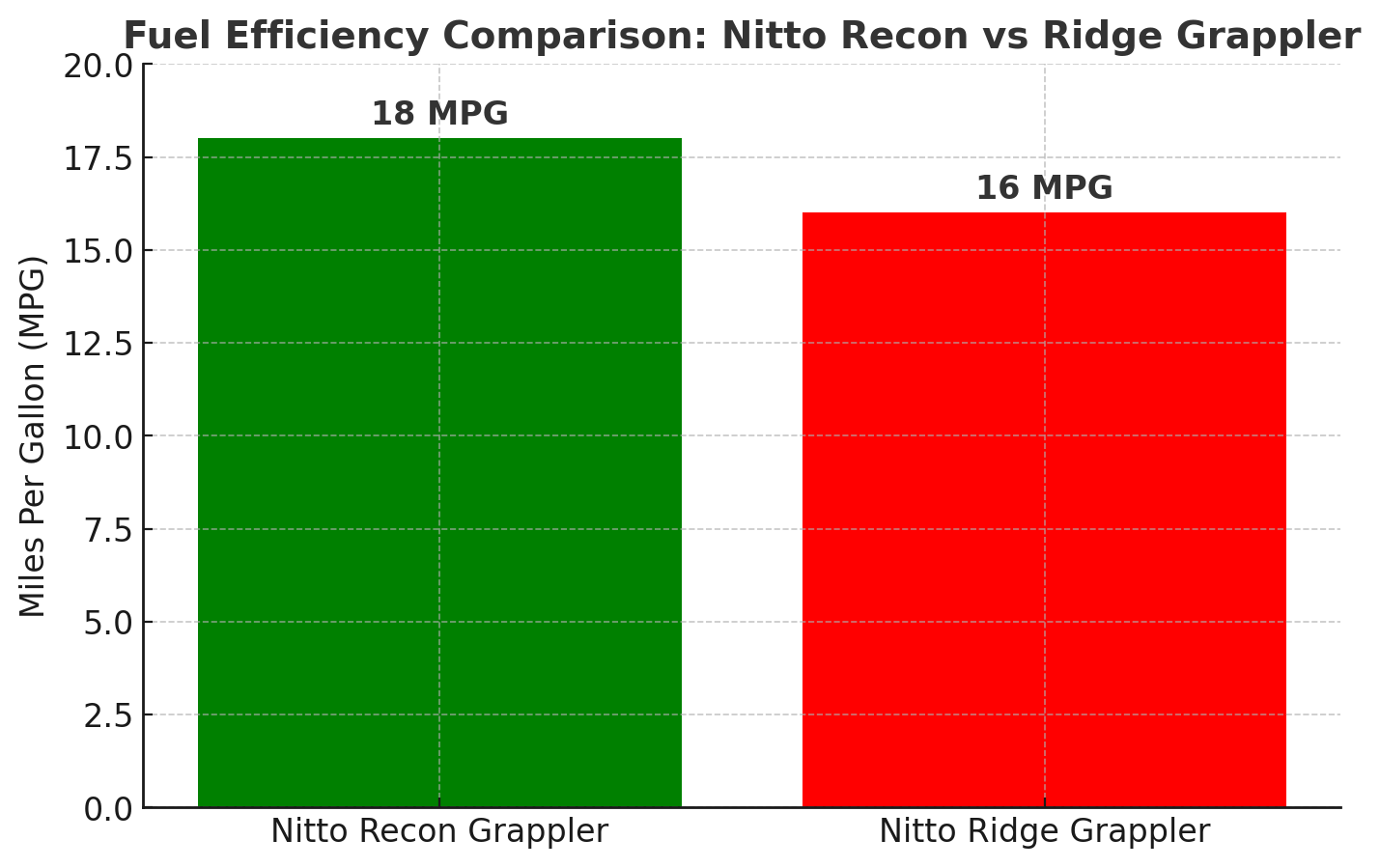
    Bar chart comparing fuel efficiency between Nitto Recon Grappler and Nitto Ridge Grappler tires. The Recon Grappler shows 18 MPG in green, while the Ridge Grappler shows 16 MPG in red.
    Recon Grappler wins on efficiency — 18 MPG vs Ridge Grappler’s 16 MPG. 🛞⛽

    Comfort scores highlight the difference: Recon rates 7.3/10, Ridge lower at 6.8/10. Recon rides smoother, quieter, and feels less punishing on daily commutes. Ridge starts out relatively quiet for how it looks, but hums more as tread wears.

    Community chatter: Recon is described as “civilized for a tough tire,” while Ridge owners note “quiet at first, louder over time.” The engineering trade-off is straightforward: Ridge’s aggressive voids and hybrid carcass hum louder, Recon’s lighter block design dampens road resonance.

    • SUVs & crossovers: Recon clearly wins for comfort.

    • ½-tons: Recon smoother highway ride; Ridge acceptable but firmer.

    • ¾-ton & HD: Ridge blends into background noise, but Recon still smoother.

    👉 Verdict: Recon is more livable day-to-day; Ridge grows rougher with miles.

    Note from the Expert: For years, choosing all-terrain meant accepting noise—a true compromise for off-road grip. That’s why the question, Are All-Terrain Tires Louder than Highway Tires?, used to have a simple “yes” answer. Now, with the rise of on-road models, the core issue has shifted from noise to overall refinement. To fully understand which side of the comfort spectrum you’re buying into, you need to determine Are All-Terrain Tires Good for Daily Driving?—a question that depends entirely on the tire’s construction, not just the name.

    Longevity

    Driver Feedback:
    At ~15,000 miles, Recon showed even tread wear. Ridge, however, feathered its shoulders faster when rotation was skipped.

    🧠 Root Cause:
    Recon’s balanced tread stiffness prevents uneven wear. Ridge’s aggressive voids put stress on shoulders.

    🏁 Verdict:
    Recon is more rotation-friendly and longer-lasting. Ridge demands strict maintenance.

    Where They Fit Best

    • Nitto Recon Grappler A/T: Best for drivers who want Nitto’s rugged styling but prioritize wet, winter, and ice security alongside comfort. A strong fit for SUVs and ½-ton trucks that see mixed conditions and mild trails, especially in snow-belt or rainy regions.

    • Nitto Ridge Grappler: The tougher hybrid for drivers who need serious off-road grip and sharper dry handling, and who don’t mind longer wet/ice stops or more cabin noise. Ideal for ½-ton and ¾-ton trucks in Southwest deserts, rocky trails, and mud-heavy terrain.

    👉 Bottom line: Recon is the more balanced, winter-safe Nitto; Ridge is the aggressive hybrid built for off-road authority.

    Tire Size Selection: The Basics You Can’t Skip

    Even the best tread design can’t rescue a tire that’s built too weak. Back when I was testing tires at Bridgestone, I saw all-terrain models that should’ve performed but fell short — simply because the basics (size, load strength, and speed rating) weren’t matched to the vehicle.

    P-Metric vs. LT (Light Truck) Tires

    The first step is knowing whether you need LT or passenger tires. LT (Light Truck) tires are built with extra reinforcement and stiff sidewalls, designed for towing, hauling, or off-road use. Passenger (P-metric) tires are lighter, smoother, and tuned for daily comfort and fuel efficiency — but they’ll flex more under load.

    Understanding Tire Load Range: XL vs. E-Load

    Then comes the tire load index and load range — essentially your tire’s strength rating. Here’s where things split between passenger XL and LT E:

    • XL (Extra Load) is a passenger tire with reinforced sidewalls. It can handle a bit more pressure (~41 PSI) than a standard SL tire and is perfect for SUVs, crossovers, or light trucks that carry extra gear, passengers, or small trailers. XL tires ride softer and quieter than LT options, making them ideal for daily use.

    • E Load Range is an LT tire class built with a much thicker casing. E-rated tires can handle far more pressure (up to ~80 PSI) and heavier loads, which makes them essential for ¾-ton and 1-ton trucks towing trailers or hauling close to max capacity. The trade-off is weight, stiffer ride, more road noise, and a small drop in fuel efficiency.

    Put simply: XL is for “extra luggage and family,” while E is for “truck bed full of bricks or a car trailer.”

    Why the Tire Speed Rating Matters for Safety

    Finally, don’t overlook the tire speed rating. It’s not just about top speed — it measures how well a tire handles heat and stress at highway pace. Lower ratings (like S) tend to ride softer and last longer, while higher ratings (H, T) feel more stable and responsive under sharp maneuvers. Heat build-up is the silent killer of tires, and speed rating is your safeguard.

    Bottom line: Match your tire’s construction (LT vs P-metric), load range (XL vs E), and speed rating to your vehicle’s demands. Get those right, and everything else — off-road grip, winter traction, comfort — will finally perform the way it was designed to.

    Final Verdict — Which Should You Buy?

    If you want sharper steering and extreme off-road ability, the Nitto Ridge Grappler is the obvious choice. It excels in dirt, mud, and rocky terrain, feels planted when pushed on dry roads, and suits half-tons and heavier trucks in the Southwest, desert, or muddy backcountry. The cost is comfort, noise, and longer wet/ice stops.

    For drivers who balance city commutes, winter safety, and mild off-road use, the Nitto Recon Grappler is the smarter fit. It stops shorter in rain, snow, and ice, rides smoother, and provides enough trail confidence for gravel, hunting roads, and light adventure. SUVs and ½-tons in the Snow Belt or rainy regions will find Recon the safer and easier daily choice.

    Frequently Asked Questions: Nitto Ridge Grappler vs Nitto Recon Grappler A/T

    • Which tire has better dry performance?
      Ridge Grappler, with a 130-ft stop and 0.75 g cornering, outperforms Recon’s 138 ft and 0.72 g in dry grip.

    • How do they compare in wet conditions?
      Recon stops shorter at 192 ft, while Ridge stretches to 203 ft, making Recon the safer wet-weather choice.

    • Which tire is better in snow and ice?
      Recon is stronger, with a 74-ft snow stop and 46.5-ft ice stop, compared to Ridge’s 78 ft in snow and 55.7 ft on ice.

    • Which tire offers more off-road traction?
      Ridge dominates off-road with scores around 9.0 in dirt, mud, and rock, while Recon averages in the low-8s.

    • Which tire is more comfortable for daily driving?
      Recon rides smoother and quieter with a 7.3/10 comfort score, while Ridge rates lower at 6.8/10 and grows noisier with miles.

    • Who should buy the Nitto Recon Grappler A/T?
      Drivers who want safer wet/winter handling, smoother comfort, and enough off-road versatility for light trails and mixed conditions.

    • Who should buy the Nitto Ridge Grappler?
      Drivers who prioritize dry grip and extreme off-road authority, and don’t mind louder road manners or longer wet/ice stops.

    Filed Under: All Terrain Tires Tagged With: Comparisons, nitto, Recon Grappler, ridge grappler

    Nitto Ridge Grappler vs Toyo Open Country RT

    Updated: November 11, 2025 by Emrecan Gurkan Leave a Comment

    Ridge Grappler and Open Country RT are rugged-terrain tires built in the same factory. As rugged-terrain tires, they place between mud-terrain and all-terrain tires. Though, some rugged-terrain tires are built with all-terrain intent and some with mud-terrain intent. Hence, their usage range might show some differences. Let’s see which one will meet with your expectations!

    Ridge Grappler has an aggressive appearance and supports this with satisfying on-road manners
    Nitto Ridge GrapplerToyo Open Country RT
    Better forLifted vehicles and wider aftermarket wheels,
    appearance,
    highway-oriented driving,
    mid-size SUVs
    Wet and winter traction,
    off-road lovers, 
    longevity
    ProsSatisfying wet and dry traction,
    can handle mild and severe off-road,
    quiet for its design
    Satisfying wet and dry traction,
    great winter performance,
    great off-road durability,
    long-lasting rubber,
    well-balanced air-down / highway tire
    ConsThe ride is a bit stiff,
    P-Metric sizes are providing average tread life
    A bit noisy (not as much as mud tires),

    As a former Bridgestone engineer, from my standpoint, Nitto Ridge Grappler has better on-road manners. It offers a smoother and quieter ride. Moreover, it’s a lightweight tire in this comparison. Hence, it provides superior gas mileage. They both can handle mild off-road. Yet, Toyo Open Country RT is a slightly better off-road tire due to its sidewall durability. The tread life warranty of Open Country RT is another take-home point.

    Table of Contents

    What Vehicles Will They Fit?

    • Chevrolet Silverado 1500
    • Ford F-150
    • GMC Sierra 1500
    • Nissan Titan
    • Ram 1500
    • Toyota Tundra
    • Toyota Land Cruiser
    • Jeep Wrangler
    • Jeep Wrangler Rubicon
    • Toyota Land Cruiser
    • Any SUV
    • Any 4×4
    • Any Crossover
    • Any 3/4 ton or above light trucks (Toyo RT is a better option in this case)

    Road Noise and Comfort

    Most customers use rugged-terrain tires only for their aggressive look, not off-road capability. Therefore, they generally need on-road manners instead of off-road manners. Road noise and comfort are crucial metrics for highway usage. Let’s see which one is better!

    Nitto Ridge Grappler (vs Trail and Terra Grappler) has exceptional on-road performance. Due to its variable pitch tread pattern and soft compound, it can reduce road noise easily. That feature makes it one of the best rugged-terrain tires regarding quietness. Moreover, these asymmetrical tread lugs can grip to surface in order. Hence, they alternately hit the ground and absorb the vibration.

    Toyo Open Country RT, on the other hand, I love Open Country RT’s tread design. It works as pretty as Ridge Grappler. Due to its narrowed center section gaps, it reduces the road noise very well. Though worth reminding, it has a bit stiffer compound than Ridge Grappler. Therefore, it’s not comfy as Ridge Grappler.

    Ridge Grappler and Open Country RT hand to hand in this section. Yet, I recommend Nitto Ridge Grappler due to its smoother ride.

    Durability

    Open Country R/T is a better pick if you're an advanturer

    Durability is the main concern for rugged-terrain tires. No worries, these tires are secure picks unless you use them on the right vehicles and operations.

    Open Country RT isn’t designed for towing, hauling, or heavy-duty applications. So, if you use these tires on 3/4 ton or 1-ton trucks, there is no way you can get decent tread life. It’s a good pick for 1/2 trucks, SUVs, Crossovers. On the other hand, its 3-ply construction increases cut & chipping resistance significantly and offer you protection against punctures and uneven wearing.

    However, Ridge Grappler also has a similar application range. It’s not usable for heavy trucks. They became rattle bag products during the towing or hauling. Even though, it has a stronger sidewall, its cut & chipping resistance is limited compared to Open Country RT.

    The difference is minor in this section. I recommend Open Country RT if you like to spend some time off the road. For mainly on-road users, both are trustworthy options. 

    Getting maximum wear life from a tire is related to you as well as your tire,

    If you’d like to learn how to get maximum tread life:

    https://tireterrain.com/how-to-make-tires-last-longer/

    Fuel Efficiency

    Decreasing in fuel mileage is expected on rugged-terrain tires. Due to their higher rolling resistance, they lose fuel mileage.

    Toyo Open Country RT is the heavier option. Therefore, it has higher rolling resistance. Higher rolling resistance means low fuel mileage. Nitto Ridge Grappler is the winner of this section.

    Dry Traction

    Dry traction is hard to compare for premium brand tires. Most of them have great traction ability due to their mud-terrain looks like patterns. Therefore, continuity of traction is the game-changer in that case.

    Nitto Ridge Grappler has full-depth sipes that Open Country RT doesn’t have. For this reason, it can maintain its traction ability during its tread life.

    Warranty

    Toyo Open Country RT has 45,000 miles of tread wear warranty. You can click here to see its detailed warranty document.

    Nitto Ridge Grappler doesn’t have any mileage warrany.

    Wet Performance

    Ridge Grappler's low profile sizes offer quick steering response

    Wet performance is hard to reach for rugged-terrain tires. Their footprint doesn’t step on surfaces completely and they lose grip from time to time.

    Toyo Open Country RT has the above problem. It has a stiff compound. In addition, lack of siping causes grip loss. It has poor wet traction. I don’t recommend it unless you’re a calm driver and don’t go over 70 mph during heavy rain.

    Nitto Ridge Grappler has a couple of advantages for wet ground. First of all, it has a soft compound. Nitto made a wise move and supported soft tread with well-siped rubber. It has decent wet performance.

    Nitto Ridge Grappler is a significantly better tire on wet grounds.

    Winter Performance

    Before beginning, these tires aren’t rated for severe winter conditions(3PMSF).

    3 different evaluation criteria constitute winter performance. Light snow, heavy snow, and ice.

    Light snow is where Ridge Grappler is shining. Its grip and evacuation ability ensures that you don’t have any traction issues. Well, it’s not that successful in deep snow. Its shallow grooves and shorter tread depth put it behind in deep snow. Table turn again for icy conditions. Sipes get into the game and increase its ice traction significantly.

    I recommend Nitto Ridge Grappler for winter conditions. Open Country RT is struggling a lot due to a lack of siping.

    If you are looking for something solid for winter, I recommend you to check this article out!

    Off-Road Performance

    These tires aren’t designed to perform on severe off-roads. Rock crawling and deep mud aren’t their expertise.

    You can also check this article out for a solid off-road solution!

    Sand

    Less aggressive design always works on sand better. Nitto Ridge Grappler is the winner of this section.

    Mud

    Mud driving depends on tire evacuation capability. In that case deep grooves, stone ejector blocks(for compact mud) and, staggered shoulder works best. Well, both tires have these features with a little difference. Wide-open shoulders.

    Open Country RT step ahead with wide-open shoulders. It can evacuate the mud easily and keep the tread clean. Hence, traction remains at the top of the ladder most time.

    Note: Nitto Ridge Grappler is a better choice for light mud. It can grip surfaces very well and avoid sliding.

    Gravel and Dirt

    Both tires are trustworthy options on gravel and dirt. You can go either way. Yet, I prefer Nitto Ridge Grappler due to its stone ejection capability.

    Specs

    Toyo Open Country RTNitto Ridge Grappler
    CategoryHybrid All-Terrain TireHybrid All-Terrain Tire
    VehicleLight Truck, SUVLight Truck, SUV
    Available Sizes (Rim)16”, 17’’, 18’’, 20’’, 22’’, 24’’16”, 17”, 18”, 20”, 22”, 24”
    Weight49-100 lbs40 – 95 lbs
    Made InWhite, GA, USAWhite, GA, USA
    Severe Snow Rated (3PMSF)NoNo
    Warranty (P-metric)45000N/A
    Warranty (LT Sizes)45000N/A
    Dual Sidewall DesignYes (White, Black Lettering)Yes (White, Black Lettering)
    PriceContinue the below sectionContinue the below section

    Price

    The tire market has a dynamic price policy. Hence, in my point of view, sharing tire price is pointless.

    Though, I’ve analyzed the top 10 brands of most popular tire brands.

    Here are the dealers with a reasonable price range,

    DiscountTire

    • Biggest dealer in the US. Founded in 1960
    • 1000 stores in 35 states. You most probably find one on your parallel street
    • Free rotation and balancing
    • 5% off for DiscountTire cardholders on online purchase
    • Highest rated online tire dealer in Consumer Affairs
    • Almost all brands are available
    • Delivery takes 2-4 days (30% shorter average waiting time when you book online)
    • Frequent discounts and promotions

    Nitto Ridge Grappler: https://www.discounttire.com/buy-tires/nitto-ridge-grappler

    Toyo Open Country R/T: https://www.discounttire.com/buy-tires/toyo-tire-open-country-r-t

    SimpleTire

    • Free shipping
    • Delivered in 2 days
    • Verified shops near you(for mount and balance)
    • Mobile installation option
    • 7 million customers since 2021
    • 4.7/5 points on Google rate
    • Top-notch customer service, you may even request a price match

    Nitto Ridge Grappler: https://simpletire.com/brands/nitto-tires/ridge-grappler

    Toyo Open Country R/T: https://simpletire.com/brands/toyo-tires/open-country-r-t

    TireRack

    • Fast and Free shipping
    • Usually delivered in 1 day
    • Joint venture with DiscountTire(their installers and dealers are on your service)
    • Tons of installer options, they also help you to choose the best one
    • Mobile installers in many areas, your tires will be replaced while you’re working in the office
    • Tire test results and comparisons can be found on the most product page
    • 4.6/5 points on Google rate

    Nitto Ridge Grappler: Not available

    Toyo Open Country R/T: https://www.tirerack.com/tires/toyo-open-country-r-t

    While choosing dealers, I especially pay attention to reliability. All of the dealers on this list have 15-20 years of experience in the online tire business. Therefore, I can guarantee a smooth and fast tire buying process.

    Conclusion

    These tires should be used on suitable vehicles. Otherwise, they can’t perform efficiently. 

    Nitto Ridge Grappler is a better all-round tire. It has superior wet performance. Moreover, it’s less vocal and offers smoother ride. I don’t recommend Open Country RT unless you don’t spend your time off-road driving.

    Nitto Ridge GrapplerToyo Open Country RT
    Better forLifted vehicles and wider aftermarket wheels,
    appearance,
    highway-oriented driving,
    mid-size SUVs
    Wet and winter traction,
    off-road lovers, 
    longevity
    ProsSatisfying wet and dry traction,
    can handle mild and severe off-road,
    quiet for its design
    Satisfying wet and dry traction,
    great winter performance,
    great off-road durability,
    long-lasting rubber,
    well-balanced air-down / highway tire
    ConsThe ride is a bit stiff,
    P-Metric sizes are providing average tread life
    A bit noisy (not as much as mud tires),

    I hope this article was helpful for anyone who is debating. If you have any further questions, please let me know!

    Filed Under: Rugged Terrain Tires Tagged With: Comparisons, open country rt, ridge grappler, toyo open country rt

    BFGoodrich KO2 vs Nitto Ridge Grappler — Off-Road Performance Showdown 2025

    Updated: November 11, 2025 by Emrecan Gurkan 3 Comments

    BF Goodrich KO2's durability is insane

    Real test data, off-road insights, and daily-driving impact — from a former Bridgestone engineer.

    The BFGoodrich KO2 and Nitto Ridge Grappler represent two different branches of the all-terrain market. The KO2 is a classic Off-Road A/T tire, trusted on Wranglers, Tacomas, and ½-ton pickups for its bulletproof sidewalls, long tread life, and 3PMSF-rated winter traction — though it rides firmer and louder on pavement. If you’re curious about how it compares to its newer sibling, see our BFGoodrich KO3 vs KO2 guide.

    The Ridge Grappler, on the other hand, sits in the Rugged-Terrain category — a hybrid between A/T and mud-terrain. Popular on Silverados, Rams, and Jeeps, it offers a blockier tread for stronger loose-surface bite, a more aggressive look, and surprising on-road manners for its class, though comfort and efficiency take a hit compared to KO2.

    That’s the trade-off most buyers face — and in the sections ahead, we’ll break down how they compare across dry, wet, snow, and off-road testing. You can also line them up in our All-Terrain Tire Decision Tool for quick recommendations tailored by SUV, CUV, or truck class.

    ⚡ Quick Verdict – Who Wins What?

    Nitto Ridge Grappler

    Nitto Ridge Grappler tire
    Tested Rating: 8.2/10

    Trusted Retailers with Best Deals:

    Tire Rack
    Free road-hazard coverage Backed by Discount Tire
    SimpleTire
    Financing options Local installers
    Amazon
    Prime shipping Direct from brands

    BFGoodrich All-Terrain T/A KO2

    BFGoodrich KO2 tire
    Tested Rating: 8.3/10

    Trusted Retailers with Best Deals:

    Tire Rack
    Free road-hazard coverage Backed by Discount Tire
    Amazon
    Prime shipping Direct from brands

    The Nitto Ridge Grappler bites harder on dry pavement (~130 ft, 0.75 g) and digs deeper off-road (9.0 dirt / 9.3 mud / 9.2 rock), but it runs noisier and feels less reliable in bad weather. The BFGoodrich KO2 is steadier under load, stops shorter in the rain (195 ft, 0.43 vs Ridge’s 203 ft, 0.47), and comes out ahead in snow (76-ft stop, 46-ft launch) and ice (51 ft vs 55.7 ft). On the highway, the KO2 rides smoother (~7.0 comfort vs Ridge’s ~6.8) and ages more evenly, while the Ridge demands more rotation to stay quiet. In short: KO2 is the safer, quieter long-haul tire; Ridge is the aggressive off-road performer with extra bite and style.

    Let’s clear up a couple of common questions before starting

    I often get asked about these — and Tire Rack has some great quick reads that explain them better than any post could:

    • Is AWD or 4WD really enough for rain, slush, snow, and ice?
      https://www.tirerack.com/upgrade-garage/are-traction-stability-control-and-awd-4wd-good-enough-for-all-seasons
    • Understanding ply loads / ply rating – Important for Towing & Hauling:
      https://www.tirerack.com/upgrade-garage/what-are-load-ranges-ply-ratings

      Raw Test Data

      Tire Test Data

      Pick categories to show metrics, then open ☰ to pick tires. Optional chart is hidden by default.

      Parentheses show the rank among the currently displayed tires (1 = best for that metric).
      Left axis lists metrics. Top axis is used for g-force metrics so they scale clearly.
      Note: Lower is better for Stopping & Acceleration; higher is better for g-force, comfort, traction & off-road ratings. Parentheses show the rank among the currently displayed tires (1 = best for that metric).
      Sources worth checking
      Tire Rack AT Tire Test Tire Rack On-Road A/T Ratings Tire Rack Off-Road A/T Ratings SimpleTire Reviews Amazon SUV/LT Tires

      🔬 Construction & Tech Breakdown

      KO2: Built Like a Tank

      • Dual steel belts + nylon wrap

      • CoreGard™ Sidewall Armor

      • 3PMSF Certified

      • Primarily LT sizes with E-load range

      🧠 Why It Matters: KO2 is engineered for strength over comfort. That means it’s heavier and stiffer, but it won’t flinch when aired-down or bouncing off granite.

      Ridge Grappler: Rugged-Hybrid DNA

      • Dynamic hybrid tread pattern for off-road bite and highway control

      • Staggered shoulder lugs and variable pitch blocks

      • Available in P-metric and LT with load ranges up to F

      🧠 Why It Matters: Ridge Grappler delivers the rugged tread voids of an MT tire with a tread block layout that won’t drone on the highway.

      Dry Performance — KO2 holds smoother grip, Ridge more bite in rugged use

      Nitto Ridge Grappler's appearance is dopeeee!

      KO2 stops in 142.0 ft with 0.71 g cornering, while Ridge Grappler is at 130.0 ft with 0.75 g. That means Ridge tends to bite quicker in aggressive driving, but KO2 holds steadier during long straight-line braking and highway braking.

      On Reddit and F-150 forums, KO2 owners regularly say that even as they age, the KO2s retain grip and feel planted. Ridge owners praise their tires for sharper turn-in and more aggressive pavement behavior, especially when coming off trails.

      From an engineering standpoint, Ridge’s more aggressive tread pattern and block structure give better lateral grip under rugged inputs. KO2’s build is more conservative — slightly softer blocks, more void fill between, which helps with ride stability and reduces harshness in everyday braking.

      For SUVs & crossovers, Ridge gives more performance flavor, KO2 gives more confidence in comfort. For ½-tons, KO2 offers smoother feel on pavement, Ridge gives more feedback when pushed. For ¾-ton & 1-ton HD trucks, KO2’s steadier footprint under load helps with braking stability, while Ridge will be more responsive but harsher.

      👉 Verdict: Ridge Grappler wins dry bite and responsiveness; KO2 wins smooth confidence under load.

      Wet Performance — KO2 stops shorter, Ridge grapples with wet bite

      In wet tests, KO2 does 195.0 ft with 0.43 wet traction, while Ridge Grappler registers 203.0 ft with 0.47. Both are a bit slow compared to wet-optimized designs, but KO2 tends to engage more consistently over wet pavement unless Ridge is aggressively driven.

      Forum feedback: KO2 users often comment, “good in the rain, still safe,” while Ridge users frequently note needing more braking space when wet — especially on inclines or with heavy loads. On r/f150 people say Ridge is “more capable in off-dirt in wet” but less forgiving during sudden wet stops.

      Technically, Ridge’s larger voids help move water but reduce contact patch initially; KO2’s more uniform tread blocks maintain more wet adhesion under braking. Under load, KO2’s contact pressure helps in wet braking; Ridge may flex and lose bite under heavy load.

      On SUVs & ½-tons, KO2 gives a bit more confidence in wet braking. For ½-tons towing or loaded, KO2 still might feel safer in worst-case stops. For ¾-ton & 1-ton HD trucks, the difference in wet feel is magnified under load — Ridge’s flexibility works against it in emergency braking, whereas KO2 tends to resist squirm.

      👉 Verdict: KO2 is the safer pick in wet conditions for everyday use; Ridge gives traction gains in trails but demands margin.

      Note from the Expert: When it comes to rain, I always emphasize two things: compound grip and water evacuation. You can see the full details in my analysis, but if you take just one thing away, remember that an AT tire’s stiff nature makes achieving top-tier wet performance a constant battle. This is why the question, Are All-Terrain Tires Good in Rain?, requires a nuanced answer that balances tread design against rubber stiffness.

      Winter & Snow — KO2 shines with 3PMSF traction, Ridge struggles more

      In snow & winter stopping, KO2 posts a 76.0 ft stop and 46.0 ft snow acceleration, whereas Ridge stops in 78.0 ft and launches 47.7 ft. KO2’s edge in snow is slight but meaningful for drivers who face real winter weather.

      Community voices: On Jeep/Truck forums many KO2 owners note they trust the tire in snow and mixed winter, applauding its consistency. Ridge owners often say they like the snow look and feel but admit Ridge isn’t as sure-footed in heavy snow or ice.

      Engineer insight: KO2 is 3-PMSF rated, its tread & compound stay more pliable in cold, offering more mechanical interlock with snow. Ridge’s compound is tougher, and while its blocks dig better in some terrain, cold conditions reduce its bite.

      For SUVs & ½-tons, KO2 gives more predictable snow behavior. For ½-tons hauling in winter, KO2’s reliability matters. For ¾-ton & 1-ton trucks, snow stops under load are where KO2 shines; Ridge may feel less secure.

      👉 Verdict: KO2 is superior in snow situations; Ridge is less reliable in serious winter conditions.

      Note from the Expert: Our discussions often boil down to the core tradeoff. On one hand, you must understand why all-terrain tires are truly effective in deep snow, but not on ice. On the other hand, you face the 3PMSF Paradox—the hidden cost of that badge. The short answer is: The 3PMSF badge certifies traction, but it costs you durability. Dive into our full analysis on the critical 3PMSF rating for severe winter and off-road service, and its hidden costs, before you risk your rig on the trail.

      Ice — KO2 wins the margin, Ridge more abrupt slips

      On glare ice KO2 stops in 51.0 ft, Ridge in 55.7 ft according to the dataset. That extra few feet can matter, especially in surprise icy patches.

      Forum threads: KO2 folks say they get better control in ice, less sliding. Ridge users mention they slide sooner and need more careful throttle control.

      From technical standpoint, KO2’s compound maintains bit more flexibility at low temps; Ridge’s aggressive tread and heavier block design increase risk of abrupt loss of grip.

      For SUVs & ½-tons, KO2 is safer on ice. For ½-tons towing, KO2 again wins for stability. HD trucks will appreciate KO2’s more controlled behavior under ice, while Ridge can get loose under load.

      👉 Verdict: KO2 is the safer choice on icy roads; Ridge is more style/off-road oriented but riskier here.

      Off-Road — Ridge dominates mud & rock, KO2 more balanced under mixed terrain

      Ridge scores 9.0 dirt / 8.5 sand / 9.3 mud / 9.2 rock, while KO2 has 9.3 dirt / 9.0 sand / 9.3 mud / 9.5 rock from your dataset. KO2 matches or beats Ridge in several off-road areas, though Ridge wins visible aggression and block design in technical conditions.

      Owners often praise Ridge for its rocky terrain bite and mud climbing. KO2 users note KO2 handles everything decent but doesn’t give the dramatic block aggression Ridge does.

      Engineer side: Ridge’s aggressive sidewall lugs, large voids, and block shape give more bite and traction when trail gets rough; KO2 still holds excellent capability but trades off some extreme grip for more uniform behavior and less fatigue.

      For SUVs & ½-tons, Ridge provides off-road thrill. KO2 offers more balance for drivers doing both road and trail. For ¾-ton & 1-ton HD trucks, KO2’s ability to maintain grip while resisting deformation under load gives it advantage in long off-road runs.

      👉 Verdict: Ridge excels in aggressive trail use; KO2 is more dependable for mixed terrain and heavy duty work.

      Note from the Expert: Every successful day on the trail is about preparation and physics, because tire longevity is earned, not given. Before you even start, you must master the critical link between tire pressure and load range for every rig to maximize your contact patch. Once moving, remember your ultimate off-road armor is your sidewall protection against the inevitable pinch flat. And finally, your traction on the obstacle is dictated by choosing the right aggressive vs hybrid tread pattern for your terrain. Master those three steps, and your rig will be ready for anything.

      Comfort & Noise — KO2 calms cabin; Ridge louder but showy

      I love Ridge Grappler and Rubicon cooperation!

      Comfort ratings: KO2 ~7.0, Ridge ~6.8. On highway, KO2s are quieter, smoother. Ridge starts strong, but road roar and vibrations become noticeable, especially as tread wears.

      Forum input: On Bronco6G, one user said, “KO2 has a better pavement ride feel and control.” Ridge fans admire the look & off-road performance but admit trade-offs in noise. Bronco6G Forum

      Engineer explanation: KO2 uses smaller tread blocks, less aggressive shoulder lugging, softer block transitions which reduce noise. Ridge’s large voids and aggressive shoulders contribute to more sound, especially at speed and under load.

      For SUVs & ½-tons, KO2 will feel more civilized. For ½-tons towing/heavy load, KO2 reduces fatigue. In ¾-ton & 1-ton rigs, noise is more pronounced with Ridge Grappler; KO2 remains easier to live with.

      Note from the Expert: For years, choosing all-terrain meant accepting noise—a true compromise for off-road grip. That’s why the question, Are All-Terrain Tires Louder than Highway Tires?, used to have a simple “yes” answer. Now, with the rise of on-road models, the core issue has shifted from noise to overall refinement. To fully understand which side of the comfort spectrum you’re buying into, you need to determine Are All-Terrain Tires Good for Daily Driving?—a question that depends entirely on the tire’s construction, not just the name.

      Tread Life & Longevity — KO2 has proven life, Ridge dependent on use

      After 63,000 KM (40,000 miles), KO2 still have most of its tread. You can see the minor chipping. Yet, it's totally fine at this wear level

      KO2 has long track record for mileage; Ridge Grappler is built tough but folks report faster wear in certain conditions (lots of road miles, abrasive off-road).

      On r/f150 a user said KO2 “got louder as they wore down,” Ridge users say they “wear down but chunks in harsh terrain show sooner.” Reddit

      Technically, KO2’s block geometry and compound reduce chunking and resist shoulder damage; Ridge gives more aggressive block edges which bite but take more abuse.

      For SUVs & ½-tons, KO2 likely lasts longer on road/trail mixes. For ¾-ton & 1-ton, KO2’s even wear under load gives more consistent performance; Ridge will need more rotation, more maintenance to stay balanced.

      Where They Fit Best

      If you want rugged trail flair, mud and rocky climbs, and don’t mind more road noise and trade-offs, Nitto Ridge Grappler is your passion tire. If you need long highway miles, good snow/ice reliability, lower noise, and less fuss in mixed use, BFGoodrich KO2 is the more dependable all-around choice.

      • For SUVs & Crossovers: KO2 for daily comfort and all-season steadiness; Ridge for style + weekend trail punch.

      • For ½-ton trucks: KO2 favors smoother highway runs and easier living; Ridge delivers aggression and feedback when pushed.

      • For ¾-ton & 1-ton HD duty: KO2 wins on predictable aging, quieter ride under load; Ridge shows off-road strength but with more compromise.

      👉 Bottom line: KO2 is the safer, more balanced tire for heavy duty, long trips, snow, road mileage. Ridge is strong for off-road dramatics, rough terrain, and those who prioritize aggression.

      Tire Size Selection: The Basics You Can’t Skip

      Even the best tread design can’t rescue a tire that’s built too weak. Back when I was testing tires at Bridgestone, I saw all-terrain models that should’ve performed but fell short — simply because the basics (size, load strength, and speed rating) weren’t matched to the vehicle.

      P-Metric vs. LT (Light Truck) Tires

      The first step is knowing whether you need LT or passenger tires. LT (Light Truck) tires are built with extra reinforcement and stiff sidewalls, designed for towing, hauling, or off-road use. Passenger (P-metric) tires are lighter, smoother, and tuned for daily comfort and fuel efficiency — but they’ll flex more under load.

      Understanding Tire Load Range: XL vs. E-Load

      Then comes the tire load index and load range — essentially your tire’s strength rating. Here’s where things split between passenger XL and LT E:

      • XL (Extra Load) is a passenger tire with reinforced sidewalls. It can handle a bit more pressure (~41 PSI) than a standard SL tire and is perfect for SUVs, crossovers, or light trucks that carry extra gear, passengers, or small trailers. XL tires ride softer and quieter than LT options, making them ideal for daily use.

      • E Load Range is an LT tire class built with a much thicker casing. E-rated tires can handle far more pressure (up to ~80 PSI) and heavier loads, which makes them essential for ¾-ton and 1-ton trucks towing trailers or hauling close to max capacity. The trade-off is weight, stiffer ride, more road noise, and a small drop in fuel efficiency.

      Put simply: XL is for “extra luggage and family,” while E is for “truck bed full of bricks or a car trailer.”

      Why the Tire Speed Rating Matters for Safety

      Finally, don’t overlook the tire speed rating. It’s not just about top speed — it measures how well a tire handles heat and stress at highway pace. Lower ratings (like S) tend to ride softer and last longer, while higher ratings (H, T) feel more stable and responsive under sharp maneuvers. Heat build-up is the silent killer of tires, and speed rating is your safeguard.

      Bottom line: Match your tire’s construction (LT vs P-metric), load range (XL vs E), and speed rating to your vehicle’s demands. Get those right, and everything else — off-road grip, winter traction, comfort — will finally perform the way it was designed to.

      🏁 Final Verdict: Which One Would I Actually Buy?

      If you’re chasing rugged styling and weekend trail power, the Nitto Ridge Grappler delivers — it bites harder off-road, feels sportier on pavement, and looks the part. But if you want a tire that can handle daily commutes, towing, and winter weather with fewer compromises, the BFGoodrich KO2 is still the benchmark: predictable in snow and ice, quieter on the highway, and longer-lasting under load. Ridge = aggression and trail drama. KO2 = confidence and durability.

      Nitto Ridge Grappler Related Articles

      Review not available.
      Compare with:
      vs BFGoodrich All-Terrain T/A KO2 vs BFGoodrich All-Terrain T/A KO3 vs Falken Wildpeak A/T3W vs Falken Wildpeak A/T4W vs Nitto Recon Grappler A/T

      BF Goodrich KO2 Related Articles

      Read Review
      Compare with:
      vs BFGoodrich All-Terrain T/A KO3 vs Falken Wildpeak A/T3W vs Falken Wildpeak A/T4W vs Firestone Destination XT vs General Grabber ATX vs Nitto Ridge Grappler vs Toyo Open Country A/T III vs Yokohama Geolandar A/T4

      Frequently Asked Questions: KO2 vs Ridge Grappler

      • Which tire has better dry grip?
        Ridge Grappler. It stops shorter (~130 ft vs KO2’s ~142 ft) and feels sportier in cornering. KO2 is steadier for highway and towing.

      • Which is safer in the rain?
        KO2. It stops around 195 ft (0.43), compared to Ridge at ~203 ft (0.47). KO2 feels more consistent in wet braking, especially under load.

      • How do they compare in snow and ice?
        KO2 wins both. Snow stop ~76 ft vs Ridge’s ~78 ft, and ice ~51 ft vs 55.7 ft. KO2 is 3PMSF rated, making it more reliable for winter driving.

      • Which is better off-road?
        Ridge Grappler. With 9.0 dirt, 9.3 mud, 9.2 rock, it excels in aggressive terrain. KO2 is strong but trades some bite for balance and load stability.

      • Which rides quieter and smoother?
        KO2. It scores ~7.0 comfort and keeps noise lower. Ridge is around ~6.8 and develops more hum as it wears.

      • Which lasts longer?
        Both average 45–50k miles, but KO2 wears more evenly and resists chunking better. Ridge can cup and get louder late in life.

      • Which is better for heavy-duty trucks?
        KO2. It feels steadier under load and holds line straighter when towing, while Ridge tends to wander more with heavy trailers.

      Filed Under: All Terrain Tires, Rugged Terrain Tires Tagged With: bf goodrich, Comparisons, KO2, nitto, ridge grappler

      Nitto Ridge Grappler vs Toyo Open Country AT3 — Off-Road Performance Showdown 2025

      Updated: December 13, 2025 by Emrecan Gurkan Leave a Comment

      If you're changing from the H/T tires, Toyo AT3 can provide aggressive look. Still, I prefer Ridge Grappler

      Toyo Open Country A/T III, AKA the Toyo AT3, and the Nitto Ridge Grappler, AKA the Ridge Grappler, are both top-rated contenders, massively popular with SUV and LT owners, and that is exactly why we need to look beyond the reputation. While the Toyo is known for its balanced, classic Off-Road A/T blueprint, offering superior wet and winter pavement performance, the Rugged-Terrain Nitto surprises users with its decent comfort rating despite a blockier, reinforced structure built to maximize deep-terrain traction. The ultimate choice comes down to where you want the compromise to be; pavement safety and overall balance, or flat-out trail ruggedness with surprisingly good on-road manners.

      I’m a former Bridgestone engineer, and we’re cracking open Tire Rack’s raw data right now to translate those numbers into real-world performance for your rig.

      Quick Verdict – Who Wins What?

      Nitto Ridge Grappler

      Nitto Ridge Grappler tire
      Tested Rating: 8.2/10

      Trusted Retailers with Best Deals:

      Tire Rack
      Free road-hazard coverage Backed by Discount Tire
      SimpleTire
      Financing options Local installers
      Amazon
      Prime shipping Direct from brands

      Toyo Open Country A/T III

      Toyo Open Country A/T III tire
      Tested Rating: 8.5/10

      Trusted Retailers with Best Deals:

      Tire Rack
      Free road-hazard coverage Backed by Discount Tire
      SimpleTire
      Financing options Local installers
      Amazon
      Prime shipping Direct from brands

      The Nitto Ridge Grappler feels sportier on pavement, biting quicker with a ~130-ft dry stop and 0.75 g grip, while the Toyo Open Country AT3 is calmer and steadier (131.5 ft, 0.78 g) — especially when towing. In the rain, Toyo is the safer choice, stopping at 185 ft (0.50) versus Ridge’s longer ~203 ft (0.47). In winter, Toyo hooks up earlier with a 74-ft snow stop, 44-ft launch, and ~50-ft ice stop, while Ridge needs more space (~78 ft / 47.7-ft launch, ~55.7 ft ice). Off-road, the story flips: Ridge dominates with 9.0 dirt, 8.5 sand, 9.3 mud, and 9.2 rock, while Toyo leans toward highway manners with light-trail grip. On the highway, Toyo rides quieter (~8/10 comfort) and steadier under load, while Ridge hums louder (~6.8/10). Both deliver ~45–50k miles, but Toyo tends to wear more evenly, while Ridge can cup and grow louder late in life.

      Let’s clear up a couple of common questions before starting

      I often get asked about these — and Tire Rack has some great quick reads that explain them better than any post could:

      • Is AWD or 4WD really enough for rain, slush, snow, and ice?
        https://www.tirerack.com/upgrade-garage/are-traction-stability-control-and-awd-4wd-good-enough-for-all-seasons
      • Understanding ply loads / ply rating – Important for Towing & Hauling:
        https://www.tirerack.com/upgrade-garage/what-are-load-ranges-ply-ratings

        Raw Test Data

        Construction & Tech Breakdown: Why the Two Tires Feel So Different

        Let’s talk specs and design goals. Every single decision a tire engineer makes, from the type of silica in the rubber blend to the angle of the polyester plies, is a trade-off. Breaking down the construction helps explain why the AT3 is king in the rain and the Ridge Grappler feels so tight in the dry.

        Toyo Open Country AT3: The All-Season Technician

        The Toyo AT3 is built to deliver comfort and versatility. This means the engineers prioritized a flexible, compound-driven approach:

        • Tread Design: Features balanced siping and a flexible casing, available in both lighter P-metric (Passenger) and heavier LT (Light Truck) sizes.

        • Engineering Goal: Focus on compound flexibility and water evacuation to deliver stellar wet and winter performance.

        • Root Cause Insight: This design approach is the reason the AT3 crushes the competition in severe conditions, like its 42.7 second Snow Acceleration time (a 5.0-second advantage over the Nitto) and its dramatically safer 164.0 feet Wet Stopping distance. This tire is the perfect choice for the daily driver who needs year-round confidence.

        What the Truck Owners Say: “The AT3s are quieter on the highway and still grip well in snow. Perfect for city and light trail.” This sentiment is spot-on; the data backs the grip and compliance claim.

        Nitto Ridge Grappler: The Rugged Structuralist

        The Ridge Grappler’s mission is brute-force performance and durability. It’s a structure-driven design, prioritizing stability and puncture resistance above all else:

        • Tread Design: Features a unique hybrid tread pattern with thicker, staggered shoulder blocks and a reinforced carcass.

        • Engineering Goal: Maximize resistance to cuts and chunks off-road, and provide maximum tread-block stability on pavement.

        • Root Cause Insight: The aggressive shoulder and reinforced construction are the reason the Ridge Grappler provides such a tight feel, earning it a 0.75 g Dry Cornering figure, which actually beats the more road-focused AT3. However, that stiff structure is what increases the on-road compromise, leading to a much longer 193.0 feet wet stop.

        What the Engineer Noticed (Debunking the Myth!): The common wisdom is that R/T tires hum like a beast, but the data showed the Ridge Grappler was actually slightly quieter than the AT3 (6.17 vs 6.00 on the Noise/Comfort index). This is a shout-out to Nitto’s engineers for using advanced pitch sequencing: it randomizes the tread block size enough to break up the harsh noise frequency, giving you a remarkably quiet ride for such a dope-looking tread pattern.

        Dry Performance: The Ridge Grappler Takes the Asphalt Title

        Beefy sidewalls of Toyo AT3

        You would expect the road-biased Toyo AT3 to win here, but this is a classic surprise! The rugged design of the Ridge Grappler pays an immediate dividend on dry pavement. That stiffness we talked about earlier translates directly into shorter braking and sharper handling for your rig.

        MetricToyo Open Country AT3 (The Smoother Choice)Nitto Ridge Grappler (The Structural Winner)What the Engineer Sees
        Dry Stopping (60–0 mph)134.0 feet130.0 feetThe Ridge Grappler stops 4.0 feet shorter! Its reinforced structure prevents the tread blocks from rolling over under heavy pedal pressure, maximizing rubber-to-road contact.
        Dry Cornering (g-force)0.72 g0.75 gA clear handling win. The R/T’s tough, stiff casing resists side-load “squat,” giving you a sharper 0.75 g of lateral grip and a much more direct, responsive steering feel.

        The Engineering Breakdown on Dry Roads

        The data validates exactly what drivers feel: the Ridge Grappler feels “sportier” and has that quick “bite” because its blocky, reinforced structure (the R/T DNA) handles braking and cornering forces with minimal flex. If you like steering feedback and a taut feel on your truck, the Nitto delivers.

        The Toyo AT3, conversely, is built for compliance. Its relatively softer compound and more flexible sidewall mean it doesn’t slam the brakes or carve corners quite as sharply. However, this compliance is an asset when you’re towing or hauling heavy weight. That little bit of give helps the tire track straighter and feels much more composed at highway speeds, making the AT3 the calmer, more composed daily driver, especially under load.

        The Verdict: The Ridge Grappler is sharper and stops shorter in the dry; the Toyo AT3 is the steadier, more comfortable choice, especially for work rigs and towing.

        Wet Performance — Toyo More Predictable, Ridge Needs Room

        Nitto Ridge Grappler looks dope on lifted trucks!

        Wet tests show Ridge Grappler stopping in 203 ft with 0.47 g traction, while Toyo AT3 comes in at 185 ft with 0.50 g. Ridge needs more space to slow down, and that difference shows in real rain driving.

        On forums, F-150 owners often call Ridge “a handful in heavy downpours,” while Toyo users mention “safe as long as you give margin.” I side with that: Ridge feels looser when pushed, while Toyo doesn’t grip aggressively but stays steady and predictable.

        Technically, Ridge trades wet grip for durability and off-road bite, with fewer sipes and a firmer compound. Toyo uses more siping and a balanced rubber blend, which means shorter wet stops and smoother control. For HD trucks, Toyo’s stiffer casing also resists squirm when braking under load — Ridge tends to wander more with weight.

        👉 Verdict: Toyo is safer and steadier in the rain; Ridge demands more caution but rewards with toughness off-road.

        Note from the Expert: When it comes to rain, I always emphasize two things: compound grip and water evacuation. You can see the full details in my analysis, but if you take just one thing away, remember that an AT tire’s stiff nature makes achieving top-tier wet performance a constant battle. This is why the question, Are All-Terrain Tires Good in Rain?, requires a nuanced answer that balances tread design against rubber stiffness.

        Winter & Snow — Toyo Reliable, Ridge Struggles More

        Toyo AT3 handles snow with a 74 ft stop and 44 ft launch, while Ridge stretches to 78 ft stop / 47.7 ft launch. On real roads, that margin is clear — Toyo hooks up earlier, Ridge feels like it hunts for grip.

        Community chatter reflects that: Ridge owners on Colorado forums often admit “great off-road, but dicey on ice and snow,” while Toyo drivers praise it as “fine in plowed routes, stable in slush.” My own take? Toyo doesn’t dig as aggressively as Falken A/T3W, but it’s consistent. Ridge is out of its depth unless you’re mixing in dirt or gravel.

        From design, Toyo’s 3PMSF rating + balanced siping give it credibility in snow-belt states. Ridge, built as a rugged hybrid, isn’t tuned for snow and feels it. For ¾-ton and 1-ton trucks, Toyo again holds steadier — less slip when hauling, and braking stays straighter.

        👉 Verdict: Toyo is the safer winter tire; Ridge is for drivers who avoid heavy snow duty.

        Note from the Expert: Our discussions often boil down to the core tradeoff. On one hand, you must understand why all-terrain tires are truly effective in deep snow, but not on ice. On the other hand, you face the 3PMSF Paradox—the hidden cost of that badge. The short answer is: The 3PMSF badge certifies traction, but it costs you durability. Dive into our full analysis on the critical 3PMSF rating for severe winter and off-road service, and its hidden costs, before you risk your rig on the trail.

        Ice — Neither Perfect, Toyo More Forgiving

        On ice, Toyo stops in 50 ft while Ridge takes 55.7 ft. Both need margin, but Toyo feels calmer as grip fades — Ridge tends to let go sharper.

        Truck forums back this up. Ridge owners often say, “on ice, you gotta baby it,” while Toyo users note “predictable and easy to correct.” As a driver, I agree: Ridge snaps earlier, Toyo eases you into the slide.

        That comes from compound — Ridge’s tougher rubber hardens more in sub-freezing temps, while Toyo stays pliable longer. For HD rigs, Toyo again feels steadier, though neither is a true ice tire.

        👉 Verdict: Toyo takes the edge for predictability; Ridge slips earlier and requires careful throttle.

        Off-Road — Ridge Grappler’s Playground, Toyo More Balanced

        Guys, look how clean it is!

        Here’s where Ridge shows its teeth: scoring 9.0 dirt / 8.5 sand / 9.3 mud / 9.2 rock, compared to Toyo’s 7.2 / 7.3 / 6.8 / 7.0. On dirt and rock, Ridge digs harder, clears mud better, and climbs more confidently.

        Off-roaders echo this — Jeep and Tacoma forums are full of Ridge praise for “digging like an MT but behaving better on-road.” Toyo isn’t weak; it just isn’t in Ridge’s class once the trail gets rough. What I’ve seen is that Toyo feels more predictable on mixed trails and holds up better on long gravel runs, especially under tow.

        From a technical lens, Ridge is a rugged-terrain hybrid, built with deeper voids and chunkier tread, so traction jumps. Toyo’s tighter pattern balances wear, noise, and mild trail grip. On ¾-ton and 1-ton trucks, Ridge grips harder but also transmits more shake; Toyo stays calmer for long gravel hauls.

        👉 Verdict: Ridge Grappler is the off-road pick, especially for mud and rock. Toyo is steadier for blended highway + trail use.

        Note from the Expert: Every successful day on the trail is about preparation and physics, because tire longevity is earned, not given. Before you even start, you must master the critical link between tire pressure and load range for every rig to maximize your contact patch. Once moving, remember your ultimate off-road armor is your sidewall protection against the inevitable pinch flat. And finally, your traction on the obstacle is dictated by choosing the right aggressive vs hybrid tread pattern for your terrain. Master those three steps, and your rig will be ready for anything.

        Comfort & Noise — Toyo Wins on Highway, Ridge Adds Hum

        Comfort scores put Toyo at 8.0/10 and Ridge at 6.8/10 — and that matches what you feel. Ridge adds a low growl at 65+ mph, while Toyo blends in like a quieter A/T.

        Owners say the same. On Tundra forums, Ridge fans admit, “it’s louder than stock, but worth it for the look,” while Toyo owners often write, “quiet enough that family doesn’t notice.” I’d agree — Ridge hums more, Toyo disappears easier into highway background noise.

        The difference sharpens in heavy trucks. Ridge resonates more on ¾-ton/1-ton rigs, while Toyo’s casing damps vibration. For daily commuting and long drives, Toyo is simply more livable.

        👉 Verdict: Ridge sacrifices noise for off-road bite and looks; Toyo keeps the cabin calmer.

        Note from the Expert: For years, choosing all-terrain meant accepting noise—a true compromise for off-road grip. That’s why the question, Are All-Terrain Tires Louder than Highway Tires?, used to have a simple “yes” answer. Now, with the rise of on-road models, the core issue has shifted from noise to overall refinement. To fully understand which side of the comfort spectrum you’re buying into, you need to determine Are All-Terrain Tires Good for Daily Driving?—a question that depends entirely on the tire’s construction, not just the name.

        Tread Life & Longevity — Both Durable, Toyo More Even

        Mileage reports show both around 45–50k miles with rotations. Ridge holds tread deep, but owners mention edge cupping and noise rise over time. Toyo, by contrast, wears more evenly and stays quieter as it ages.

        Forum feedback backs it: Ridge owners on Silverado boards note, “great life, but louder by 20k,” while Toyo owners say, “still even and quiet at 40k.” From my seat, Ridge will last, but Toyo’s tread pattern + compound blend make for steadier wear.

        On ¾-ton and 1-ton trucks, Toyo again has the advantage — resisting irregular wear under tow/haul, while Ridge shows more vibration and hum.

        👉 Verdict: Both last, but Toyo’s even wear makes it a stronger long-haul tire.

        Where They Fit Best

        If your use is trail-heavy and you want aggressive hybrid styling with more off-road bite on weekends — and don’t mind extra road noise or on-road trade-offs — the Nitto Ridge Grappler makes sense. But if you’re after one tire that’s balanced, calm on the highway, capable off-road, and predictable under load, the Toyo Open Country AT3 is the more versatile pick.

        For SUVs & crossovers: Ridge adds style and weekend trail pop, while Toyo AT3 is the smarter call for long commutes and mixed-weather daily use.
        For ½-ton trucks: Toyo edges it with comfort and predictable wear, while Ridge gives more steering feedback and grip if you push harder.
        For ¾-ton & 1-ton HD duty: Toyo AT3 stands out with better hauling stability, more uniform aging, and lower highway noise under load.

        👉 Bottom line: Ridge Grappler is for drivers who want off-road aggression and visual punch. Toyo AT3 is for those who need one tire that won’t punish them in daily use, towing, or long-term wear.

        Tire Size Selection: The Basics You Can’t Skip

        Even the best tread design can’t rescue a tire that’s built too weak. Back when I was testing tires at Bridgestone, I saw all-terrain models that should’ve performed but fell short — simply because the basics (size, load strength, and speed rating) weren’t matched to the vehicle.

        P-Metric vs. LT (Light Truck) Tires

        The first step is knowing whether you need LT or passenger tires. LT (Light Truck) tires are built with extra reinforcement and stiff sidewalls, designed for towing, hauling, or off-road use. Passenger (P-metric) tires are lighter, smoother, and tuned for daily comfort and fuel efficiency — but they’ll flex more under load.

        Understanding Tire Load Range: XL vs. E-Load

        Then comes the tire load index and load range — essentially your tire’s strength rating. Here’s where things split between passenger XL and LT E:

        • XL (Extra Load) is a passenger tire with reinforced sidewalls. It can handle a bit more pressure (~41 PSI) than a standard SL tire and is perfect for SUVs, crossovers, or light trucks that carry extra gear, passengers, or small trailers. XL tires ride softer and quieter than LT options, making them ideal for daily use.

        • E Load Range is an LT tire class built with a much thicker casing. E-rated tires can handle far more pressure (up to ~80 PSI) and heavier loads, which makes them essential for ¾-ton and 1-ton trucks towing trailers or hauling close to max capacity. The trade-off is weight, stiffer ride, more road noise, and a small drop in fuel efficiency.

        Put simply: XL is for “extra luggage and family,” while E is for “truck bed full of bricks or a car trailer.”

        Why the Tire Speed Rating Matters for Safety

        Finally, don’t overlook the tire speed rating. It’s not just about top speed — it measures how well a tire handles heat and stress at highway pace. Lower ratings (like S) tend to ride softer and last longer, while higher ratings (H, T) feel more stable and responsive under sharp maneuvers. Heat build-up is the silent killer of tires, and speed rating is your safeguard.

        Bottom line: Match your tire’s construction (LT vs P-metric), load range (XL vs E), and speed rating to your vehicle’s demands. Get those right, and everything else — off-road grip, winter traction, comfort — will finally perform the way it was designed to.

        🏁 Final Verdict: Which Tire Should You Choose?

        If you want aggressive hybrid looks and real off-road bite for weekends, the Nitto Ridge Grappler delivers—just budget extra braking distance in rain and accept more cabin hum. If you need one tire to do it all—calm on highways, predictable in weather, and stable under tow—the Toyo Open Country AT3 is the safer, more livable choice, especially for ¾-ton and 1-ton trucks.

        Toyo Open Country AT3 Related Articles

        Read Review
        Compare with:
        vs BFGoodrich All-Terrain T/A KO2 vs BFGoodrich All-Terrain T/A KO3 vs Cooper Discoverer AT3 4S vs Cooper Discoverer AT3 XLT vs Falken Wildpeak A/T3W vs Falken Wildpeak A/T4W vs Nitto Recon Grappler A/T vs Nitto Terra Grappler G3 vs Toyo Open Country R/T Trail vs Yokohama Geolandar A/T4

        Nitto Ridge Grappler Related Articles

        Review not available.
        Compare with:
        vs BFGoodrich All-Terrain T/A KO2 vs BFGoodrich All-Terrain T/A KO3 vs Falken Wildpeak A/T3W vs Falken Wildpeak A/T4W vs Nitto Recon Grappler A/T

        Frequently Asked Questions: Nitto Ridge Grappler vs Toyo Open Country AT3

        • Which feels better on dry pavement?
          The Ridge Grappler feels sportier and grabs sooner (~130-ft stop, 0.75 g). The Toyo AT3 is smoother and more composed (131.5-ft, 0.78 g), especially if you’re carrying weight or towing.

        • Which is safer in heavy rain?
          Toyo AT3. It stops shorter (~185 ft, 0.50) versus Ridge’s longer ~203 ft (0.47). Ridge trades wet grip for durability and off-road bite.

        • How do they compare in snow and on ice?
          Toyo AT3 hooks up earlier (74-ft snow stop / 44-ft launch; ~50-ft ice). Ridge needs more room (~78-ft / 47.7-ft; ~55.7-ft ice) and feels out of its element in winter commutes.

        • Which is better off-road?
          Ridge Grappler. It digs harder in dirt/mud and climbs rock with more authority (~9.0/8.5/9.3/9.2). Toyo is better for mixed highway + light trails.

        • Which rides quieter and smoother day-to-day?
          Toyo AT3. It has a lower highway hum (~8/10 comfort). Ridge hums more (~6.8/10), especially above 65 mph.

        • What about towing and heavy loads (¾-ton/1-ton)?
          Toyo AT3. Its LT build tracks straighter and resists squirm when braking under load; Ridge can wander more with tongue weight.

        • How long do they last?
          Both typically see ~45–50k miles with rotations. Toyo tends to wear more evenly and stay quieter; Ridge keeps depth but may cup and get louder late in life.

        Filed Under: All Terrain Tires, Rugged Terrain Tires Tagged With: Comparisons, nitto, Open Country AT3, ridge grappler, toyo

        Primary Sidebar

        Find Tires

        Contact Channels

        • Email
        • Facebook
        • LinkedIn
        • Twitter

        High-End Tires by Category

        Best All-Terrain Tires

        Best Rugged-Terrain Tires

        Best Mud-Terrain Tires

        Best All-Season Tires for Snow

        Best Tires for Snow Plowing

        Best Semi-Truck Tires

        Categories

        Copyright © 2026

        • Disclaimer
        • About Me
        • Contact
        • Privacy Policy