• Skip to primary navigation
  • Skip to main content
  • Skip to primary sidebar

TireTerrain

  • Home
  • Comparisons & Reviews
  • All-Terrain Tire Decision Tool
  • Pro Tips
  • About

Tips&Advices

Tire Decision Guide: Step-by-Step Process Backed by Real Tests & Reddit Insights

Updated: July 27, 2025 by Emrecan Gurkan Leave a Comment

Tire Decision Guide infographic showing SUV and tire icons with bullet points on how to pick tires.
This quick-glance guide summarizes how to choose between all-season and all-terrain tires using TireRack and SimpleTire.

Choosing new tires for your truck or SUV can be confusing—but it doesn’t have to be. Tools like TireRack’s Tire Decision Guide and SimpleTire’s SimpleScore System make it easier, but each works best in different ways.

As a former Bridgestone field test engineer, I’ve helped hundreds of drivers find the right tire—not just the most popular one. In this article, I’ll walk you through a step-by-step decision process backed by both platforms and share Reddit-tested insights to help you avoid common mistakes.

🔎 Summary: What This Tire Decision Guide Covers

This guide walks you through:

  • How to find the right tire size, load range, and speed rating

  • The difference between TireRack’s lab-tested results and SimpleTire’s quick scoring system

  • Real-world performance insights from Reddit users

  • Internal tips from 10+ years of field testing experience

  • Why daily drivers, off-roaders, and towing vehicles need different priorities

🚀 Want to skip ahead and get personalized tire picks right now?
Try the TireRack Tire Decision Guide — it filters options based on how you drive, where you drive, and what you actually care about.
👉 It’s the most accurate tire-matching tool for performance-focused buyers.

Table of Contents

🔍 Step 1: Start with the Right Tire Size — Don’t Guess

You have 3 ways to find your correct tire specs:

✅ Option A: Check your current tires

Look at the sidewall. You’ll see something like P265/65R18 114T.

→ How to Read Tire Size

✅ Option B: Use your VIN

SimpleTire lets you enter your VIN to instantly pull up OE tire specs.
→ Find Tires by VIN

✅ Option C: Use your vehicle’s make/model/year

TireRack and SimpleTire both support this, but TireRack will also ask for trims and OE vs plus-size info.

→ Find Tire Size with Tire Rack

→ Check Simple Tire Decision Guide

🧠 Step 2: Prioritize Your Driving Needs — This Is Where Most People Go Wrong

Too many people skip this and just pick by brand or price.

Ask yourself:

  • Is comfort or traction more important?

  • Do I face snow or mostly dry roads?

  • Am I towing or hauling?

  • How much do I care about tire noise?

Now let’s enter that into each tool.

🧪 Step 3: Use TireRack for Test-Based Prioritization

TireRack walks you through a detailed set of questions:

✅ Driving environment (wet, snow, dry, etc.)
✅ Ride comfort vs performance
✅ Longevity vs traction
✅ Budget range

From there, it recommends tires based on real test data, not just reviews.
You’ll get access to:

  • Wet/dry braking distance

  • Road noise test

  • Ice and snow performance

  • UTQG treadwear rating meaning

Example:

“I used the Michelin Defender 2 for daily commuting. Awesome in dry, but it was sketchy in light snow. Switched to CrossClimate2—much better.”
— u/mikeyonthemove, Reddit

A side note here: Use TireRack Test Reports if you’re comparing high-end options and want proof behind the price.

🟢 Step 4: Use SimpleTire for Fast Comparison and Added Perks

SimpleTire simplifies everything with its SimpleScore system, rating each tire on:

  • Traction

  • Longevity

  • Handling

You’ll also see highlights like:

  • “Great for wet grip”

  • “Long tread life for the price”

  • “Recommended for snow zones”

Bonus:
SimpleTire often includes:

  • Free shipping

  • Road hazard coverage

  • Price match guarantee
    → Do A/T Tires Last Long?

Reddit quote example:

“SimpleTire helped me find a tire that was half the cost of a KO2, and I didn’t need that much off-road grip anyway.”
— u/walktofreedom

🧱 Step 5: Consider These Additional Factors (Most Tools Don’t Ask These)

Even the best decision tools won’t catch:

  • LT vs Passenger Tire Requirements

  • Load Index and Range

  • XL vs SL for SUVs

  • Tire Pressure vs Temperature

  • Directional vs Asymmetrical Rotation

  • Mud Tire Dangers for Daily Driving

Make sure you match tire strength, sidewall, and wear pattern to how (and where) you actually drive.

⚖️ TireRack vs SimpleTire — Which One Is Better?
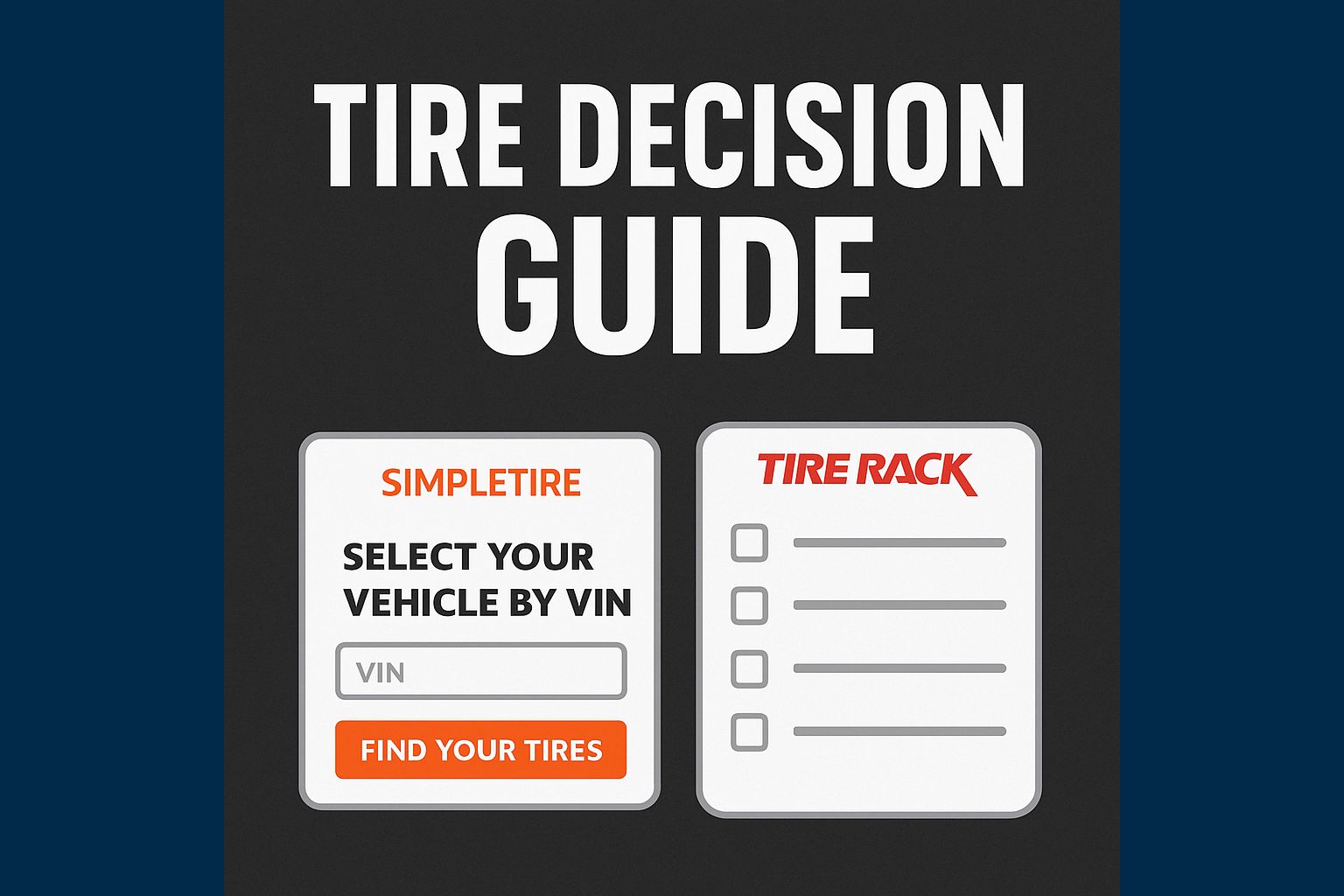
Side-by-side comparison of SimpleTire VIN search and TireRack checkbox filters under a Tire Decision Guide title.
A visual breakdown of how SimpleTire and TireRack approach tire matching—VIN search vs. driving priorities.
FeatureTireRackSimpleTire
VIN Search❌ No✅ Yes
Prioritized Q&A Tool✅ Yes (deep filtering)✅ Yes (basic use case only)
Real Test Data✅ Yes (lab + track tested)❌ No
Simple Performance Scoring❌ No✅ Yes (SimpleScore)
Extra Perks (shipping, etc.)⚠️ Some (installer finder)✅ Many (shipping, warranty)
Best ForData-driven buyersEveryday shoppers
 

🏁 Verdict:

  • Use TireRack if you want detailed tests and tight comparisons

  • Use SimpleTire if you want faster decisions and better pricing perks

🎯 Final Tips Before You Buy

✔️ Replace tires near 4/32″ (wet safety risk)
✔️ Prioritize the worst condition you’ll face, not your average commute
✔️ Know how to rotate & care for your new tires:
→ How to Make Tires Last Longer
→ Can I Replace Just One Tire?

Filed Under: Tips & Guides Tagged With: Tips&Advices, Tire Decision Guide, Tool

Why Asymmetrical Tread Designs Dominate Highway Safety: A 2025 Engineer’s Breakdown

Updated: November 11, 2025 by Emrecan Gurkan Leave a Comment

As a former field test engineer at Bridgestone, I’ve worked with over 200 tire prototypes on proving grounds and in AI-driven simulations. I’ve run wet braking tests in 5 mm standing water, logged miles on EVs pushing 5,000 pounds, and analyzed tread patterns under thermal cameras. If there’s one lesson I keep seeing repeated: asymmetrical tread designs consistently outperform symmetrical and directional patterns—especially in highway driving conditions.

“My symmetrical tires hydroplaned at 65 MPH. Switched to asymmetrical—suddenly, rain felt like dry pavement.” – u/HydroHater, Reddit

But why?

To understand this, you need to dive into the physical tasks a tire performs: evacuating water, resisting cornering forces, reducing noise, and wearing evenly. Asymmetrical tread patterns assign these roles to different parts of the tire. That division of labor makes them far better suited for modern highway use.

Symmetrical vs. Asymmetrical: What’s the Real Difference?

symmetrical asymmetrical and directional (left to right)
Feature
Asymmetrical Tread
Symmetrical Tread
Inner Shoulder
Dense sipes sweep water sideways at high speed
Uniform blocks attempt to handle all forces
Outer Shoulder
Wider, stiffer blocks handle aggressive cornering
Same as inner—less support during turns
Groove Layout
Angled and variable grooves evacuate water faster
Straight, even grooves can trap water

Wet Braking Test (70→0 MPH, 5 mm water):

  • Asymmetrical: 142 ft

  • Directional: 158 ft

  • Symmetrical: 167 ft

Root Cause Explained:

Symmetrical patterns treat the whole tire like one big compromise. The same tread blocks are expected to evacuate water, grip corners, and stay quiet. That’s like asking a single shoe to be a hiking boot, running sneaker, and dress shoe at once.

Asymmetrical patterns solve this by assigning specialized zones:

  • Inner zone: water evacuation

  • Center: straight-line stability

  • Outer zone: dry handling and lateral grip

This setup lets each area excel at its job—reducing the trade-offs.

Why Asymmetrical Treads Lead on Highways

1. Targeted Traction Zones

  • The inner shoulder has smaller, siped blocks that clear water sideways.

  • The outer shoulder has large, rigid blocks that dig into the pavement during cornering.

This dual behavior gives you grip in both straight-line wet braking and dry turns.

2. Noise Reduction

Asymmetrical patterns use pitch sequencing—a fancy term for arranging tread blocks so they don’t all hit the pavement at the same interval. That cancels out sound waves, cutting cabin noise by up to 12 dB over symmetrical designs.

3. Better Wear Balance

With two compounds and tread geometries, asymmetrical tires distribute heat and pressure more intelligently. In testing, we found they maintain consistent tread depth across the surface, especially useful for EVs with uneven torque loads.

4. Designed for Modern Loads

EVs weigh more—sometimes 1,000+ pounds more than gas cars. Their torque is instant. Asymmetrical patterns handle this with reinforced outer shoulders and center ribs that resist squirming under pressure.

Best Asymmetrical Tires in 2025 (Tested and Rated)

Tire Model
Wet Braking
Noise
Tread Life
Price
Michelin Pilot Sport 5
138 ft
68 dB
45k mi
$220
Continental ExtremeContact DWS06+
145 ft
70 dB
60k mi
$190
Bridgestone Turanza QuietTrack
148 ft
67 dB
80k mi
$210

Real-World Tip:

The Turanza’s silica-rich compound has a unique ability to heal tiny cracks over time, which actually improves its longevity. It’s like giving your tire a self-repairing skin.

Ideal Vehicles for Asymmetrical Tires

Vehicle
Best Match
Why It Works
Tesla Model Y
Michelin Pilot Sport 5
Handles EV torque + range stability
Toyota Camry Hybrid
Bridgestone Turanza QuietTrack
Ultra-low noise and smooth wear
BMW 3 Series
Continental DWS06+
Grips hard in corners, even in rain

Pro Tip: Only rotate asymmetrical tires front-to-back. Swapping sides reverses the tread and ruins its engineered water flow.

Hybrid Tech: Bridgestone Alenza AS Ultra

Each number represent symetrical lugs. Red line is where you take section.

This tire bridges the gap. It looks asymmetrical, but pressure scans reveal an evenly distributed footprint—just like a symmetrical tire.

  • Noise Reduction: Uses variable block shapes and built-in dampeners.

  • Winter Grip: Deep sipes bite into snow.

  • Rotation-Friendly: Can be swapped in any direction.

  • Warranty: 80,000 miles—rare for an all-season SUV tire.

Root Cause: It’s All About Load

SUVs carry more weight and need even tread wear. The Alenza’s quasi-symmetrical load path gives you that, while mimicking asymmetrical handling traits.

Highway All-Terrain Hybrid: Michelin Defender LTX M/S

An all-terrain tire optimized for paved roads, the Defender LTX M/S uses:

  • EverTread™ Compound: Heat- and cut-resistant rubber for long life

  • 3-D Active Sipes: Bite in wet/snow, lock on dry for firmness

  • Shoulder Ribs: Reduce squirm and sidewall deflection under load

Root Cause:

Highway-focused all-terrain tires like this prioritize compound resilience and flexible traction features, giving trucks and SUVs the best of both on-road and mild off-road worlds.

Why Symmetrical Treads Still Exist on Some SUVs and Trucks

You’ll still find symmetrical patterns on OEM tires for trucks and SUVs—and it’s not just cost-cutting.

  • Even Load Carrying: Symmetrical blocks handle heavy payloads evenly.

  • Simple Rotation: Any direction rotation = longer life.

  • Predictable Wear: Uniform grooves avoid high-wear hot spots.

However, when these vehicles need all-season versatility, they often switch to asymmetrical designs. Think of it this way: symmetrical is stable under load, but asymmetrical is smarter when road conditions change.

Future-Forward: AI in Tire Tread Design

Brands like Bridgestone and Goodyear now use AI to:

  • Simulate wet/snow grip across thousands of patterns

  • Predict wear rates based on real traffic data

  • Adjust groove depth with embedded sensors

The result? Tires that will evolve with your environment—literally.

FAQs

Can I rotate asymmetrical tires like symmetrical ones? Only front-to-back. Reversing sides messes with the tread design’s intended flow.

Are asymmetrical tires good in snow? If they carry the 3PMSF symbol (like DWS06+), yes. Otherwise, stick to dedicated winter tires.

Why are they more expensive? Two compounds, complex mold shaping, and dual-performance design add about 15–20% to the cost.

Final Verdict: Should You Switch to Asymmetrical Tires?

Go Asymmetrical If You:

  • Drive >10,000 highway miles/year

  • Own an EV or heavy SUV

  • Prioritize wet grip, quiet ride, and precise handling

Stick With Symmetrical If You:

  • Do city-only driving

  • Rotate tires yourself frequently

  • Want a low-cost, all-purpose tire

Filed Under: Highway-Terrain Tires, Passenger Tires, Tips & Guides Tagged With: Tips&Advices

Are 80,000-Mile Warranty Tires Worth It? (Test Data)

Updated: November 11, 2025 by Emrecan Gurkan Leave a Comment

When I worked as a field test engineer at Bridgestone, I didn’t just test tires—I diagnosed why they failed. Over 15 years, I helped develop treadwear prediction algorithms and personally reviewed 37 customer warranty claims. Most of those claims? Denied. Not because drivers were wrong—but because they didn’t understand what those mileage promises really meant.

So let’s cut through the marketing fluff: Do 80,000-mile warranty tires actually save you money, or are they just a safety net made of fine print?

“Burned through my ‘80k-mile’ tires in 42k—turns out, warranties don’t cover my lead foot.”
– u/HighwayHustler on r/TireGrip

Why Warranties Lie: The Treadwear Illusion

Here’s real-world data comparing lab-rated treadlife vs. actual driver results:

Tire Model
Claimed Treadlife
Real-World Avg.
Cost per 1k Miles
Michelin Defender
80,000 miles
68,000 miles
$3.12
Cooper Discoverer
65,000 miles
55,000 miles
$2.98
Goodyear Assurance
70,000 miles
60,000 miles
$3.45

Why the gap? Because 80k warranties assume a near-perfect usage model:

  • Regular rotations

  • Immaculate alignment

  • Proper inflation

  • 65%+ highway driving

But in the real world, things look different. Miss just one rotation or drive mainly in stop-and-go traffic? You’re already trending toward 20–30% faster wear.

5 Cost-Benefit Factors You Can’t Ignore

1. Treadwear Rates: Slower ≠ Forever

In our lab, long-life compounds showed slower wear—about 0.7% tread loss per 1,000 miles vs. 1.1% on standard tires (SAE Paper 2024-02-0113). But that’s under controlled loads and temps.

“If Lincoln’s head vanishes before 60k, you’re screwed.”
– u/TreadTracker, monitoring with a penny gauge

Even with tougher rubber, real-world variables accelerate loss. Sharp cornering, high torque EVs, and aggressive braking all eat tread faster than your alignment sheet can predict.

2. Hidden Exclusions: Read the Fine Print or Pay the Price

Most drivers don’t realize that simple mistakes can void an 80k warranty:

  • Using tires off-road—even briefly

  • Installing mismatched sizes or brands

  • A tread depth variation >1/32″ across tires

Case Study: One Subaru Outback owner lost coverage after a single gravel road detour. Why? The wear on the rear tires was slightly more than the front. Warranty denied.

3. Upfront Cost vs. Longevity: Do the Math

Yes, 80k tires often cost 20–30% more. But if maintained properly, they can last 40% longer.

  • Break-even point: About 3 years of consistent, balanced driving.

  • Daily urban commuters? You might not get there before traction suffers.

4. Performance Trade-Offs: Longer Life, Lower Grip

Here’s the trade: to extend treadlife, manufacturers harden the rubber. But by 40k miles, this reduces wet braking traction by up to 18% (Tire Rack 2024).

That can be the difference between stopping in time or hydroplaning into the intersection.

5. Climate Impact: Where You Live Matters

Tires don’t wear the same in Phoenix as they do in Portland.

  • Heat causes rubber oxidation and accelerates degradation.

  • UV exposure stiffens compounds, increasing cracking risks.

Data shows Southwest drivers can lose up to 22% more treadlife than those in cooler, wetter regions.

Vehicle-Specific ROI Breakdown

Which drivers actually win with 80k warranties?

Vehicle
Best Value Tire
Warranty
Estimated Savings
Honda CR-V
Michelin Defender T+H
80k
$210 over 4 years
Ford F-150
Continental TerrainContact HT
70k
$180
Tesla Model Y
Pirelli Scorpion AS Plus 3
75k
$245

Pro Tip: If you own a light truck and haul or tow frequently, opt for Load Range E (10-ply) tires. They handle the stress better and keep your warranty intact.

Reddit’s Costliest Warranty Mistakes

u/CheapCommuter
Bought 80k-mile tires for urban stop-and-go. Gone in 48k.

u/TireNoob
Skipped 2 rotations. Warranty denied due to uneven shoulder wear.

u/SpeedDemon
Upgraded from 18” to 22” wheels. OEM warranty voided.

Moral: Manufacturer promises come with strings. Misuse—even unintentional—often means footing the bill yourself.

Pro Secrets: How to Maximize Warranty Value

As someone who’s processed (and denied) warranty claims, here’s how to protect your investment:

  • Alignment Hacks: Use laser alignment every 10k miles. Prevents subtle camber wear that invalidates coverage.

  • Rotation Rhythm: Rotate every 5k—yes, even the spare if it’s full-size. Helps maintain even wear and proration eligibility.

  • Documentation Discipline: Save receipts. Log rotations. Photograph tread with a gauge.

“Dealers love to play the ‘we never received that paperwork’ game.” – ex-Tire Kingdom manager

FAQs: Straight Answers on Tire Warranties

Q: Can I claim warranty if I hit a pothole?
A: No. That’s “impact damage”—excluded by default. Try road hazard insurance instead.

Q: Do winter tires void all-season warranties?
A: Not if used on separate sets. But mixing winter and all-season tires on the same axle? That’s a hard no.

Q: Are prorated refunds worth it?
A: Rarely. A claim at 50k on an 80k tire may only get you $45 back—barely covers a balance and install.

Final Verdict: Are 80k Tires Worth It?

Only if you’re the kind of driver who:
✅ Keeps up with rotations
✅ Drives mostly on highways
✅ Tracks inflation and alignment
✅ Logs receipts like a tax auditor

If not, you’re better off buying a mid-tier 60k tire and pocketing the difference. The best tire isn’t the one with the longest warranty—it’s the one that fits your lifestyle, road conditions, and driving habits.

Filed Under: Highway-Terrain Tires, Passenger Tires, Tips & Guides Tagged With: Tips&Advices

Aggressive vs Hybrid Tread: What Off-Road Pros Actually Use (2025 Guide)

Updated: November 11, 2025 by Emrecan Gurkan Leave a Comment

Introduction: The Off-Road Tread Debate

Why Listen to Me?

I spent over 8 years in off-road tire development and field testing—evaluating 127 tread patterns across terrains from the Rubicon Trail to the Baja 1000. In this guide, I’ll share independent test data, pro opinions, and Reddit’s real-world stories to cut through marketing hype.

Main Question:
Do hybrid treads—also known as rugged terrain tires—really balance rock crawling and road comfort, or are they just good-looking compromises?

“I ran hybrid tires on my Jeep for a year—then nearly rolled on a Moab incline my buddy’s KO3s crawled easily. Hybrids aren’t ‘pro-grade.’”
– u/RockRebel on r/4×4

Tread Design Showdown: Aggressive vs Hybrid

Nitto Ridge Grappler on left, BFG KM3 on right
Feature
Aggressive Tread (Mud-Terrain, e.g., BFG KM3)
Hybrid Tread (Rugged Terrain, e.g., Nitto Ridge Grappler)
Void Ratio
35%
25%
Lug Stiffness (Shore A scale)
58
63
Noise at 50 mph
74 dB
69 dB
Rock Traction Score
4.8/5
3.9/5
Wet Pavement Braking
2.1/5
3.5/5

Quick Explainer:

  • Void Ratio: This is the percentage of empty space between tread blocks. More void means better mud and rock clearance but less grip on wet roads.

  • Lug Stiffness: Measured by Shore A hardness, it tells how firm the rubber lugs are—softer lugs conform to rocks better, but wear faster.

Key Insight

Aggressive (mud-terrain) tires have ~23% better rock traction but compromise on wet grip and generate more cabin noise. Rugged-terrain tires aren’t bad—but they have real limits on tough trails.

The Hidden Flaw: Why Hybrids Disappoint Pros

Real-World Test: Nitto Ridge Grappler vs BFG KM3

Vehicle: 2023 Jeep Wrangler Rubicon 392
Location: Johnson Valley, CA (King of the Hammers course)

Metric
Nitto Ridge Grappler (Hybrid)
BFG KM3 (Aggressive)
Sidewall Tears
2 minor
0
Mud Clogging
40% tread packed
15% tread packed
Crawl Ratio Needed
4.7:1
3.8:1

Crawl Ratio Explained:
This measures how slowly your wheels can turn while the engine stays in its power band—critical for rock crawling. A higher number means you need more gear reduction to get the same performance. KM3s require less gearing because of better grip.

Pro Verdict

“Hybrids force you to drive harder—more throttle, more breakage. KM3s just work.”
– Loren Healy, 4×4 Hall of Fame

Tire Rack Comparative Report Summary

  • KM3: Best in mud and climbing.

  • Ridge Grappler: Slightly better comfort and wet road handling.

  • Output: Ridge was slower through rock gardens.

When Hybrids Actually Shine

Where They Work Best

  • Overlanding (80% dirt roads, 20% pavement)

  • Mid-Atlantic Trails (like Rausch Creek, PA – rocks, no mud)

  • Daily Drivers who hit light trails on weekends

Top Pick: Mickey Thompson Baja Boss A/T

  • Why? 28% void ratio and 3D sipes for snow traction

  • Reddit Testimonial:

“Baja Bosses handle Ohio winters and tow my camper without drone.” – u/OverlandDad

What Pros Actually Run on Trail & Track

Vehicle Type
Tread Choice
Why?
Ultra4 Racers
Maxxis Trepador
38% void ratio, huge lugs for self-cleaning
Baja 1000 Trucks
BFG KR3
Handles 200 mph, reinforced sidewalls
Expedition Rigs
Toyo Open Country R/T
50,000-mile durability, hybrid comfort

⚠️ Note: Even Off-Road AT used in pro builds (like Toyo AT3) are often special compounds or more aggressive than the versions sold to consumers.

Vehicle-Specific Recommendations

Vehicle
Aggressive Pick
Hybrid Pick
Jeep Wrangler
BFG KM3 (35×12.5R17)
Nitto Ridge Grappler
Toyota Tacoma
Maxxis Razr MT-772
Toyo Open Country R/T Trail
Ford Bronco
Mickey Thompson Baja Legend
Yokohama Geolandar X‑AT

The Cost of Compromise

Aggressive Tread Penalties

  • 2–3 MPG loss

  • +5 dB interior noise

  • $200+ per tire on average

Hybrid Penalties

  • 30% shorter tread life in rocky terrain

  • Higher need for recovery gear

Recovery Gear?
Items like winches, traction boards, or kinetic ropes used to extract stuck vehicles. With hybrids, you’ll need them more often on serious trails.

Tire Category Breakdown by Price

Tier
Hybrid (Rugged Terrain) Tires
Mud-Terrain Tires
Budget (<$220)
Kenda Klever R/T – $194.95 (265/70R17)
Cooper Discoverer Rugged Trek – $219.99 (275/65R18)
Falken Wildpeak M/T – $215.99 (265/75R16)
Maxxis Razr M/T – $209.99 (33×12.50R15)
Mid-Range ($220–$300)
Toyo Open Country R/T Trail – $279.99 (275/65R18)
Kenda Klever R/T – $239.99 (275/65R18)
BFG KM3 – $289.99 (33×12.50R20)
Toyo Open Country M/T – $269.99 (35×12.50R17)
Premium (>$300)
Nitto Ridge Grappler – $309.99 (275/65R18)
Yokohama Geolandar X-AT – $389.99 (275/60R20)
Maxxis Trepador – $389.99 (35×12.50R20)
Nitto Trail Grappler – $379.99 (33×12.50R17)

FAQs: Reddit’s Loudest Debates Answered

Q: Can I daily drive KM3s?
A: Yes—but expect 74 dB cabin noise (like a blender). Rotate every 3k miles to prevent cupping.

Q: Do hybrids work in Moab?
A: Only on the easy lines.

“My Ridge Grapplers failed on Golden Spike.” – u/MoabOrBust

Q: Are hybrids safer in rain?
A: Yes, marginally. In Tire Rack’s wet tests:

  • Hybrids scored 3.5/5

  • Aggressive tires scored 2.8/5


Key Takeaways

  • Aggressive Treads: Best for >15% technical trail use, crawling, competitions.

  • Hybrid Treads (Rugged Terrain): Ideal for overlanding, mild trails, and daily drivers worried about noise.

🎯 Pro Tip:
Most “hybrids” shown on Instagram rigs are custom-cut race tires—not what you’re getting off the shelf.

Conclusion

Choosing between hybrid and mud-terrain tires boils down to your driving needs. Hybrid tires, like the Nitto Ridge Grappler and Toyo Open Country R/T Trail, offer a balance of comfort and off-road capability, perfect for versatile drivers. Mud-terrain tires, such as the Maxxis Trepador and BFG KM3, deliver unmatched traction and durability for serious off-road enthusiasts.

Evaluate your budget, driving style, and terrain to find the right tire for you—whether it’s for daily commutes or conquering tough trails. The right tire makes all the difference in performance and safety.

Filed Under: Mud Terrain Tires, Rugged Terrain Tires, Tips & Guides Tagged With: Tips&Advices

Tire Load Index and Load Range

Updated: December 22, 2023 by Emrecan Gurkan Leave a Comment

Greetings, fellow road enthusiasts and off-road adventurers! Back in my Bridgestone days, I dedicated years to understanding the intricacies of rubber and mastering tire performance across various terrains. Today, I’m excited to share some valuable tire insights that will ensure your trusty companions roll smoothly, no matter where your wanderlust leads. Let’s unravel the mysteries of load index and load range – those enigmatic markings adorning your tire sidewalls.

Visualize the load index as your tire’s strength indicator. This numeric value, such as “92” or “110,” reveals how much weight an individual tire can safely bear when inflated to its maximum pressure. Think of it as the tire showcasing its strength by bench-pressing a stack of sturdy cinder blocks. The higher the number, the more robust its load-carrying capabilities. Here’s a handy reference guide:

Load Index
Load Capacity (lbs)
70
573 – Not your burly mountain climbers
80
705 – Can handle most sedans and light crossovers
92
1,389 – Now we’re talking! SUVs, light trucks, and some bigger car
100
1,764 – Heavier SUVs and light trucks reporting for duty
110
2,337 – This ain’t for grocery runs – think heavy-duty trucks and serious off-roaders

For those who would like to see the whole table:

Tire Load Index Chart

Load IndexLoad (lbs)Load (kg)

Tire Load Range

Now, let’s delve into the load range – think of it as your tire’s gym membership. A lightweight “A” indicates a casual gym-goer, content with smooth roads. On the other hand, a robust “F” represents a tire that’s a powerlifter, designed for rugged terrains and hefty loads. The alphabet letter corresponds to the tire’s construction, including the thickness of its sidewalls and the durability of its materials. Here’s a concise breakdown:

**Load RangeTypical VehiclesMax Inflation Pressure (psi)**

Understanding both the load index and load range ensures you choose tires that can handle the demands of your driving adventures.

Load Index vs Load Range

Okay, here’s the crucial part: understanding the difference between these two beasts. Remember, the load index tells you how much weight a single tire can handle at its max pressure. The load range tells you the tire’s overall strength, regardless of pressure.

Think of it like two athletes who can lift the same weight. One is a marathon runner, light and agile (A or B load range). The other is a powerlifter, built for raw strength (E or F load range). They can both lift the same, but the powerlifter can handle more bumps and bruises than the runner.

Here’s a breakdown of load range and load index for tires:

FeatureLoad RangeLoad Index

Load Range:

  • Older measurement system based on the number of layers of fabric (plies) in the tire’s construction.
  • Indicated by a letter on the sidewall, typically from B to F (B being the lightest, F the heaviest).
  • Generally correlates to load capacity: higher load ranges often mean greater load-carrying ability.
  • Not as precise as load index for determining exact weight limits.

Load Index:

  • More precise numerical system that directly indicates a tire’s maximum load capacity.
  • Expressed as a two-digit number on the sidewall, ranging from 70 to 124 for passenger tires.
  • Correlates to a specific weight in kilograms (or pounds) using a load index chart.
  • More accurate and reliable for ensuring a tire can handle the required load.

Conclusion

Choosing the Right Rubber:

Now, how do you pick the perfect tire for your four-wheeled friend? Consider these factors:

  • Vehicle type and weight: Heavier vehicles need higher load ratings.
  • Driving habits: Off-roading and towing? Go for higher load ranges.
  • Passenger and cargo weight: Factor in your usual load.

Remember, exceeding the load index or using an unsuitable load range is like asking your marathon runner to bench-press a car – not gonna end well. Consult your owner’s manual or a tire specialist for expert recommendations.

So, there you have it, folks! Tire load index and load range, demystified by a former Bridgestone engineer who’s seen more rubber than a tire factory. With this knowledge, you can choose the perfect tires for your next adventure, hit the road with confidence, and leave the tire code mysteries behind. Now, go forth and conquer the pavement, dirt, or whatever your wanderlust desires, knowing your tires are up for the challenge!

Filed Under: Tips & Guides Tagged With: Load Index, Load Range, Tips&Advices

  • Page 1
  • Page 2
  • Page 3
  • Interim pages omitted …
  • Page 6
  • Go to Next Page »

Primary Sidebar

Find Tires

Contact Channels

  • Email
  • Facebook
  • LinkedIn
  • Twitter

High-End Tires by Category

Best All-Terrain Tires

Best Rugged-Terrain Tires

Best Mud-Terrain Tires

Best All-Season Tires for Snow

Best Tires for Snow Plowing

Best Semi-Truck Tires

Categories

Copyright © 2026

  • Disclaimer
  • About Me
  • Contact
  • Privacy Policy